Blog
/
Managing Amazon DSP: A Week by Week Operating Guide for Live Accounts
Managing Amazon DSP: A Week by Week Operating Guide for Live Accounts
Neha Bhuchar
Managing a live Amazon DSP account is a different job from setting one up. Setup is a one time decision tree: pick an objective, build audiences, choose creative, set a budget, launch. Management is what happens after, a recurring loop with no natural endpoint, where you decide every single day, week, and month whether the account is still doing what it was built to do, or quietly burning the budget while nobody is watching.
This article covers that gap end to end. It walks through the full operating rhythm at every frequency, the specific metrics worth tracking along with the formula behind each one, the primary use cases DSP is actually built to solve, which product categories get disproportionately more value out of active management, and how the entire cadence has to shift during a high volume event like Prime Day.
Across the accounts we review on a recurring basis, the single biggest predictor of whether DSP spend holds up over a quarter is not the initial audience strategy, it is whether anyone is still looking at the account in week six the same way they looked at it in week one. Most drift happens quietly, not through a dramatic mistake, which is exactly why a defined operating rhythm matters more here than in most other paid channels.
Here's what's ahead:
The full daily, weekly, monthly, and quarterly operating rhythm, not just a summary table
Who should own it, in house, through an agency, or self serve with software
Which metrics actually matter, with the formula for each one
A simple rule for deciding when a metric change is real versus noise
The primary use cases Amazon DSP is actually built to solve
Which categories need active DSP management more than others
How to manage DSP differently during Prime Day and other high volume events
The mistakes that quietly waste the most budget in accounts nobody is actively managing
Where retail aware software like Atom11 fits into the ongoing workflow
Your Amazon DSP Management Cadence at a Glance
Frequency | Task |
|---|---|
Daily | Check budget pacing against monthly target, confirm no line item paused unexpectedly, scan for delivery drop offs by day part |
Weekly | Review frequency caps, new to brand rate, ASIN level inventory against active retargeting, flag any metric outside your variance threshold, review creative approval status |
Monthly | Refresh AMC audiences, review attribution window assumptions, rotate creative showing fatigue, reallocate budget across use cases, refresh conquesting target lists |
Quarterly | Reassess self serve versus managed versus agency ownership, revisit budget allocation across campaign types, review audience strategy against category shifts, plan the event calendar for the next quarter |
Event weeks | Scale budgets ahead of the event, tighten frequency caps, and check pacing more than once a day |
That table is the whole article compressed. The section below explains how to actually run each row, in more depth than the table alone can carry.
What Managing Amazon DSP Actually Means, Separate From Setting It Up
Amazon DSP is a demand side platform that lets you buy display, video, and audio inventory programmatically, both on Amazon owned properties and across third party sites, targeted by audience rather than keyword. If you need the fundamentals, Amazon's own DSP guide covers definitions, ad formats, and attribution windows in detail, including the fact that Amazon DSP typically runs a 14 day click and 1 day view through attribution window by default.
Setting up a campaign is a one time decision tree: pick an objective, build audiences, choose creative, set a budget. Managing that same account is a recurring loop with no natural endpoint, and it is where most of the actual performance is won or lost, since a well built campaign left unattended for a month rarely stays well optimized on its own. The two skill sets are related but not the same, and most of what ranks for "Amazon DSP" online is written for the first problem, not the second.
Who Should Own Amazon DSP Management
Before any operating rhythm matters, someone has to actually own it. There are three real options, and the right one depends less on company size than on how much internal bandwidth exists to run the cadence below consistently.
In house ownership works when someone on the team can commit real weekly hours to the account, not just check in when something looks wrong. This is usually the right call once DSP spend is meaningful enough to justify a dedicated owner but the team wants full control over strategy and messaging.
Agency ownership hands the operating cadence to an outside team, in exchange for a management fee. This removes the internal bandwidth requirement entirely, but it also means your visibility into daily decisions depends entirely on how transparent that agency chooses to be.
Self serve with software splits the difference: your team keeps direct control and console access, but retail aware tooling absorbs a large share of the recurring workload, particularly the diagnostic and bid logic pieces that used to require a dedicated specialist. This is the route where the daily and weekly workload below gets meaningfully shorter to actually run by hand.
None of the three is universally correct. What matters is being honest about which one your team can actually sustain past the first month, since an unmanaged DSP account, whatever the ownership model, tends to drift toward wasted spend faster than an unmanaged Sponsored Products campaign, simply because the audience based targeting gives you fewer obvious signals like a falling click through rate to notice something is wrong.
The Weekly Amazon DSP Review Checklist
This is the core of ongoing management. Run through these five checks every week, not just when a monthly report flags a problem.
Budget pacing. Confirm spend is tracking toward the monthly target, not just that the account has not run out of budget. A campaign pacing at 40% of budget by day 20 is as much a problem as one that overspends by day 15.
Frequency caps. Check how many times the same user is seeing your ad. A cap that is too low leaves reach on the table, one that is too high burns budget on diminishing returns and can actively hurt brand perception. Most managed accounts settle into a range of 3 to 4 impressions per user per week for prospecting and slightly higher for retargeting, though the right number depends on your category and creative refresh rate.
New to brand rate. This metric tells you whether DSP is actually expanding your customer base or mostly reaching people who already buy from you. A dropping new to brand percentage over consecutive weeks usually means audience overlap with existing Sponsored Ads targeting has grown, and it is worth checking before assuming the campaign itself is underperforming.
Inventory against active retargeting. If a retargeting audience is actively pointed at a product that just went out of stock or lost the buy box, that spend is being wasted on clicks that cannot convert. This is one of the most common silent budget leaks in DSP accounts, precisely because DSP reporting on its own has no visibility into inventory or buy box status.
Line item level anomalies. Scan for any single line item performing meaningfully outside the account average, in either direction. A later section covers exactly how to decide whether that deviation is worth acting on.
Extending The Cadence: What Daily, Monthly, and Quarterly Actually Involve
The weekly checklist above gets most of the attention because it carries the most detailed diagnostic work, but the other three tiers in the cadence table are not just lighter versions of the same list. Each one has a distinct job.
Daily, in practice. This is a five minute check, not a full review, and it should stay that way. Open the account and look at three things only: spend against the daily pace needed to hit the monthly target, whether any line item shows zero delivery in the last 24 hours, which almost always means a paused status or a rejected creative rather than a performance issue, and whether any product tied to an active campaign shows a stock or price alert if that data is visible to you. Anything beyond these three belongs in the weekly review, not the daily one, since checking everything daily is how teams burn out on DSP management within a month and stop doing it consistently.
Monthly, beyond the cadence table. The table lists AMC refresh, attribution review, and creative rotation, but a full monthly pass also includes reallocating budget across the use cases covered later in this article based on which ones actually delivered that month, refreshing the conquesting target list against any new competitor ASINs that have entered the category, and benchmarking your CPMs and win rates against the prior month to catch a slow creep in auction pressure before it shows up as a full quarter of declining efficiency. This is also the natural point to review whether frequency caps set months ago still match current creative refresh rates, since caps set once and never revisited are one of the more common sources of the fatigue problem covered later.
Quarterly, beyond the ownership question. The cadence table frames the quarterly review around ownership and budget allocation, but it should also include a structural audience review, checking whether the lifestyle and in market audiences used for prospecting still match how the category itself has shifted, since audience definitions that made sense two quarters ago can quietly go stale as new segments become available or old ones shrink. This is also the point to plan the next quarter's event calendar, mapping known high volume weeks against the guidance covered further down, rather than discovering an event is three days away with no budget scaling plan in place.
Which Amazon DSP Metrics Actually Matter, And How To Track Each One
A cadence only works if you are watching the right numbers in the first place, with a clear formula behind each one rather than a vague sense of whether something looks fine. Most teams either track everything the console surfaces, which buries the signal, or track only last-click ROAS, which misses most of what DSP is actually doing. The metrics below are the ones that consistently separate a well run account from one that only looks fine on the surface.
New to brand rate.
New To Brand Rate = (Orders From New To Brand Customers ÷ Total Orders) × 100
Measures the share of orders coming from customers who have not purchased the brand in the past year. Track it in the DSP console at the campaign and line item level, and compare it month over month rather than week over week since it moves slowly. This is the clearest signal of whether prospecting spend is doing its job. In Atom11, new to brand trend lines sit next to inventory and pricing data on the same view, so a drop can be checked against a stock or buy box change before it gets treated as a targeting problem.
Frequency.
Frequency = Total Impressions ÷ Unique Reached Users
Track average frequency per unique user per week, available in DSP reporting broken out by audience. Rising frequency with flat conversion is the earliest warning sign of creative fatigue, usually weeks before ROAS actually drops. Atom11 flags frequency drift against your set threshold automatically rather than requiring a manual pull of the frequency report every week.
Detail page view rate.
Detail Page View Rate = (Detail Page Views ÷ Impressions) × 100
The share of impressions that lead to a detail page visit, tracked in DSP reporting. This sits between an impression and a purchase and is a useful early signal for creative and audience quality before enough orders have accumulated to trust ROAS.
Reach saturation check.
Saturation Signal = Week Over Week Frequency Growth % > Week Over Week Reach Growth %
If frequency is climbing faster than reach, the audience pool is saturated and more budget will not buy more reach, it will just increase frequency past the point of returns. This is checked by comparing week over week reach in DSP reporting against week over week frequency for the same line item.
Cost per acquisition.
CPA = Total Ad Spend ÷ Total Conversions
Judged against the trailing 7 day average using the variance rule below, not a single week in isolation, since a single week's CPA on its own is close to meaningless in a channel with DSP's typical order volume per line item.
Return on ad spend, split by attribution type.
ROAS = Total Attributed Sales ÷ Total Ad Spend
Calculate this separately for click attributed and view through attributed sales rather than blending them, since a campaign with a high view through share is not underperforming just because its click attributed ROAS looks weak on its own, it is likely doing upper funnel work that a blended number hides.
Retail aware software matters most here because several of these metrics only mean something in combination with data DSP reporting alone does not have, inventory position, buy box status, and organic rank. Atom11 pulls those signals into the same view as the ad metrics above rather than requiring a manual cross reference between two separate reports every week.
When To Actually Change A Bid Or Audience
The hardest part of ongoing management is knowing the difference between a real signal and normal week to week noise. A simple variance rule prevents both overreacting to a fluke and ignoring a genuine problem:
Flag Threshold = Trailing 7 Day Average ± 20%
If a line item's key metric, cost per acquisition, ROAS, or click through rate, moves more than 20% away from its own trailing 7 day average, it earns a closer look. If it stays within that band, leave it alone. Reacting to every daily fluctuation inside normal variance is one of the fastest ways to waste money on unnecessary bid changes that were chasing noise, not a real shift in performance.
When something does cross that threshold, check three things before touching the bid: whether inventory or pricing changed on the product being advertised, whether the audience size shrank enough to reduce delivery, and whether a creative in that line item is now old enough to be experiencing fatigue. Only adjust the bid itself once those three are ruled out, since a bid change addresses none of them.
Primary Amazon DSP Campaign Use Cases
DSP gets pitched as a general purpose advertising tool, but in practice almost every account we look at is really running some combination of five distinct use cases, each with a different goal and a different metric to judge it by.
Retargeting site and product visitors. The most common starting point for most brands, aimed at shoppers who viewed a detail page or added to cart without purchasing. Judged primarily on ROAS, using the formula above, rather than new to brand rate, since the audience already knows the product.
New to brand prospecting. Built on lifestyle, interest, or in market audiences rather than past shoppers, with the explicit goal of expanding the customer base. This is the use case new to brand rate exists to measure, and it is usually the first line item to get cut when budgets tighten, which is often the wrong instinct if the goal is long term growth rather than short term ROAS.
Conquesting on competitor ASINs. Targeting shoppers actively viewing a competing product's detail page. This works best in categories with high consideration and frequent comparison shopping, and it is one of the few DSP use cases where a slightly higher acceptable CPA still makes sense, since the audience is already deep in a purchase decision.
Cross sell to existing customers. Uses purchase based audiences to advertise a complementary or higher tier product to people who already bought something else in the catalog. This tends to have the strongest ROAS of the five use cases because the audience already trusts the brand, but it does nothing for new to brand growth by definition.
Audience extension using AMC segments off Amazon. Built from first party signals in Amazon Marketing Cloud, then activated across both Amazon owned inventory and select off Amazon placements. This is the use case that has grown the most as AMC access has widened, though it is also the one most held back by the SQL requirement that a drag and drop AMC builder like Atom11's is specifically meant to remove.
Most accounts should be running at least two or three of these simultaneously with separate budgets and separate expectations, rather than one blended campaign judged against a single blended ROAS target.
Which Categories Need Amazon DSP Management More Than Others
DSP delivers value everywhere, but the accounts where active management pays off the most tend to share a few characteristics, and they are worth knowing before deciding how much internal bandwidth or budget to allocate to the operating rhythm above.
Categories with a long consideration cycle, electronics, appliances, furniture, and higher priced beauty or health devices, benefit the most from retargeting and cross device reach, since the gap between first exposure and purchase can run weeks. This is also where the default 14 day click attribution window is most likely to undercount real contribution, which is why the mistake covered later in this article matters more here than in categories with an impulse purchase pattern.
Categories with heavy Sponsored Ads competition get outsized value from DSP because keyword based placements have become expensive relative to the audience they reach, and DSP's audience targeting can reach the same shopper through a channel with less direct bidding pressure.
Categories that sell replenishable or subscription eligible products, supplements, household staples, pet food, get the most out of the cross sell and lapsed customer use cases specifically, since the purchase based audiences DSP builds from are strongest where repeat purchase behavior already exists.
Private label and challenger brands competing against an established category leader tend to lean hardest on conquesting, since it is one of the few paid channels that lets a smaller brand appear directly in front of a competitor's own audience at the moment of comparison.
Highly seasonal categories, gifting, outdoor and seasonal apparel, holiday decor, need active management more than steady state categories simply because the entire annual plan compresses into a few weeks, which is exactly what the next section covers.
Managing Amazon DSP Around High Volume Events Like Prime Day
The operating rhythm above assumes relatively stable demand. Prime Day, Black Friday, Cyber Monday, and category specific peaks like back to school break that assumption, and treating an event week like a normal week is one of the more expensive mistakes an otherwise well managed account can make.
Scale budgets ahead of the event, not during it. Amazon's own advanced Prime Day strategy guide recommends starting to scale budgets 3 to 5 days before the event in 20 to 30 percent increments, rather than making one large jump on the day itself, since a sudden budget increase can take time to fully deliver and a campaign marked as limited by budget during peak hours loses reach it cannot get back.
Tighten frequency caps rather than loosening them. Traffic volume rises sharply during an event, which means the same frequency cap that felt conservative in a normal week can deliver far more impressions per user than intended if left unchanged, particularly on retargeting audiences pointed at shoppers who are actively comparison shopping.
Check pacing more than once a day. The daily check covered above is not frequent enough during an event window, since a budget that is tracking fine at 10am can be exhausted by early afternoon when traffic is running several times normal volume.
Expect cost controls to matter more, not less. Amazon's own data shows display campaigns using cost controls during Prime Day saw a 2.6X uplift in ad attributed sales compared to campaigns without them, which suggests the instinct to remove guardrails during a high volume event in order to chase reach is usually the wrong one.
Plan for a post event window, not just the event itself. The same guide notes that a two week window after the event still captures buyers with longer research and procurement cycles, particularly relevant for the long consideration categories covered above, so retargeting audiences built during the event should stay active rather than being paused the moment the event ends.
This is also where the variance rule earns its keep in reverse. During a normal week, a metric moving more than 20% from its trailing average is worth investigating. During an event week, the entire account is expected to move well outside that band, so the useful check shifts from single line item variance to whether the account is pacing against its event specific plan, not its pre event baseline. This is also where version control matters most: a bid or budget change made quickly during a live event day needs to be reversible just as quickly if it turns out to be wrong, which is harder to do reliably by hand under time pressure than it is on a normal week.
Common Amazon DSP Management Mistakes That Burn Budget
Setting it and forgetting it. DSP's audience based targeting does not degrade as visibly as a Sponsored Products keyword losing relevance, which makes it easy to assume an account is fine simply because nothing looks obviously broken.
Judging performance on last click ROAS alone. DSP's job is often upper funnel, awareness and retargeting, work that a pure last click metric systematically undercounts. Amazon's own published case studies illustrate what this actually looks like in practice: an apparel brand used DSP's ASIN level shopping signals to drive traffic to its own site and achieved 11.4x ROAS with 47% of conversions from new to brand customers, a result that would look very different measured only against in platform last click behavior.
Never refreshing creative. The same display asset run for months loses effectiveness as the same audience sees it repeatedly, and frequency capping alone does not fix creative fatigue.
Letting attribution windows go unquestioned. The default 14 day click window does not fit every purchase cycle. A category with a longer consideration period, covered above, will systematically undercount DSP's contribution if nobody revisits that assumption.
Managing DSP and Sponsored Ads in separate silos. Amazon has been actively closing this gap itself: unified reporting across Sponsored Ads and DSP reached general availability in June 2026, letting one report span both, which makes there far less excuse to manage the two as disconnected accounts than there was even a year earlier
How Atom11 Fits Into The Ongoing Management Workflow
Everything covered above, the daily and weekly rhythm, the metrics, the event handling, is manageable by hand, but it is also exactly the kind of recurring, data heavy work that determines whether self serve ownership is sustainable past the first few months. This is where retail aware software changes the actual time cost of management rather than just the setup cost.
Retail Aware Bid Logic Handles The Inventory Check Automatically
Rather than a human manually cross referencing active retargeting audiences against current stock levels every week, Atom11 ties bid and budget decisions directly to inventory position, buy box status, pricing, and organic rank, so a bid pulls back automatically on an ASIN before someone has to notice the problem manually.
Neo Replaces The Manual Anomaly Investigation
Instead of a person deciding by hand whether a metric crossing the variance threshold warrants a bid change, Neo compares ad and retail signals across the relevant period and surfaces a likely cause directly, closing the gap between noticing an anomaly and understanding it.
AMC Audience Refresh Without A Dedicated Analyst
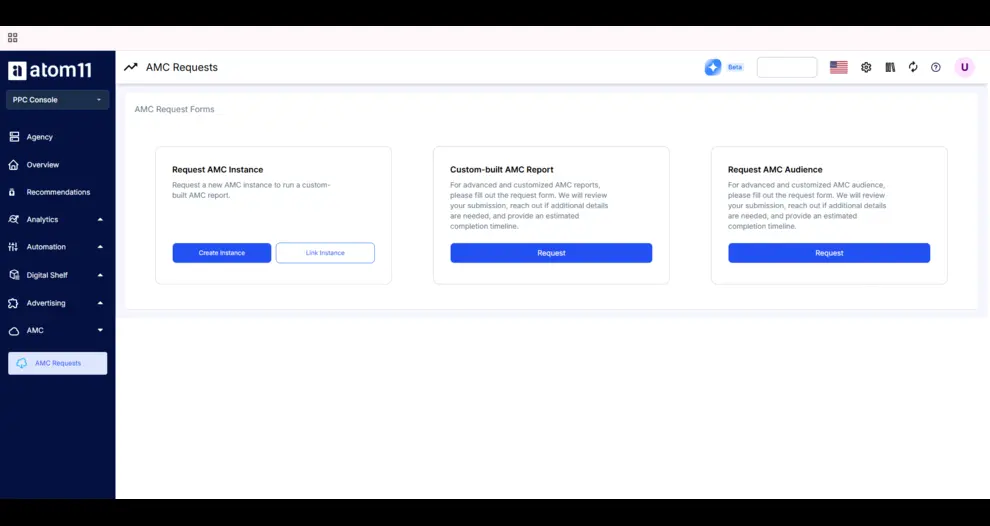
The monthly AMC audience refresh in the cadence table above traditionally requires SQL skills. Atom11's drag and drop AMC audience builder lets that recurring task happen without a data analyst on staff, which matters most for teams managing this cadence with limited internal bandwidth, and it is what makes the audience extension use case covered above realistically accessible to a smaller team.
Version Control For Safer Weekly Changes
Every bid and budget state can be saved as a version before a change is made, so a weekly adjustment, or a fast decision made during an event window, that turns out to be wrong can be rolled back rather than manually reconstructed.
MCP Access For Conversational Weekly Reviews
The weekly checklist itself can be run partly through Atom11's MCP connection to Claude or ChatGPT, asking directly which line items crossed the variance threshold this week rather than pulling and cross referencing reports by hand.
None of this removes the need for someone to own strategy and make the final call on what changes to approve. What it changes is how much of the recurring, day to day and week over week workload requires a dedicated specialist versus how much a smaller team can sustain on its own, which is usually the deciding factor in whether self serve ownership holds up past the first quarter and through the first major event week.
Conclusion
Managing Amazon DSP is a different discipline from setting it up, and it is the discipline most guides skip entirely. The accounts that actually perform well over time are not the ones with the most sophisticated launch strategy, they are the ones with a consistent operating rhythm at every frequency, the right metrics on the dashboard with a formula behind each one, a clear read on which use cases the budget is actually funding, and a different playbook ready for the handful of weeks a year when demand does not behave normally. Whether that cadence is run in house, through an agency, or through self serve software built to absorb the recurring workload, the accounts that skip this ongoing discipline are the ones that quietly underperform without ever showing an obvious red flag.
Want to see how Atom11 can simplify your Amazon advertising workflow? Book a demo to explore how it fits into your team's day-to-day management.
FAQs
Is Amazon DSP the same as Amazon's Delivery Service Partner program?
No. Amazon DSP in advertising refers to the Demand Side Platform used to buy programmatic display, video, and audio ads. The Delivery Service Partner program is Amazon's separate last mile delivery fleet business and has no connection to advertising
How often should I check my Amazon DSP account?
A short daily check on pacing and delivery, a full weekly review covering frequency caps, new to brand rate, inventory conflicts, and line item anomalies, and a deeper monthly pass for AMC refresh and creative rotation. During Prime Day or another high volume event, pacing checks should happen more than once a day.
Which Amazon DSP metric matters most?
There is no single metric that works alone. New to brand rate tells you whether prospecting is working, frequency tells you when creative is about to fatigue, and detail page view rate gives an early read before enough orders exist to trust ROAS. Judging DSP on last click ROAS alone is one of the most common mistakes covered above.
Does every category need the same level of DSP management?
No. Categories with a long consideration cycle, heavy Sponsored Ads competition, or strong seasonality tend to need more active management than steady state, impulse purchase categories, since the cost of drift compounds faster in those conditions.
How do I know if a performance change is worth reacting to?
A practical rule is to flag anything moving more than 20% away from its own trailing 7 day average, and leave smaller fluctuations alone, since normal week to week variance within that range is rarely a real signal. During an event week, the useful comparison shifts to your event specific plan rather than the pre event baseline.
