Blog
/
AI vs Rule Based Amazon PPC: The Real Differences, With Formulas and Examples
AI vs Rule Based Amazon PPC Automation: Key Differences
Nivesh J
Key Takeaways
Rule based automation executes logic you write. It is transparent and predictable, but thresholds go stale and the same rule fires on 3 clicks as on 3,000.
AI automation estimates each keyword's economics from data and bids accordingly. It scales and adapts, but needs conversion history and can feel like a black box.
Thin data is the sharpest difference. Most rule sets pause profitable keywords too early. You can fix this with a minimum click formula (below).
Reaction speed has a price. A rule running on a 14 day lookback can take more than a week to respond to a sudden conversion drop, and you pay for every day of lag.
The best setup is hybrid. Let the model optimize bids. Keep break even ACOS, budget caps, inventory and Buy Box conditions as hard rules above it.
For Amazon DSP, bidding is already algorithmic, so rules matter most for pacing, frequency, budget shifts and retail readiness
The difference between AI and rule based Amazon PPC comes down to who writes the decision logic. In rule based automation, a person writes IF THEN conditions (for example, "IF ACOS is above 40% after 20 clicks, THEN lower the bid by 10%") and the software executes them on a schedule. In AI automation, a machine learning model learns the logic from your account's own data, predicts what each click is worth, and adjusts bids and budgets continuously toward a goal you set, such as a target ACOS or ROAS.
Rules give you control, predictability and a clear audit trail. AI gives you speed, scale and keyword level precision. Neither is automatically better. Most accounts that perform well in 2026 run a hybrid: AI or algorithmic bidding does the optimizing, and deterministic rules set the boundaries it cannot cross.
The stakes are rising because the auction keeps getting more crowded. Amazon's advertising business generated $19.8 billion in revenue in Q2 2026, up 26% year over year. More advertisers bidding on the same keywords means bids move faster, thresholds go stale sooner, and slow automation costs more than it used to.
This guide explains how each approach actually makes decisions, where each one breaks, and how to choose, with the formulas we use to set thresholds and test automation on real accounts.
What Is Rule Based Amazon PPC Automation?
Rule based automation is a set of IF THEN instructions that software runs against your campaign data on a fixed schedule, usually once a day. Each rule has four parts:
Scope: which campaigns, ad groups, keywords or targets it applies to
Lookback window: the date range it evaluates (7, 14, 30 or 60 days)
Condition: the metric threshold, such as ACOS, spend, clicks, orders, CVR or impressions
Action: raise or lower a bid, pause a target, add a negative, change a budget, or send an alert
Typical rules look like this:
IF clicks ≥ 20 AND orders = 0 in the last 30 days, THEN pause the keyword.
IF ACOS > 35% AND orders ≥ 3 in the last 14 days, THEN lower the bid by 10%.
IF ACOS < 20% AND impressions fell week over week, THEN raise the bid by 10%.
IF a search term has 2 or more orders in an auto campaign, THEN harvest it into an exact match campaign and add it as a negative exact in the source campaign.
IF a campaign runs out of budget before 6 pm AND ROAS > 4, THEN raise the daily budget by 20%.
Amazon itself offers rule based features inside the console. Budget rules let you raise budgets on a schedule (for Prime Day or Black Friday) or when a performance threshold is hit, such as raising the budget by 20% when ROAS reaches 5. Sponsored Products also has rule based bidding, where you set a ROAS guardrail and Amazon adjusts bids to try to hold it.
Where rules shine:
Full control. You decide exactly what happens and when.
Predictability. The same inputs always produce the same action.
Perfect auditability. The rule text is the explanation for every change.
Low data requirements. Rules work on day one, even for a new ASIN.
Business logic encoding. Rules are the easiest way to act on things a model may not see, such as "pause ads when stock falls under 14 days of cover" or "never bid above $2.50 on this brand term."
What Is AI Powered Amazon PPC Automation?
AI automation replaces fixed thresholds with a model that learns from your account's history. Instead of asking "has this keyword crossed my line?", it asks "what is one more click on this keyword worth right now?" and sets the bid to match. A PPC AI software can use these signals to make smarter, more responsive bidding decisions as campaign performance changes.
A typical AI bidding loop works like this:
Collect signals: clicks, orders, CVR, CPC, placement, time of day, and in better systems, price, inventory, Buy Box status and organic rank.
Estimate value: predict the conversion rate and order value for each keyword, often adjusted for placement and hour.
Derive the bid: convert that estimate into a maximum CPC that hits your target.
Act and learn: push the change, observe the result, update the estimate, and repeat many times a day.
The core math most AI bidders solve is some version of this formula:
Max CPC = Target ACOS × Predicted CVR × Average order value
Example: Your target ACOS is 25%. The model predicts a 12% conversion rate for the keyword "insulated water bottle 32 oz" and your average order value is $30.
0.25 × 0.12 × $30 = $0.90 maximum CPC
If the model later sees that the top of search converts at 18% for the same keyword, it can bid $1.35 there and less elsewhere. A rule can do this too, but only if a person writes a separate rule for every keyword and placement combination. You can test your own numbers with a real bid calculator.
Amazon's native bidding is also partly algorithmic. With dynamic bids up and down, Amazon can raise or lower your bid by up to 100% in real time based on how likely a click is to convert. Amazon's Ads Agent, a conversational AI tool, now also helps build and optimize campaigns. Third party AI tools add a layer on top: cross campaign budget allocation, keyword level bid models and signals from outside the ad console.
Where AI shines:
Scale. It can manage tens of thousands of keywords without a person writing a rule for each.
Keyword level precision. Two keywords in the same campaign can get opposite bid moves in the same cycle.
Speed. It recalculates many times a day, not once.
Adaptation. Seasonality, competitor price cuts and changing conversion rates are absorbed into the estimates without anyone rewriting a threshold.
AI vs Rule Based Amazon PPC: The Differences in Detail
Dimension | Rule based automation | AI automation |
Who writes the logic | A person, up front | A model, learned from account data |
How a bid is decided | Threshold crossed, then a fixed % change | Bid derived from predicted value per click |
Granularity | One threshold per campaign or rule group | Separate estimate per keyword, often per placement |
Reaction speed | Days (lookback window plus daily run) | Hours or less |
Thin data handling | Same rule fires on 3 clicks and 3,000 | Small data moves bids a little, strong data a lot |
Seasonality and drift | Thresholds go stale until someone updates them | Estimates recalibrate as data changes |
Data needed to start | None | Weeks of conversion history |
Transparency | High: the rule is the explanation | Varies by vendor; can be a black box |
Control | Total | Set goals and limits, the model does the rest |
Setup effort | High, and grows with every campaign | Low after connection and goal setting |
Ongoing maintenance | Frequent rule reviews | Monitoring and guardrail reviews |
Failure mode | Slow bleed: a stale rule keeps firing | Fast error: a bad estimate moves quickly |
Business signals | Easy to encode (stock, price, events) | Only if the tool ingests them |
Best fit | Small catalogs, launches, strict margins, specific tactics | Large catalogs, many accounts, volatile categories |
The table shows the headline differences. The four below matter most in practice, and most comparisons skip them.
1. Thin data: the zero order trap
Most rule sets include a version of "pause after X clicks with no orders." The problem is that X is usually picked by gut feel, and small numbers lie.
The probability that a keyword with a true conversion rate of CVR gets zero orders in n clicks is:
P(zero orders) = (1 minus CVR) ^ n
For a keyword that truly converts at 10%:
Clicks | Chance of zero orders by pure luck |
10 | 35% |
15 | 21% |
20 | 12% |
30 | 4% |
So a "pause after 10 clicks with no orders" rule will wrongly pause roughly one in three good keywords that convert at 10%. That is how rule managed accounts quietly kill their future winners.
Formula: minimum clicks before a pause rule should fire
Minimum clicks ≈ 3 ÷ Expected CVR
This gives about a 95% confidence that zero orders is not bad luck.
Expected CVR of 10%: 3 ÷ 0.10 = 30 clicks
Expected CVR of 5%: 3 ÷ 0.05 = 60 clicks
Expected CVR of 20%: 3 ÷ 0.20 = 15 clicks
Use the average CVR of the ad group or ASIN as your expected CVR. If the clicks that threshold requires would cost more than you are willing to lose, lower the bid instead of pausing.
How AI handles the same problem. Well built AI bidders use a technique called shrinkage, which blends a keyword's own results with a prior (usually the category or ad group average) until the keyword has enough data to stand on its own:
Adjusted CVR = (Orders + Prior CVR × m) ÷ (Clicks + m)
Here m is how many clicks of "trust" the prior gets. With a prior of 10% and m = 20, a keyword with 1 order from 3 clicks gets:
(1 + 0.10 × 20) ÷ (3 + 20) = 3 ÷ 23 = 13%, not the 33% the raw data suggests.
The bid moves up a little, not three times over. As the keyword gathers clicks, its own data outweighs the prior. This is one of the clearest ways to test whether a tool's "AI" is real: ask what it does with a keyword that has 3 clicks.
2. Reaction speed and the cost of lag
Rules evaluate averages over a lookback window. When performance changes suddenly, the average moves slowly.
Example: A keyword spends $40 a day at 25% ACOS. A competitor cuts price and the keyword's conversion rate halves overnight, pushing its real ACOS to 50%. Your rule says "IF 14 day ACOS > 35%, lower bids by 10%."
The 14 day ACOS only crosses 35% once enough bad days are in the window. With sales halving at the same spend, that takes about 9 days. Then the rule cuts the bid by only 10%, so it needs several more runs to get the bid right.
Cost of lag ≈ Daily spend × Days until correction × (1 minus Target ACOS ÷ Actual ACOS)
$40 × 9 × (1 minus 25% ÷ 50%) = $180 of excess spend on one keyword, before the first bid change. Multiply by a few hundred affected keywords during a price war or a seasonal shift and the number gets serious.
Shortening the window makes rules faster but noisier (see the zero order trap). An AI model that updates continuously, especially one fed by hourly data through Amazon Marketing Stream, avoids forcing that tradeoff.
3. Seasonality and drift
A rule's threshold encodes the conditions that existed when it was written. An ACOS target set in March reflects March's prices, competition and conversion rates. By Q4, CPCs are higher and conversion rates are different, but the rule keeps firing as if nothing changed.
With rules, you must maintain seasonal versions yourself: looser ACOS limits during Prime Day and BFCM, tighter ones in January. With AI, the model adjusts its estimates, but you still need to tell it about planned events, because a model trained on normal weeks cannot predict an event that has not happened yet.
4. Transparency and failure modes
Rules fail politely. A stale rule keeps doing the wrong thing slowly, and you usually find it in a monthly review.
AI fails sharply. A wrong estimate (from a tracking glitch, a listing suppression or a sudden price change) can push bids fast in the wrong direction. That is why the question to ask any AI vendor is not "how accurate is your model?" but "what stops it when it is wrong?" The answer should be hard limits the model cannot override, plus a log showing why each bid changed.
The Signals Both Approaches Often Miss
Neither rules nor AI can fix a problem they cannot see. Many PPC tools, rule based and AI alike, look only at advertising data. But some of the biggest drivers of ACOS happen outside the ad console:
Inventory: Advertising an ASIN with a week of stock left burns budget and risks a stockout that hurts organic rank.
Buy Box: If a reseller holds the Buy Box, your ad clicks can turn into someone else's sale.
Price changes: A 10% price increase can cut conversion rates enough to break every bid calculated before it.
Organic rank: A keyword where you already rank in the top three organically may not need an aggressive bid.
Listing suppression: A suppressed listing stops converting completely.
Formula: days of inventory cover
Days of cover = Units available ÷ Average daily units sold
Example: 600 units ÷ 40 a day = 15 days of cover. If replenishment takes 30 days, bid down or pause ASIN's ads now. A simple rule such as "IF days of cover < replenishment lead time, THEN lower bids by 30%" often saves more money than any bid algorithm, because no amount of bid precision helps when the product cannot be bought.
When you compare tools, check whether their automation (rule or AI) can use these retail signals, not just ad metrics.
When to Use Rule Based Automation
Choose rules when:
You manage a small catalog (roughly under 20 active campaigns or a few dozen ASINs) and have time to review them.
You are launching new ASINs with no conversion history. AI models need data; rules work on day one.
You have strict margin or brand constraints you must enforce exactly.
You want to run specific tactics: dayparting, search term harvesting and negation, inventory based pausing, or event budgets.
Your team needs to explain every change to a client or finance team.
Tips for writing rules that do not backfire:
Base every pause rule on the minimum click formula, not a round number.
Require a minimum number of orders (at least 3) before any ACOS based bid change, so one lucky or unlucky order does not swing the bid.
Make small moves (5% to 15%) and let each change settle for at least 3 to 7 days.
Set your ACOS threshold from your real break even ACOS, not an industry average.
Make sure two rules can never act on the same target in opposite directions.
Review rules at least monthly and before every major sales event.
Formula: break even ACOS
Break even ACOS = (Price minus COGS minus Amazon fees minus Other variable costs) ÷ Price
Example: Price $30, COGS $9, referral and FBA fees $9, returns and other costs $1.50. ($30 minus $19.50) ÷ $30 = 35%. Anything above 35% ACOS loses money on the ad sale itself, so your "lower bid" threshold should sit below it, and your target lower still if you need profit, not just breakeven.
When to Use AI Automation
Choose AI when:
You manage hundreds or thousands of keywords, or many client accounts.
Your category is volatile (frequent competitor price changes, strong seasonality).
Your keywords have enough conversion history, usually several weeks with steady orders.
Your team spends more time maintaining rules than thinking about strategy.
You can define a clear goal (target ACOS, ROAS or TACOS) and are comfortable letting a model pursue it inside limits.
How to roll out AI bidding safely:
Start with mid performing campaigns, not your best sellers.
Keep a control group of similar campaigns on your current method for 30 days.
Set hard guardrails before you switch it on: maximum bid, daily budget cap, break even ACOS.
Compare the metrics that matter: total sales, TACOS, and profit after ad spend, not just ACOS.
Do not judge results in week one. Most models need 2 to 4 weeks to settle.
The Hybrid Model: Why Most Top Accounts Use Both
The most useful way to think about it: rules should set the boundaries, and AI should optimize inside them.
A reliable hybrid stack, in order of priority:
Layer | What it does | Example |
1. Hard guardrails | Absolute limits nothing can override | Max bid $3.00; stop all ads if days of cover < 10 |
2. Human overrides | Deliberate decisions for strategy | Defend the brand term at top of search regardless of ACOS |
3. AI or algorithmic bidding | Moves bids toward the goal | Keyword level bids to hit 25% ACOS |
4. Tactical rules | Repeatable workflows | Harvest converting search terms, add negatives, daypart budgets |
One warning: never let two systems set bids on the same keyword. If a rule lowers a bid at 6 am and an AI raises it at 8 am, they fight, and your budget pays for it. Let the AI own bids, and let rules own boundaries, budgets, harvesting and negation.
A 20 Minute Audit: Is Your Current Automation Working?
Whatever you use today, pull your bid change history for the last 60 days and check these five things:
Oscillation rate: What share of bid changes were reversed within 7 days? Above 25% suggests your rules or model are reacting to noise.
Thin data actions: What share of pauses or big bid cuts happened on targets below your minimum click number? Anything significant means you are killing keywords too early.
Stale thresholds: When was each ACOS threshold last updated? If it predates your last price change, it is wrong.
Conflicts: Did any target receive opposite changes from different rules or tools on the same day?
Out of stock spend: How much did you spend on ASINs with low inventory or no Buy Box? This is the cleanest waste to eliminate.
This audit usually tells you more than any vendor demo about whether you need better rules, AI, or both.
AI vs Rules in Amazon DSP
Amazon DSP works differently from Sponsored Products. You do not set a bid per keyword. You choose a goal and KPI for each order, and Amazon's algorithm bids for each impression toward that goal. In other words, DSP bidding is already AI driven by design.
That shifts where rules and human decisions add value:
Pacing: keeping several orders on track toward one monthly budget
Frequency caps: setting caps per audience so remarketing pools are not overexposed
Budget shifts: moving money toward ad groups that deliver above target
Retail readiness: pausing or reducing spend on ASINs that are low on stock or have lost the Buy Box
Reporting: reading DSP results together with Sponsored Ads, since DSP often creates demand that search ads capture
Formula: remarketing spend ceiling
Maximum daily spend ≈ Audience size × Share reachable per day × Daily frequency cap × CPM ÷ 1,000
Example: A 50,000 shopper "viewed but did not buy" audience, 50% reachable daily, a cap of 3, and a $6 CPM gives 50,000 × 0.5 × 3 × $6 ÷ 1,000 = $450 a day. Budget above that has nowhere productive to go, no matter how smart the bidding algorithm is.
For agencies running DSP across many advertisers, the manual work (building orders, checking pacing, exporting reports and stitching data together) is often the real bottleneck, not bidding.
How to Evaluate Amazon PPC and DSP Automation Tools
Ask every vendor, rule based or AI, the same questions:
What exactly is automated? Bids, budgets, harvesting, negation, placements, dayparting, DSP pacing?
What does it do with a keyword that has 3 clicks?
Can I see why a specific bid changed, with the inputs and the logic, not just a trend chart?
What hard limits sit above the automation, and can I set my own?
Does it use retail signals such as inventory, price, Buy Box and organic rank?
Can I roll back changes after an event like Prime Day?
Does it cover DSP and Sponsored Ads in one view, if you run both?
How does it handle many accounts, if you are an agency?
For a wider comparison, see our roundup of Amazon PPC software.
How Atom11 Supports a Hybrid Approach for Brands and Agencies
Atom11 is built around the hybrid model described above: transparent rules that you control, informed by retail data, with AI used to explain what is happening in the account.
Rules that see beyond ad metrics
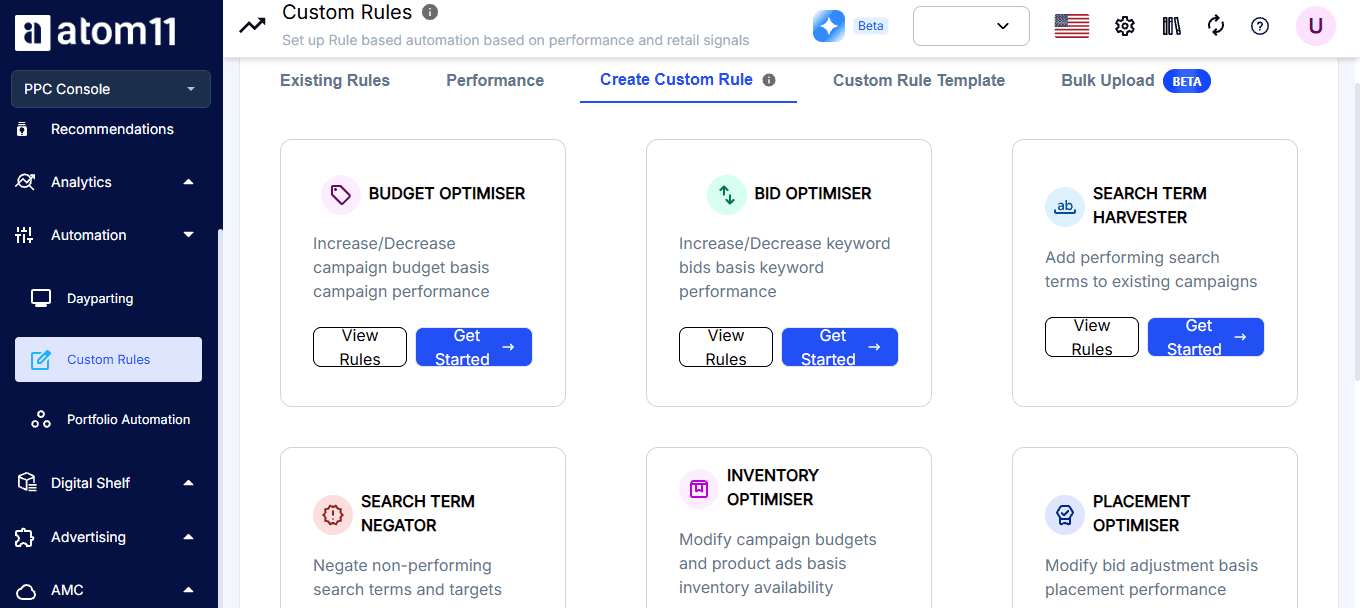
Atom11's automations run on rules you set, but those rules can use retail signals such as inventory, pricing, Buy Box and organic rank alongside ad performance. That means a bid rule can react to a stock problem or a lost Buy Box, not just to ACOS.
Visibility into how automation performs
A performance monitor shows how each automation affects results, and version control lets you save and roll back bids and budgets, for example before and after Prime Day. This addresses the black box concern that often comes with automated bidding.
Running Amazon DSP efficiently at scale
For DSP, the Amazon DSP module focuses on the manual work that slows teams down. Brands and agencies can bulk create orders and ad groups, pace spend across orders toward a monthly budget, set frequency caps by audience, use AMC audiences, and see DSP and Sponsored Ads results in one report.
AI for diagnosis, not just bidding
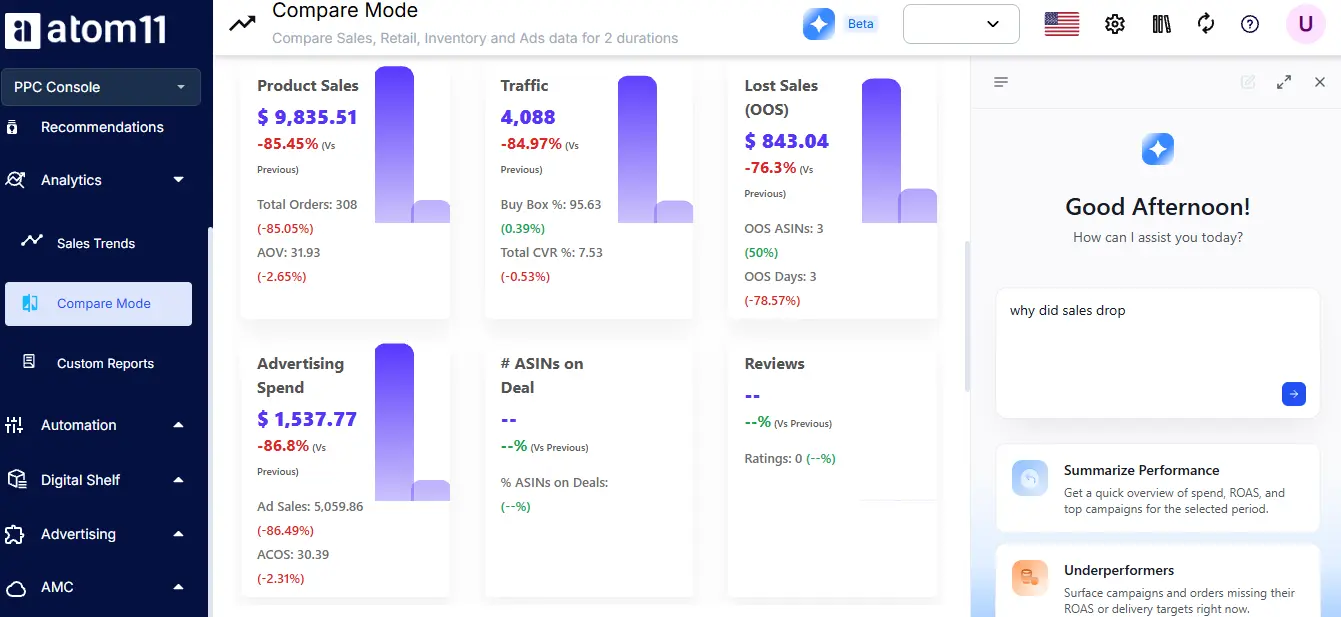
Its AI analyst, Neo, and the Atom11 MCP let teams ask plain language questions about their data, such as why sales or ACOS changed in a given week.
As with any tool, test it against your own workflow and a control group before committing.
Example: A Retail-Aware Rule in Action
Here's how the hybrid model plays out on a single ASIN.
The setup: a keyword is bidding at $1.50, converting at a healthy 15% CVR, with ACOS at 22% against a 25% target. A pure ACOS rule would leave the bid alone or even raise it.
What a rule-based-only system sees:
Bid stays at $1.50, or increases, because ACOS(22%) < Target(25%)
What Atom11's retail-aware rule sees: inventory has dropped to 4 days of cover at current sell-through, and the Buy Box was lost overnight on a competing offer.
The retail-aware rule:
IF ACOS < Target AND Days of Cover < 7 AND Buy Box = Lost → Lower bid by 40% and cap daily budget
The rule drops the bid immediately, before a stockout or a lost Buy Box turns efficient spend into wasted spend — something an ACOS-only rule, and most black-box AI bidders optimizing purely for ad metrics, would miss entirely.
Where AI comes in: the following Monday, the account owner asks Neo, "why did ACOS spike on this ASIN last week?" Instead of pulling three reports, Neo answers directly: spend was cut automatically due to low inventory and a lost Buy Box, and provides a one-line explanation rather than a black-box bid change with no record of why.
The result: version control lets the team roll bids back to their pre-event levels the moment stock and the Buy Box are recovered, using the Performance Monitor to confirm the rule's pause actually protected ROAS rather than just guessing that it did.
As with any tool, test it against your own workflow and a control group before committing.
Conclusion
The AI vs rule based Amazon PPC debate is not really about which technology is smarter. It is about who owns each decision. Rules are the right owner when you need exact control, have little data, or must encode business logic such as stock levels, margin floors and event budgets.
AI is the right owner when the number of decisions outgrows what people can maintain, and when speed and keyword level precision matter more than a readable rule. The accounts that perform best use both: deterministic rules as guardrails, algorithmic bidding inside them, and retail signals feeding every decision. Start by auditing what your current automation actually does, fix the thin data and lag problems with the formulas above, and then decide how much of the bidding you want a model to own.
FAQs
What is the difference between AI and rule based Amazon PPC?
Rule based Amazon PPC uses IF THEN conditions that a person writes, such as lowering a bid when ACOS passes a threshold, and runs them on a schedule. AI based Amazon PPC uses machine learning to predict what each click is worth from your account's data and adjusts bids continuously toward a goal like target ACOS. Rules offer control and transparency; AI offers speed, scale and keyword level precision.
Is AI bidding better than rule based bidding on Amazon?
AI bidding usually performs better on large catalogs, volatile categories and keywords with steady conversion history. Rule based bidding is often better for new launches, small catalogs and accounts with strict margin rules, because it works without historical data and every change is explainable. Most strong accounts combine both.
Is rule based automation a form of AI?
Technically, rule based systems are the oldest form of AI, known as symbolic AI or expert systems. In Amazon PPC, though, "AI" usually refers to machine learning that learns from data. A rule based tool cannot learn on its own; it only does what its rules say until a person changes them.
How many clicks should I wait before pausing an Amazon keyword?
A useful rule of thumb is 3 divided by the expected conversion rate. For a 10% expected CVR, wait for about 30 clicks without an order before pausing. Pausing earlier risks cutting keywords that simply had bad luck.
Can I use AI and rule based automation together?
Yes, and it is usually the best setup. Let the AI or Amazon's algorithmic bidding control bids, and use rules for guardrails (maximum bids, budget caps, break even ACOS), inventory and Buy Box conditions, search term harvesting, negation and dayparting. Avoid having two systems set bids on the same keyword.
