Blog
/
Amazon PPC AI Software: How AI Ad Automation Actually Works
Amazon PPC AI Software: How AI Ad Automation Actually Works
Deepika Thakur

One bad bid change can waste thousands in ad spend before you notice it. Amazon PPC AI software is designed to prevent that by analysing campaign data and automatically adjusting bids, keywords, and budgets as performance changes. But not every tool labelled “AI” makes decisions the same way.
This guide walks through what Amazon PPC AI software actually does, in plain terms, covering:
What separates AI based bidding from ordinary rule-based automation, with a worked example
How Amazon's own AI ad tools (Performance+, Ads Agent) compare to third-party AI PPC software
The features worth checking for before you buy any tool in this category
Why MCP (Model Context Protocol) is starting to change how sellers and agencies interact with their ad data through AI assistants like Claude and ChatGPT
What Amazon PPC AI Software Actually Does
Amazon PPC software is a third party platform that connects to the Amazon Ads API and Selling Partner API, then uses machine learning models, and increasingly large language models, to make ongoing decisions about your Sponsored Products, Sponsored Brands, and Sponsored Display campaigns. That includes:
Setting and adjusting keyword and product target bids
Finding and promoting new search terms, and negating wasted ones
Pacing budgets across the day so spend does not run out at noon
Flagging performance changes and, in more advanced tools, explaining why they happened
The "AI" distinction matters because most of what people call PPC automation is really a set of if this then that rules: if ACoS rises above X, cut bid by Y percent. That is useful, but it is reactive and treats every keyword the same way. AI based tools instead build a predictive model of how likely a given keyword, placement, and time of day are to convert, and set bids against that prediction rather than against a fixed rule.
How AI Bidding Actually Works
Every bidding system, rule based or AI based, is ultimately trying to answer one question: how much can I afford to pay for a click while staying within my target ACoS? A simple way to estimate that bid is:
Max CPC bid = Conversion rate × Average order value × Target ACoS
For example, if a keyword converts at 10%, generates a $40 average order value, and has a 25% target ACoS, the calculation is:
0.10 × $40 × 0.25 = $1.00
So, a $1.00 CPC would produce a 25% ACoS if the 10% conversion rate and $40 average order value hold. AI bidding systems use this basic economic relationship alongside historical performance and other signals to determine how bids should change as conditions shift.
A rule based tool applies this formula using one conversion rate assumption per campaign or ad group, refreshed on a schedule, often daily. AI based bidding earns its name at the "conversion rate" input. Rather than one static number, the model predicts a separate expected conversion rate for each keyword, at each placement (top of search, product page, rest of search), at each hour of the day, and updates that prediction continuously as new click and order data arrives. So the bid recalculated for the same keyword can look different in the morning than in the evening, or before and after a competitor goes out of stock.
Some platforms go a step further and pull in signals that sit outside the ad account entirely, such as current inventory levels, organic search rank, or buy box ownership. A keyword with strong intent is not worth bidding aggressively on if the product is about to go out of stock, and a model that only sees advertising data has no way to know that.
Rule-Based Automation vs AI-Powered Amazon PPC Automation
Rule Based Automation | AI Powered Automation | |
|---|---|---|
Decision basis | Fixed thresholds you set (if ACoS greater than X) | Predictive model trained on your account's conversion patterns |
Update frequency | Scheduled, usually daily | Continuous, often hourly or per auction |
Transparency | High, you wrote the rule | Varies by vendor, some are closed models |
Best fit | Small catalogs, stable demand, teams that want full manual control | Large catalogs, volatile demand, teams managing many SKUs or accounts |
Main risk | Slow to react to sudden changes | Can behave like a black box if the vendor does not expose reasoning |
Neither approach is strictly better. A five SKU account with a predictable sales pattern often does fine on rule-based automation and full manual oversight. A thousand SKU catalog with daily inventory swings usually cannot be managed profitably without predictive automation, since no PPC manager can manually reprice bids across a thousand ASINs several times a day.
Core Features to Expect in Amazon PPC AI Software
Whatever vendor you evaluate, these are the capabilities that separate a genuine AI powered platform from a basic bid scheduler:
Predictive bid automation that adjusts bids per keyword, placement, and time window based on a conversion probability model, not a single fixed rule
Search term harvesting, automatically promoting converting search terms from auto campaigns into manual campaigns and negating terms that spend without converting
Dayparting, raising or lowering bids and budgets by hour and day of week based on when your audience actually converts
Budget pacing, spreading spend across the day so high value hours are not starved because the budget ran out early
Root cause or anomaly detection, surfacing which specific metric change (ad spend, organic rank, price, stock) explains a sales swing, instead of leaving you to dig through several reports
Explainable reporting, sometimes called a glass box view, showing why a bid changed rather than only that it changed
If a tool cannot explain a bid decision in plain terms when you ask, that is worth treating as a limitation, not a feature.
How MCP Is Changing Amazon PPC AI Software
The newest shift in this category is not a bidding algorithm, it is the interface. MCP, short for Model Context Protocol, is an open standard that lets AI assistants such as Claude, ChatGPT, or Cursor connect directly to live data from a third party platform, instead of you copying numbers into a chat window or exporting a spreadsheet first.
For Amazon PPC AI software, this means you can ask an AI assistant a question in plain language, such as why did ACoS increase for a specific product line this week, and have it query your actual ad account and retail data in real time to answer, rather than working from a report someone pasted in days earlier. A growing number of Amazon advertising tools have started shipping MCP connectors for exactly this reason, since it turns a dashboard people have to remember to check into an assistant people can simply ask.
Two things matter when a vendor advertises MCP support. First, whether the connection reads live account data or a stale export, since the value collapses if the AI is answering from last week's numbers. Second, whether the same permissions that apply to a user inside the platform apply when that user connects through an AI assistant, so the AI cannot see or change more than the person asking it could.
Atom11: An AI Amazon PPC Software Example
Atom11 is a full funnel Amazon PPC platform for sellers, vendors, and agencies that illustrates a few of the approaches covered above in practice.
Retail aware bidding. Atom11 integrates advertising data with seller central signals, inventory, pricing, buy box status, and organic rank, so bid and budget decisions account for stock levels and competitive position rather than ad metrics in isolation.
Neo, an AI analyst layer. Rather than only adjusting bids, Atom11's AI copilot Neo is built to explain performance changes, comparing ad and retail signals across a time period and surfacing a root cause for a sales or ACoS swing in place of leaving that analysis to a human digging through reports.
Dayparting and performance based automation. Bids and budgets can be scheduled by time of day and day of week, alongside automation rules tied to ACoS, inventory, and portfolio budget performance, with a performance monitor described as a glass box view into what each automation actually did.
Bulk actions and version control. Campaign creation, keyword additions, and negations can be done in bulk, and account states (bids and budgets) can be saved as versions and rolled back, useful around events like a peak sales period when settings need to change and then revert.
MCP integration with Claude, ChatGPT, and Cursor. Atom11 offers a live MCP integration so account data, retail signals, and Neo's underlying logic can be queried directly from an AI assistant, reading from the live account rather than an export, with access limited to what the connected user's existing permissions already allow, and revocable at any time from account settings.
For example, consider a product whose sales suddenly decline while ACoS increases. Instead of looking only at campaign metrics and immediately lowering bids, an advertiser could use Atom11 to examine advertising performance alongside inventory, pricing, Buy Box status, and organic rank. If the analysis shows that the product's price increased while its Buy Box share and conversion rate declined, the advertiser has a clearer explanation for the sales drop and can address the underlying retail issue while adjusting advertising accordingly.
This combination, retail data folded into ad bidding, an AI layer focused on explanation as well as optimization, and a live MCP connection to general-purpose AI assistants, illustrates one direction in which the AI Amazon PPC software category is evolving. Atom11 is one example among several vendor approaches, and the right fit still depends on factors such as catalog size, account complexity, and how a team prefers to manage advertising.
A Simple Framework for Deciding If You Need It
Before you buy AI PPC software, it is worth running your account through three questions rather than going by ad spend alone:
How many SKUs are you actively advertising? Below roughly 20 to 30 active ASINs, a skilled human with basic rule based automation can usually keep pace. Above that, manual bid management starts missing opportunities simply due to volume.
How volatile is your inventory and pricing? If stock levels, buy box ownership, or pricing change frequently, ad performance data alone will lag behind what is actually happening in your account, and a retail aware model becomes more valuable than a pure ad platform model.
How much of your team's time goes to reactive firefighting versus strategy? If most PPC hours go to checking dashboards and making small manual adjustments rather than testing new campaign structures or creative, that is a strong signal the reactive work can be automated and the time redirected.
If you answer yes to two or more of these, AI powered automation is likely to pay for itself. If you answer no to all three, a well built rule based system with a few automation rules may be the more cost effective choice, at least for now.
Common Mistakes When Adopting AI Amazon PPC Tools
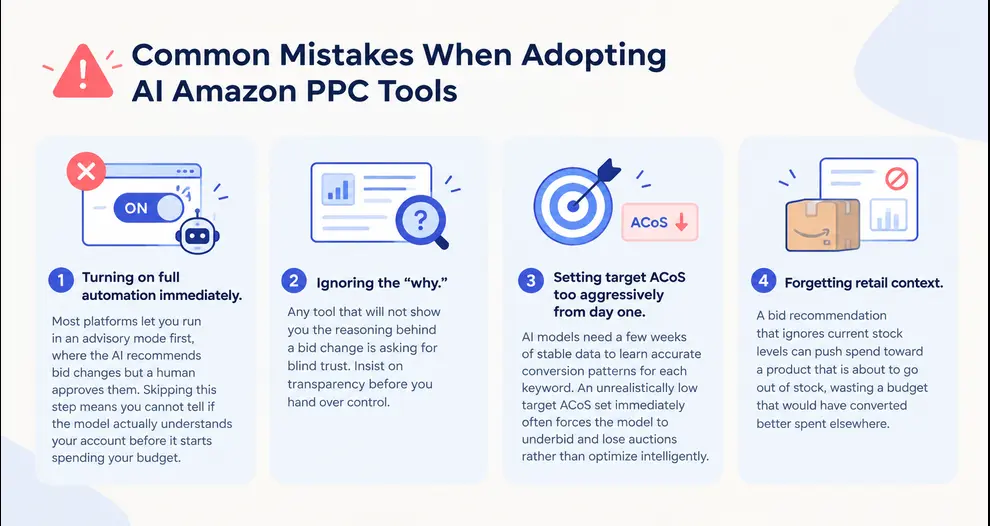
Turning on full automation immediately. Most platforms let you run in an advisory mode first, where the AI recommends bid changes but a human approves them. Skipping this step means you cannot tell if the model actually understands your account before it starts spending your budget.
Ignoring the "why." Any tool that will not show you the reasoning behind a bid change is asking for blind trust. Insist on transparency before you hand over control.
Setting target ACoS too aggressively from day one. AI models need a few weeks of stable data to learn accurate conversion patterns for each keyword. An unrealistically low target ACoS set immediately often forces the model to underbid and lose auctions rather than optimize intelligently.
Forgetting retail context. A bid recommendation that ignores current stock levels can push spend toward a product that is about to go out of stock, wasting a budget that would have converted better spent elsewhere.
Conclusion
Amazon PPC AI software is not a single category with one definition. It ranges from Amazon's own Performance+ and Ads Agent tools built directly into the ad platform, to third party predictive bidding engines, to retail aware systems like Atom11 that fold in inventory and pricing alongside ad performance and now connect to AI assistants directly through MCP. The differences that actually matter when choosing one are how the bid decision gets made (a fixed rule versus a continuously updated prediction), how much of that decision the vendor is willing to explain to you, and whether the tool understands anything about your business beyond clicks and conversions. Match those to the size and complexity of your catalog rather than chasing whichever tool has the most AI mentions on its homepage, and the choice gets a lot easier.
FAQs
Is AI Amazon PPC software worth it for a small catalog?
Usually not on its own merit for very small catalogs, since a skilled manager with basic rule based automation can typically keep pace with fewer than 20 to 30 active ASINs. It becomes more valuable as catalog size, SKU velocity, or inventory volatility increases.
How is AI PPC software different from Amazon's built in automation?
Amazon's native tools, such as Performance+ and Ads Agent, work only with Amazon Ads data and are free to use. Third party AI PPC software connects via the API and can add cross account management, custom reporting, and in some cases data from outside the ad account, such as inventory and pricing, which native tools do not use.
What is MCP and why does it matter for Amazon PPC software?
MCP, or Model Context Protocol, is a standard that lets AI assistants like Claude or ChatGPT connect directly to a platform's live data. For Amazon PPC software, it means you can ask an AI assistant questions about your ad account and get answers pulled from current data, rather than pasting exports into a chat manually.
Can AI PPC tools work with a low daily ad budget?
Yes, though the model has less data to learn from with a small budget, so bid predictions take longer to stabilize. Most platforms recommend at least a few weeks of consistent spend before judging results.
Does AI bidding replace the need for a PPC manager?
No. AI handles the repetitive bid and budget decisions at a frequency and scale humans cannot match manually, but campaign strategy, product launch sequencing, and creative testing still require human judgment.
