Blog
/
Amazon Ads AI: The Complete Guide to AI in Amazon Advertising (2026)
Amazon Ads AI: The Complete Guide to AI in Amazon Advertising (2026)
Neha Bhuchar
TL;DR
Amazon now builds real AI directly into its own ad platform, including Ads Agent and Creative Agent, both announced at unBoxed 2025 and rolling out through 2026. These native tools focus mainly on campaign creation, creative production, and in console guidance. A separate category of AI powered third party software exists alongside them, built to connect ad performance to retail data such as inventory and pricing, which Amazon's own AI tools do not access. Most advertisers end up using a combination of both rather than choosing only one.
Amazon Ads AI refers to two related but distinct things. First, Amazon's own native AI features built into the advertising console, announced primarily at the company's annual unBoxed conference. Second, the broader category of AI powered software built by outside companies to manage, automate, or analyze Amazon advertising, often pulling in data Amazon's own tools do not use. This guide covers both, starting with what Amazon itself has built.
What Is Amazon Ads Agent
Ads Agent is Amazon's AI tool for campaign building and account analysis, introduced at unBoxed 2025 in Nashville. According to Amazon's own unBoxed 2025 recap, Ads Agent helps advertisers build complex audience and analytics SQL queries using natural language, offering real time guidance so users can analyze Amazon Marketing Cloud data without writing SQL themselves.
Amazon reports that the AI powered search and campaign tools introduced alongside Ads Agent led to 67 percent faster campaign launches and meaningfully reduced daily account management time, according to the same official recap. That figure comes directly from Amazon and has not been independently verified by a third party, so treat it as a reported result rather than an audited benchmark.
What Is Amazon Creative Agent
Creative Agent is Amazon's conversational AI creative tool, first introduced within Creative Studio and expanded at unBoxed 2025 to cover streaming television and Sponsored TV formats. Per independent coverage of the announcement, Creative Agent performs market research on a brand and its products, then turns that research into a full storyboard with scene level scripts and editable visuals, producing campaign ready video or display assets in hours rather than weeks.
Amazon Campaign Manager and AI Powered Search
Amazon also unified Sponsored Ads and Amazon DSP into a single workspace called Campaign Manager, combining predictive machine learning, smart search, and guidance cards with reporting that spans fifteen months of daily insight and six years of monthly data, per Amazon's own summary of the unBoxed 2025 announcements.
AI Powered Third Party Amazon PPC Software
Alongside Amazon's native tools, a separate category of AI powered software exists specifically for managing Amazon advertising. These tools generally fall into two approaches:
Rule based automation follows fixed logic that a person configures in advance, such as raising a bid by a set percentage when a target ACoS is exceeded.
AI powered automation uses machine learning or a language model to adjust decisions based on patterns in the data, often without every rule being manually defined.
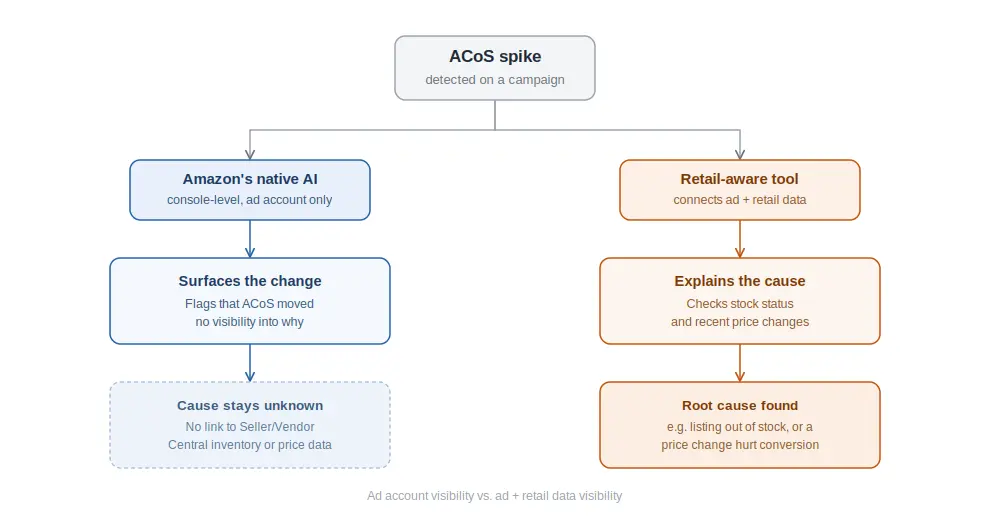
The more relevant distinction for choosing a tool is not the automation method itself, but what data the tool can see. Amazon's native AI tools work from advertising data inside the console. Third party tools built specifically for retail aware advertising can also connect inventory levels, pricing changes, and Buy Box status, which lets them explain why a metric moved rather than only reporting that it moved.
What Amazon's Native AI Tools Do Not Cover
This is a structural difference rather than something likely to change as the tools mature. Amazon's console-based AI works within the advertising account. It does not have visibility into your Seller Central or Vendor Central data, meaning it generally cannot tell you that a campaign is spending against a listing that just went out of stock or that a price change on your end just affected the conversion rate. Closing that gap requires a tool built specifically to connect ad data with retail data, which is a different job than campaign creation or creative generation.
How atom11 Extends the Capabilities of Amazon AI Ads
atom11 is built specifically for the gap described above. Rather than generating creative or building campaigns from natural language prompts, atom11 connects advertising data with inventory, pricing, and retail performance in one place, so the automation and analysis are grounded in what is actually happening across the account, not just what is happening inside the ad campaign itself.
Its AI analyst, Neo- a custom AI co-pilot, is built to answer questions that require that combined view, such as identifying every product currently in ineligible status, or explaining why sales dropped for a specific parent listing. This works because Neo has access to advertising, pricing, inventory, and retail data together, at the day, week, month, or ASIN level, rather than advertising data alone.
A more recent addition, atom11 MCP integration, connects an account's advertising and retail data directly to Claude and other AI assistants, so questions can be asked and root cause analysis run from outside the console entirely, with setup taking about five minutes.
For example: imagine an Amazon seller notices that sales for a particular product have fallen 30% over the past week. A traditional advertising-focused tool might identify that the campaign's conversion rate has declined and recommend reducing bids. But if the product's price increased by 15% during the same period, or the listing lost inventory for several hours each day, reducing bids would address the symptom rather than the underlying problem.
This is where atom11's AI analyst, Neo AI Co-Pilot, becomes particularly useful. Because Neo can access advertising, pricing, inventory, and retail performance data together, it can investigate questions that require more than a campaign-level view.
For example, instead of asking:
"Why did my ROAS decline?" an advertiser could ask: "Why did sales for this parent listing drop last week?"
Neo can look across multiple dimensions of the account and connect the dots between them:
Advertising: impressions, clicks, spend, conversions, CPC, ROAS and campaign performance.
Inventory: stock levels, availability and potential periods of lost availability.
Pricing: changes in selling price and how those changes coincided with sales or conversion changes.
Retail performance: sales trends, listing-level performance and ASIN-level changes.
Time: whether the problem appeared at the day, week or month level.
Product hierarchy: whether the issue is isolated to a particular ASIN or affects an entire parent listing.
So, rather than simply saying "conversion rate decreased," the analysis can potentially uncover a sequence such as: price increased → conversion declined → sales fell → advertising efficiency deteriorated. That gives the advertiser a much more actionable explanation of what happened.
For a closer look at these results, explore how brands are using atom11 to automate Amazon AI Ads in this real-world case study
Choosing the Right Approach
For most advertisers, this is not a choice between Amazon's own AI and an outside tool, but a combination of both:
Use Amazon's Creative Agent for faster ad creative and video production
Use Amazon's Ads Agent for natural language campaign building inside the console
Use a retail aware tool such as atom11 for diagnosis that depends on inventory and pricing data, and for managing automation across multiple accounts.
The Bottom Line
Amazon's investment in native AI is real and genuinely useful for campaign creation and creative production. It is not built to solve the separate problem of connecting ad performance to retail data, which is a different job requiring access Amazon's own console does not provide to outside factors like inventory and pricing. That gap is what tools built specifically for retail aware advertising, atom11 included, exist to close.
Want to see what retail-aware AI can uncover in your Amazon account? Book a demo with atom11 to see how it connects advertising, inventory, pricing, and retail performance in one view.
FAQs
Does Amazon have its own AI for advertising?
Yes. Ads Agent and Creative Agent are Amazon's native AI tools, announced at unBoxed 2025 and expanding through 2026, covering campaign building, audience analysis, and creative production inside the Amazon Ads console.
Do I still need third party software if I use Amazon's AI tools?
It depends on what you need. If your main need is faster campaign setup or creative production, Amazon's native tools may be enough on their own. If you need to understand why a metric changed by connecting it to inventory or pricing, or you manage more than one account, a dedicated tool covers ground Amazon's own AI does not reach.
What is the difference between rule based and AI powered Amazon PPC automation?
Rule based automation follows fixed logic set up in advance. AI powered automation adjusts decisions based on patterns in the data, sometimes without every rule being manually defined. Many tools, atom11 included, combine both approaches rather than relying on one alone.
Can AI explain why my ACoS increased?
Only if it has access to more than the ad account itself. A tool that sees only spend and conversions can report that a change happened. A tool that also has access to inventory, pricing, and Buy Box data can often explain why it happened.
