Blog
/
Amazon PPC Agency vs In-House Team vs PPC Software: The Real Cost Comparison for 2026
Amazon PPC Agency vs In-House Team vs PPC Software: The Real Cost Comparison for 2026
Kajal Sharma
Key Takeaways
Software handles the repetitive work (bids, budgets, negatives, dayparting) every day. An agency adds human judgment on strategy, creative and launches.
Software and human labor solve different problems: software executes repeatable decisions (bids, budgets, negatives, dayparting); a person, in-house or agency, supplies judgment on strategy, creative, and launches.
None of the three fixes a conversion problem. ACoS = CPC ÷ (conversion rate × average order value), if your listing or price is the weak link, no bid tool, bid manager, or account director can out-bid their way to a lower ACoS.
The cost curves bend differently as spend scales: agency fees rise in a straight line with spend, software rises in steps, and an in-house salary is a fixed cost that only pays for itself past a certain spend threshold.
Most accounts under roughly $30,000/month in ad spend are better served by software plus part-time in-house ownership than by a percentage-of-spend agency fee or a full-time hire.
At scale, the accounts that perform best usually run a hybrid: software handling daily execution, and a specialist, in-house, agency, or a managed service, handling strategy, launches, and creative.
Atom11 reads inventory, pricing and Buy Box signals alongside ad data, and its public plans start at $499 a month, priced by spend tier rather than as a percentage of spend.
Most sellers ask this question backwards. "Should I use software or hire an agency?" isn't really a two-option decision, it's a three-way trade-off between what you pay in salary, what you pay in fees, and what you pay in subscription cost, and almost every growing account ends up mixing at least two of the three. The variable that actually decides the mix isn't preference, it's ad spend: what makes sense at $10,000 a month is the wrong answer at $500,000 a month, and the "true cost" of each option changes shape as spend grows, not just size.
This guide breaks down what an in-house hire, an agency, and PPC software actually cost, fully loaded, not sticker price, and where each one stops making sense.
What Is Amazon PPC Software and What Can It Really Do?
Amazon PPC software connects to your Amazon Ads account and takes over repeat decisions. It raises or lowers bids, moves budget, adds negative keywords, harvests winning search terms from auto campaigns into manual ones, and schedules changes by hour.
Speed is the main gain. Amazon Marketing Stream delivers hourly campaign metrics in near real time to approved partners, so software can react the same day instead of waiting for tomorrow's report.
The limits matter just as much. Software follows the rules and data you give it. It cannot see that your main image is weak, that a rival undercut your price, or that a launch needs a low-profit first month. If the setup is wrong, automation repeats the mistake faster.
For example, in Atom11 you can adjust bids based on ad performance while also considering retail signals such as inventory, pricing, and Buy Box status. If a product loses the Buy Box after a competitor cuts its price, the software can reduce advertising exposure instead of continuing to optimise bids against weaker conversion rates.
What Does an Amazon PPC Agency Do That Software Can't?
An Amazon ad agency gives you people. A good one audits your account, designs campaign structure, researches keywords, plans launches, briefs Sponsored Brands creative, and explains why numbers moved. It can spot that CPC rose because a new competitor arrived, or that conversion fell after a price change.
Pricing usually follows 10–20% of ad spend or a flat retainer of about $1,500–$8,000 a month. Extras such as DSP, video and storefront design are often billed separately.
The trade-offs are capacity and control. One account manager may look after many clients, and changes may follow a weekly rhythm. You also share control of your ad account, so ownership and access terms matter.
What an In-House Hire Actually Costs
This is the leg of the comparison that gets skipped most often, because the sticker price, a salary number, looks deceptively simple next to a subscription fee or a retainer percentage.
Base salary bands in the US (2026):
Role | Base salary |
Amazon PPC Specialist | 55,000–75,000 |
Amazon PPC Manager | 75,000–120,000 |
Senior Manager / Director | 150,000–200,000 |
A specialist role alone typically pays between $55,000 and $75,000 a year in the US, depending on experience and location. Move up to a senior, spend-owning manager and base pay for someone with 4+ years of experience managing $500K+ in spend runs 75,000–110,000 a year. At the director level, scarcity of genuinely senior operators has pushed pay to 170,000–200,000 for the small pool of candidates with director-level strategic depth and 7+ years of hands-on experience.
Three costs that rarely make it into the hiring decision:
Ramp time. A new hire typically needs 60–90 days to reach full productivity on your specific catalog and account history, during which spend is still running.
Single point of failure. One person covering daily bids, reporting, and launch work has no backup during vacations, illness, or turnover. Agencies and software both spread that risk differently; a lone in-house hire doesn't.
Tool stack on top of salary. An in-house hire still needs a bid/budget platform, a reporting layer, and AMC access, the salary is the floor, not the ceiling, of what the seat costs.
What you get in exchange that neither software nor a shared agency account manager offers: full, undivided attention on your account and institutional knowledge that compounds instead of resetting every time an agency reassigns your account.
Amazon PPC Software vs Agency vs In-House: Side-by-Side
In-House | Agency | Software | |
Cost structure | Fixed salary + benefits + tools | % of spend or flat retainer | Flat fee by spend tier |
Control | Full | Shared — access sits with the agency | Full |
Speed of execution | Same-day, limited by one person's bandwidth | Usually weekly cadence | Same-day to hourly (via Marketing Stream) |
Strategic judgment | Deep on your account, limited to one person's experience | Broad, cross-account pattern recognition | None — executes rules you set |
Creative / DSP / launches | Only if the hire has that skill set | Yes, usually available | No |
Scalability | Requires another hire to add capacity | Scales with fee, not always with attention | Scales in pricing steps, not headcount |
Single point of failure risk | High | Low (team coverage) | None |
Best-fit spend range | Mid-to-large accounts that justify a dedicated seat | Complex launches, new marketplaces, messy rebuilds | Any account with clean structure and someone to review it |
Consider a brand spending $10,000 a month on Amazon ads. With PPC software, the team can set bid, budget, and keyword rules, monitor performance, and keep campaign decisions in-house for a fixed monthly fee. An agency takes over more of the day-to-day work, including strategy, optimisation, and reporting, but typically charges based on ad spend or a monthly retainer. For a brand with an established account and someone who can review automated decisions, software can reduce management costs while retaining control. An agency can suit accounts that need hands-on strategic or launch support.
The True Cost Comparison, by Ad Spend Tier
This is where the "which one is cheaper" question actually gets answered, because the three cost structures scale at completely different rates.
Monthly ad spend | In-house (loaded, fractional-to-full seat) | Agency (10–20% of spend) | Atom11 software |
$10,000 | Not viable full-time; owner/generalist covers it | 1,500–2,000 (typical agency minimum) | $499 |
$30,000 | Fractional hire, ~$1,500–2,500/mo of a specialist's time | 3,000–6,000 | $499 |
50,000–100,000 | ~6,000–8,000/mo (loaded specialist) | 5,000–20,000 | 1,199–1,700 |
200,000–300,000 | ~8,000–10,000/mo (loaded manager) | 20,000–60,000 | $2,700 |
400,000–500,000 | ~12,000–16,500/mo (senior manager/director share) | 40,000–100,000 | $4,700 |
$500,000+ | Full team (manager + specialist), $20,000+/mo | Often renegotiated below 10% at this scale, or flat retainer | Custom pricing |
Figures are illustrative, built from the salary ranges and public Atom11 pricing above; actual agency and hiring costs vary by market, offshore vs onshore hiring, and negotiated rates.
The pattern that matters: agency cost rises in a straight line with spend, software rises in discrete steps, and an in-house salary is a fixed cost that only starts to pay for itself once spend is high enough to keep one person fully occupied.
Why ACoS Is Not Only a Bidding Problem
Both options work on the same ACoS equation:
ACoS = ad spend ÷ ad sales = CPC ÷ (conversion rate × average order value)
Try it with the 2026 average CPC of $1.22, a 10% conversion rate and a $30 order value: 1.22 ÷ (0.10 × 30) = 40.7% ACoS.
Cut CPC by 10% through better bids, and ACoS falls to about 36.6%.
Lift conversion from 10% to 12% through a better listing, and ACoS falls to about 33.9%.
The listing fix beats the bid fix. This is why "software or agency?" is sometimes the wrong first question. Check whether your problem is bids, structure, or the product page.
TACoS (ad spend ÷ total sales), then shows whether ads are also lifting organic sales.
When to Choose Software, an Agency, an In-House Hire, or a Hybrid
Choose software when:
Your account structure is clean and someone, even part-time, owns PPC.
The pain point is slow, repetitive work: bids, negatives, budgets, reporting.
You want to keep full control of your data and campaigns.
Choose an agency when:
You're launching many SKUs, entering new marketplaces, or rebuilding a messy account.
You need creative production, DSP strategy, or Amazon Marketing Cloud analysis you don't have in-house.
Nobody on the team has the time or the standing to review performance weekly.
Choose an in-house hire when:
Spend and complexity justify a full-time seat, and you want institutional knowledge that compounds over years instead of resetting with every agency handoff.
You can absorb 60–90 days of ramp time without it hurting performance.
Same-day availability and full attention outweigh the fixed cost of the salary.
Choose a hybrid when:
Spend is past the point where manual work is fast enough, but not big enough to justify a full team or a large retainer.
You want daily automation plus a quarterly strategy review from a specialist.
You're an agency yourself and want one dashboard across every client account.
A Simple 5-Question Decision Test
What is your monthly ad spend? Under about $30K, software plus a few hours of your time usually costs far less than a percentage-based retainer.
Is the problem bids or something else? Use the ACoS formula. If conversion or price is the weak point, fix that first.
Do you need creative, launch or DSP work? These are the real reasons to hire humans.
How much time can you give each week? Software still needs someone to set targets and review results.
Do you own your ad account and data? Never sign anything that gives an agency ownership of your campaigns.
Manage Amazon PPC in One Place with Atom11
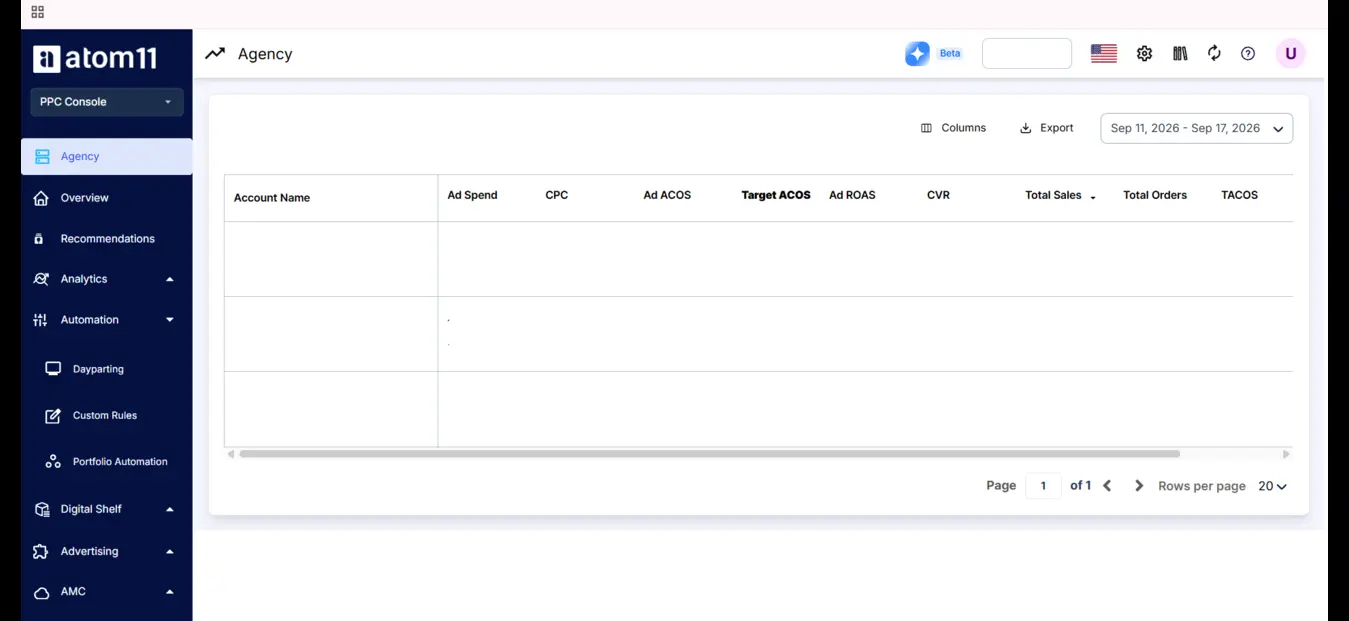
Atom11 is a retail-aware Amazon PPC platform built for sellers, brands and agencies. Most tools only see ad data. Atom11 also reads inventory, pricing, Buy Box and search rank, so your bids and budgets react to what is happening in your business. More than 2,000 brands and agencies run their Amazon advertising on it.
What you can control from one dashboard
Area | What it does |
Automation | Hourly dayparting for bids and budgets, bid optimization, keyword harvesting and negation, plus placement and portfolio budget rules |
Retail-aware rules | Pauses ads when stock is low and resumes them when it is replenished. Buy Box status (for vendors) and search rank can also drive bids |
Analytics | Ads, pricing, inventory and retail data side by side, at child ASIN, parent ASIN and custom label level |
Root Cause Analyzer | Compares two time periods and shows which metrics actually changed, so you can see why sales moved |
Bulk actions | Create or edit hundreds of campaigns, ad groups and targets, with a preview before changes go live |
Performance Monitor | Keeps before-and-after results for each keyword, so you can audit every automation |
Version Control | Saves your bids and budgets before Prime Day so you can roll back afterwards |
Neo AI and MCP | Ask questions like "why did ROAS drop?" inside Atom11 or from tools like Claude (read-only today, write access marked "coming soon") |
Ad formats | Sponsored Products, Sponsored Brands, Sponsored Display, Amazon DSP and Amazon Marketing Cloud |
Simple, predictable pricing. Atom11 prices by ad-spend tier, not as a percentage of your spend:
Beginner: $499 a month, for ad spend up to $50K a month
Professional: from $1,199 a month, for $50K–$500K a month
Enterprise: custom, for more than $500K a month
Every plan has unlimited seats and a 4-week guided onboarding.
Proof from real accounts (vendor-reported). Beco's ACoS fell from 19.4% to 12.2% after a competitor price alert triggered a bid increase. Gala reduced ACoS by 40% over six months using hourly Marketing Stream data.
Conclusion
Amazon PPC software and agencies solve different problems. Software gives you speed, consistency and control at a predictable price. An agency gives you judgment, creative work and launch planning at a higher one. For most accounts below roughly $30,000 in monthly ad spend, software wins on cost. As spend and complexity grow, a hybrid usually works best: automation for daily decisions, specialists for the big strategic calls.
Run your own numbers before you decide. Check your ACoS formula, compare fees to the value they can recover, and ask every provider to show proof of changes. If you want to see how a retail-aware platform handles this on your account, the Atom11 team can walk you through it.
Not sure whether software, an agency, an in-house hire, or a mix fits your ad spend? Share your account size and goals, and the Atom11 team will show you what can be automated and where you still need people. Book a Demo today!
FAQs
What is the difference between Amazon PPC software and an agency?
Software automates repeat tasks like bids, budgets and negative keywords. An agency is a team that plans strategy, builds campaigns, produces creative and explains performance. Software executes; an agency also decides.
Can Amazon PPC software replace an agency?
For bid management, budgets, harvesting, negatives and dayparting, yes. For creative, launch strategy, DSP planning and catalog fixes, no. Many brands use software for the first group and hire specialists for the second.
At what ad spend should I hire an Amazon PPC agency?
There is no fixed line. Agencies make more sense when spend is high enough that growth work pays for the fee, or when you need launch, creative or multi-channel help. Under about $30K a month, test software first.
Is Amazon PPC software worth it for small sellers?
Usually yes, if you can review results weekly. A fixed monthly fee does not grow with your ad spend, so small budgets avoid large percentage fees. It is not worth it if your listing conversion is the real problem.
What is a hybrid Amazon PPC model?
It combines software for daily execution with a consultant or agency for strategy, creative and launches. You keep control of the account, and pay humans only for work software cannot do.
