Blog
/
Amazon Ads vs Amazon DSP: What Actually Separates Them in 2026
Amazon Ads vs Amazon DSP: What Actually Separates Them in 2026
Deepika Thakur
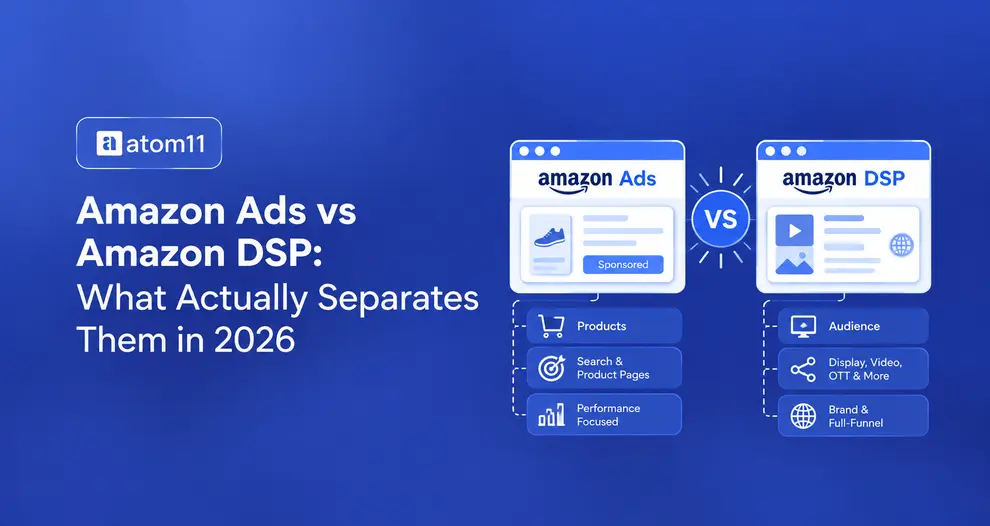
A brand spending $8,000 a month on Sponsored Products and a brand spending $80,000 a month across Sponsored Products and Amazon DSP are technically both "advertising on Amazon," but they are buying almost entirely different things. One is paying per click to appear in front of a shopper who already typed a search term. The other is paying per thousand impressions to build awareness with an audience that has not searched for anything yet, on Amazon and well beyond it, on Prime Video, Twitch, and thousands of third party sites. Confusing the two, or assuming DSP is just a bigger version of Sponsored Ads, is how budget ends up buying the wrong kind of attention.
The confusion has gotten more understandable, not less, over the past year. Amazon's own case studies show what a well targeted DSP campaign can do: apparel brand HEYDUDE used DSP's shopping signals to drive traffic to its own website and achieved 11.4x ROAS with 47% of conversions coming from new to brand customers, a result no keyword campaign inside Amazon search could have produced, since it depended on reaching people who were not searching yet. At the same time, Amazon has spent 2025 and 2026 actively merging the infrastructure behind both platforms, to the point that asking "Amazon Ads or Amazon DSP" is starting to be the wrong question entirely.
This guide untangles both sides of that, specifically:
What Amazon Ads (Sponsored Ads) and Amazon DSP each are, in plain terms, and what separates them
A side by side comparison of targeting, cost, eligibility, and funnel role
A formula for converting DSP's CPM pricing into a CPC number you can compare against Sponsored Ads, with a worked example
Who should run Sponsored Ads alone, and when adding DSP is actually worth the budget, illustrated with Amazon's own HEYDUDE case study
Why Amazon is merging the two consoles into one in 2026, and what that means for how you should be planning budget
Where a retail aware platform like Atom11 fits alongside both
What Is Amazon Ads (Sponsored Ads)?
Amazon Ads, in most conversations, refers to Sponsored Ads: Sponsored Products, Sponsored Brands, and Sponsored Display. These are self service, cost per click (or viewable CPM for Sponsored Display) campaigns you set up directly in Seller Central or Vendor Central, targeted by keyword or product, competing in an auction to appear in search results and on product pages. Amazon's own framing is that sponsored ads reach shoppers who are actively searching with relevant keywords or viewing similar products, best suited for lower funnel conversions and simpler campaign management with smaller budgets, according to Amazon's official guide to demand side platforms.
There is no minimum spend to run Sponsored Ads. A daily budget can start as low as a few dollars, and you are only eligible to run them if you sell a physical product on Amazon.
What Is Amazon DSP?
Amazon DSP is a demand side platform, a separate category of advertising technology that lets you programmatically buy display, video, and audio ad inventory in real time, both on Amazon owned properties like Prime Video and Twitch and across thousands of third party sites and apps. Unlike Sponsored Ads, DSP is available to brands whether or not they sell on Amazon, since it can send traffic to your own website rather than only to a product listing.
DSP uses audience based targeting built on Amazon's shopping, browsing, and streaming signals, rather than keywords, and it comes in two access models. Self service gives you full control of the campaign with no management fee, while managed service, where an Amazon Ads team runs the campaign for you, typically requires a minimum spend around $50,000 a month, which varies by country, per Amazon's own DSP guide.
Amazon Ads vs Amazon DSP: The Core Differences
Amazon Ads (Sponsored Ads) | Amazon DSP | |
|---|---|---|
Targeting | Keyword and product based, intent driven | Audience based, using shopping, browsing, and streaming signals |
Pricing model | Cost per click, vCPM for Sponsored Display | Cost per mille (CPM), plus fees |
Eligibility | Must sell a product on Amazon | Open to endemic and non endemic brands |
Minimum spend | None | None stated for self service; roughly $50,000 a month for managed service |
Where ads appear | Amazon search results and product pages | Amazon owned properties plus third party sites, apps, and streaming |
Funnel role | Lower funnel, capturing existing intent | Upper funnel, building awareness and retargeting |
Destination | Always an Amazon product page | Amazon or your own website |
Access | Direct, self service via Seller Central | Self service registration or managed service |
The distinction Amazon itself draws is a funnel metaphor: DSP reaches audiences before they start searching, while Sponsored Ads capture demand once purchase intent is highest. Used together, they form a connected strategy rather than competing options.
How Bidding and Pricing Actually Differ
Comparing a CPC number from Sponsored Ads against a CPM number from DSP is comparing apples to oranges unless you convert one into the other. The formula for translating a CPM buy into an effective cost per click is:
Effective CPC = (CPM ÷ 1000) ÷ CTR
Say a DSP display campaign runs at a $10 CPM with a 0.4% click through rate. The cost per impression is 10 divided by 1000, or $0.01. Divide that by the 0.4% CTR (0.004 as a decimal) and the effective CPC works out to $2.50.
Compare that against your typical Sponsored Products CPC to judge whether a given DSP placement is buying clicks at a reasonable price, keeping in mind DSP is usually paying for reach and brand exposure as much as the click itself, so a higher effective CPC is not automatically a bad result the way it would be in a pure conversion campaign
Amazon Ads vs Amazon DSP: Who Should Use Which
Sponsored Ads alone fits a brand still building out keyword coverage, with a catalog that has not exhausted the demand already searching for it on Amazon. Most sellers should have this working efficiently before adding DSP.
Add Amazon DSP once Sponsored Ads is running efficiently and you have a specific use case: retargeting shoppers who viewed but did not buy, reaching new to brand audiences beyond search, or driving traffic to your own website using Amazon's purchase data.
Non endemic brands, meaning businesses that do not sell a physical product on Amazon, such as insurance, automotive, or subscription services, cannot use Sponsored Ads at all and can only reach Amazon's audience through DSP.
Use Amazon Ads when you want to capture shoppers actively searching for products on Amazon. For example, a skincare brand can use Sponsored Ads to appear for “vitamin C serum.” Use Amazon DSP when you want to retarget past visitors, reach new audiences beyond search, or advertise a non-Amazon product such as insurance or a subscription service.
Amazon Is Blurring the Line Between Them
The "vs" framing itself is becoming less clean than it used to be. At its unBoxed conference in November 2025, Amazon began rolling out a Unified Campaign Manager that folds Sponsored Products, Sponsored Brands, Sponsored Display, and Amazon DSP into one console with a shared budget view and one campaign creation flow, rather than the two separate systems advertisers had to stitch together before. On top of that, Amazon's unified reporting feature reached general availability in June 2026, letting advertisers build a single report spanning Sponsored Ads and DSP data across accounts and countries in one place, according to Amazon's own launch announcement.
The practical effect is that the question is shifting from "should I use Amazon Ads or Amazon DSP" to "how do I split one shared budget across intent based and audience based formats," since both increasingly sit inside the same workspace rather than requiring separate logins, separate reports, and separate mental models.
How Amazon Marketing Cloud Connects Both
Amazon Marketing Cloud (AMC), Amazon's clean room analytics tool, used to require active DSP usage before you could register for it at all. That requirement was removed for advertisers working through Amazon Ads software partners, so a seller running Sponsored Ads only can now access AMC's cross format analysis through a partner without ever running a DSP campaign. This matters for the comparison because AMC is often the tool that actually tells you whether adding DSP paid off, by letting you trace whether a shopper who saw a DSP ad later converted through a Sponsored Products click, something neither platform's own reporting shows in isolation.
Common Mistakes When Choosing Between Amazon Ads and DSP
Adding DSP before Sponsored Ads is efficient. DSP works best as a layer on top of a keyword strategy that is already converting well, not as a substitute for one that isn't.
Judging DSP by last click ROAS alone. DSP's job is often awareness and retargeting, so measuring it purely against a direct conversion metric undercounts what it is actually contributing further up the funnel.
Assuming managed service is required. Self service DSP gives full campaign control with no management fee, and is the more accessible entry point for a brand that is not ready for a five figure monthly managed commitment.
Treating the two consoles as permanently separate. With Amazon actively merging reporting and campaign creation, a strategy built around keeping them siloed will need revisiting as the unified experience rolls out more broadly.
Atom11 and Where Retail Aware Tools Fit Into Your Amazon Ads and Amazon DSP Strategy
Atom11 is a full-funnel Amazon PPC platform for sellers, vendors, and agencies, built primarily around Sponsored Ads management rather than DSP itself, and it illustrates a gap that sits underneath both platforms regardless of which one you are running. Neither Sponsored Ads nor DSP, on their own, knows your inventory position, your landed margin per SKU, or whether you currently hold the buy box. Atom11 is built to close that specific gap through a few distinct pieces.
Retail Aware Bidding
Atom11 integrates advertising data with seller central signals, inventory levels, pricing, buy box status, and organic rank, so a bid or budget decision accounts for stock position and competitive standing rather than ad metrics in isolation. A bid that looks efficient against ACoS alone can still be the wrong call if the product is about to go out of stock or has already lost the buy box, and neither Sponsored Ads nor DSP reporting would show that on its own.
Neo: AI Root Cause Analysis
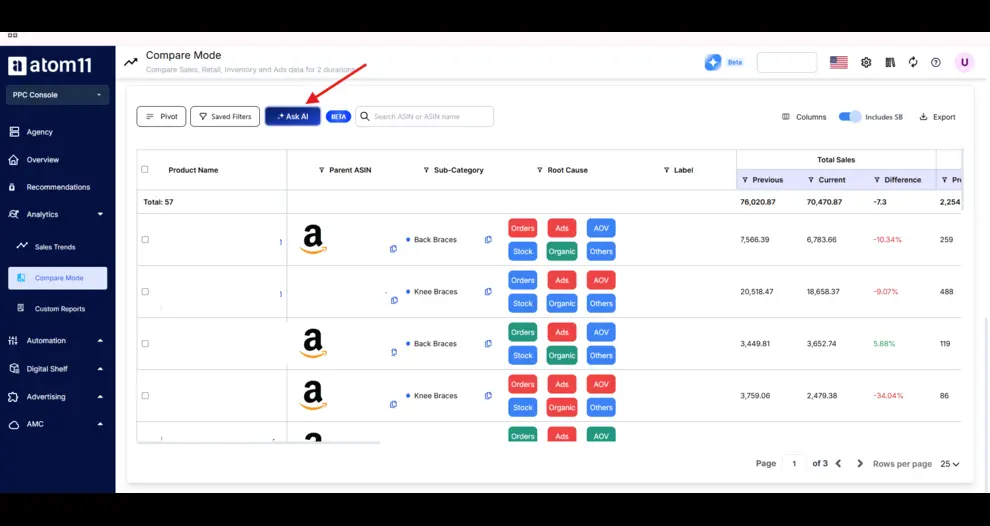
Rather than only adjusting bids, Atom11's AI copilot, Neo, is built to explain performance changes. It compares ad and retail signals across a chosen time period and surfaces a probable root cause for a sales or ACoS swing, whether that is a price change, a stock out, a rank drop, or a shift in ad spend, instead of leaving that diagnosis to a human cross-referencing several reports by hand.
Dayparting and Rule Based Automation
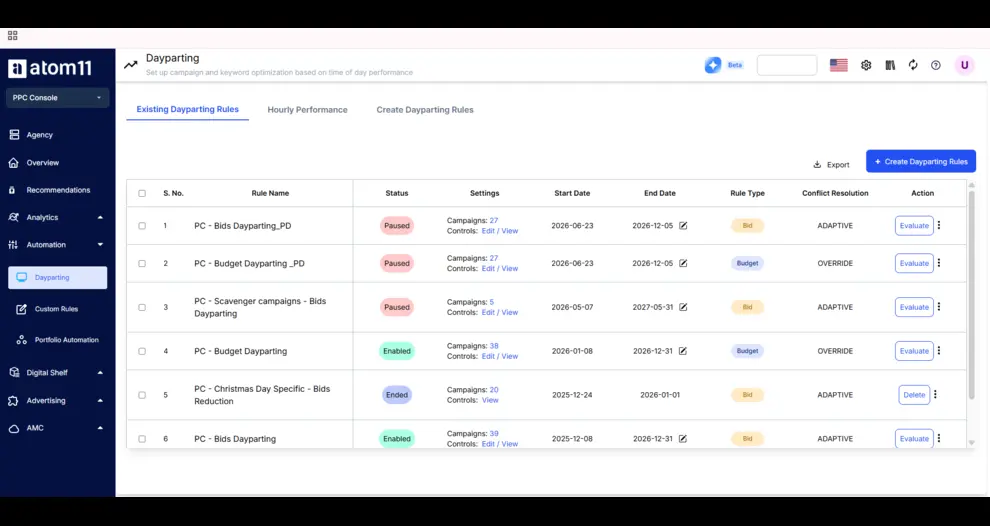
Bids and budgets can be scheduled by time of day and day of week, alongside automation rules tied to ACoS targets, inventory position, and portfolio level budget performance. Atom11 describes its performance monitor as a glass box view into what each automation rule actually did and why, rather than a black box that only shows the result.
Bulk Actions and Version Control
Campaign creation, keyword additions, and negations can be carried out in bulk rather than one campaign at a time. Account states, meaning the full set of active bids and budgets, can be saved as versions and rolled back, which is useful around a period like a peak sales event, when settings need to change temporarily and then revert without having to reconstruct the prior setup manually.
MCP Integration with Claude, ChatGPT, and Cursor
Atom11 offers a live MCP connection so account data, retail signals, and Neo's underlying analysis can be queried directly from an AI assistant such as Claude, ChatGPT, or Cursor. The connection reads from the live account rather than an export, access is limited to what the connected user's existing permissions already allow inside the platform, and it can be revoked at any time from account settings.
How Atom11 Puts These Pieces Together
Here’s how those signals come together in a real account, from spotting the problem to taking action and checking what else changed.
1. Detecting Why ACoS Changed
A practical example makes this concrete. Say ACoS on a bestselling SKU jumps overnight while the Sponsored Products bid has not changed. Neo compares that day's ad performance against the retail signals feeding into Atom11 and flags that the product lost the buy box the previous evening after a competitor cut price, which is why clicks are now converting at a lower rate even though targeting is unchanged.
2. Automating the Right Response
Because Atom11's automation rules are tied to buy box status as well as ACoS, the retail-aware bidding layer had already pulled back bids on that SKU automatically rather than continuing to pay for clicks that were unlikely to convert.
3. Connecting Account Data for Faster Decisions
Before approving any further change, the account manager checks the version history to compare the current bid state against last week's, then uses the MCP connection to ask Claude, in plain language, which other SKUs in the same portfolio lost the buy box in the same window, and gets an answer pulled from the live account rather than a manually built report. The bid pullback, the explanation, and the cross portfolio check all come from the same underlying data, rather than three separate tools that each see only part of the picture.
For a brand weighing whether to add DSP on top of Sponsored Ads, this kind of retail aware view of the Sponsored Ads side is useful groundwork, since DSP performs best once the intent capture layer underneath it is already running efficiently.
Conclusion
Amazon Ads and Amazon DSP solve different problems: Sponsored Ads capture shoppers who are already searching, while DSP builds awareness and retargets audiences across a much wider footprint, on and off Amazon. The cost models, eligibility rules, and funnel roles are different enough that treating them as interchangeable wastes budget in both directions. What is changing in 2026 is the infrastructure underneath both, with Amazon's Unified Campaign Manager and unified reporting collapsing what used to be two separate systems into one, which means the more useful long-term question is not which platform to pick, but how to split one advertising budget across intent-based and audience-based formats inside a single, increasingly shared workspace.
Want to see how this approach can work across your Amazon advertising strategy? Book a demo with the Atom11 team to explore your account and see where retail signals can improve campaign decisions.
FAQs
Can I use Amazon DSP without selling on Amazon?
Yes. Amazon DSP is open to non endemic brands, meaning businesses that don't sell a physical product on Amazon, unlike Sponsored Ads, which requires an active product listing.
Is there a minimum spend for Amazon DSP?
Self service DSP carries no stated management fee and gives full campaign control. Managed service, where an Amazon Ads team runs the campaign, typically requires a minimum spend around $50,000 a month, which varies by country, according to Amazon's official DSP guide.
Should I start with Sponsored Ads or Amazon DSP?
Most brands should start with Sponsored Ads, since it captures demand that is already searching for the product and has no minimum spend. Amazon DSP is generally added once Sponsored Ads is running efficiently and there is a specific upper funnel or retargeting goal to fund.
Do Amazon Ads and Amazon DSP use the same console now?
They are moving toward it. Amazon introduced a Unified Campaign Manager at its November 2025 unBoxed conference that combines both, and unified reporting spanning Sponsored Ads and DSP data reached general availability in June 2026, though the rollout is not complete for every advertiser.
Does Amazon Marketing Cloud require Amazon DSP?
No longer as a strict requirement. AMC originally required active DSP usage to register, but that requirement was removed for advertisers working through Amazon Ads partners, so a Sponsored Ads only seller can access AMC's cross channel analytics without running DSP campaigns directly.
