Blog
/
Why Agencies Need Different Amazon PPC Software Than Individual Sellers
Amazon PPC Software for Agencies: What Actually Differs
Kajal Sharma

Key Takeaways
Agencies need multi-account management software to move between dozens of client accounts from one dashboard, while individual sellers only ever need to manage their own single catalog.
White-label reporting matters for agencies in a way it never does for sellers; clients expect a report with the agency's name on it, not a third-party tool's logo.
Team permissions and activity history are an agency requirement, not a nice-to-have, the moment more than one specialist touches a client's account.
Percentage-of-ad-spend pricing, common with software built for single sellers, becomes a real margin problem once an agency is running it across dozens of accounts.
The right agency software should be evaluated on multi-account depth, white-labeling, permissions and bulk actions, not just whether it can manage one account well.
An individual seller and an agency are technically doing the same task running Amazon PPC but at a structurally different scale, and scale changes what "good software" even means.
A seller optimizing one account cares whether the bid engine is smart. An agency optimizing twenty cares about that too, but only after three other questions are answered: can I switch between accounts without twenty separate logins, can a report go out under my own name instead of the tool's, and can I tell which specialist changed what on which client's account last Tuesday.
PPC software for agencies needs to handle these workflows across multiple accounts, not just optimize bids. Software built for one account rarely holds up once it's asked to run twenty not because the bidding logic breaks, but because nobody designed for the parts sellers never have to think about at all: switching accounts, branding a report, and knowing who changed what.
The Core Difference: One Account vs. Many
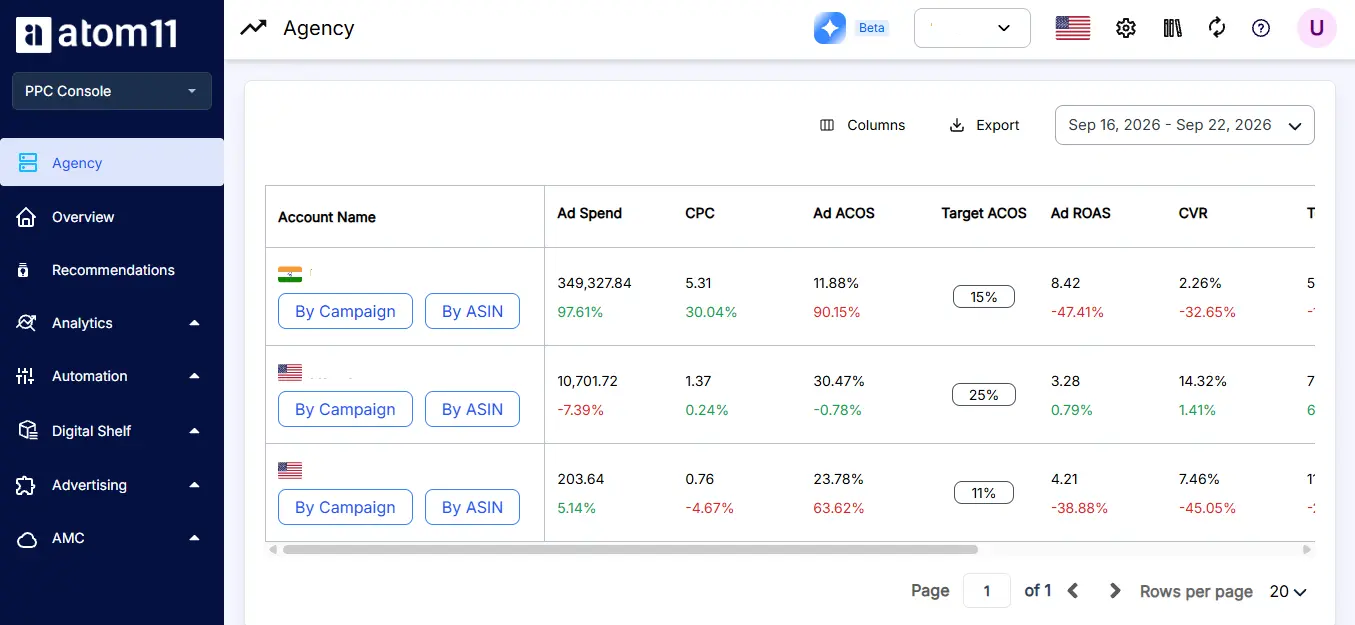
A seller opens one Seller Central login, manages one catalog, and answers to themselves. An agency logs into dozens of separate client accounts, each with its own goals, its own reporting cadence, and its own team member responsible for it. Software built around the assumption of "one account, one owner" simply doesn't map onto that reality. Multi-account PPC management requires every workflow, from bid changes to reporting, to work across many accounts at once, not one at a time.
Multi-Account Control vs. Single-Account Focus
Need | Agencies | Individual sellers |
Account switching | Toggle between dozens of client profiles from one master dashboard | Log into a single store |
Bulk changes | Apply one bid, budget or rule change across every client account at once | Apply changes to one account's campaigns |
Data scope | Cross-account visibility to spot which clients need attention today | Single-catalog performance only |
This is the single biggest reason seller-grade tools break down for agencies: a tool with no concept of "account #7 vs. account #12" forces every bulk action to be redone manually, once per client, which defeats the entire point of automation at agency scale.
White-Label Reporting vs. Standard Analytics
Individual sellers want straightforward, native analytics to check their own ACoS and ROAS the report is for them. Agencies need something different: a report that goes out under their own name, not a third-party software's branding, because that report is a client deliverable and a piece of the agency's own credibility.
Without white-labeling, an agency either builds reports by hand every month the exact manual work automation was supposed to remove or sends clients a report stamped with a tool the client didn't hire.
Team Collaboration and Permissions
Sellers usually manage their own account solo, or with a single VA, so basic login access is enough. Agencies need real permission structures: multiple account managers, copywriters and media buyers working across the same set of accounts safely, without one specialist's mistake showing up on someone else's client.
That means individual seats, not a shared login, and an activity history that shows who changed what and when both because it's operationally necessary and because it's the difference between "we found the issue in ten minutes" and "we're not sure who touched this."
What Happens When Agencies Use Seller-Grade Tools
The failure pattern is consistent, and it's the same one seller-focused software reviewers have flagged for years: poor campaign naming conventions that make no sense once ten client accounts share a workspace, countless campaigns and ad groups with no consistent structure, and no tracking of new-to-brand customer acquisition because the tool was never built to report at a client level.
None of these are software bugs; they're the predictable result of asking single-account software to do a job it was never designed for.
The Margin Problem: Why Flat-Fee Software Beats Percentage Fees at Scale
Average Amazon CPCs have climbed toward the $0.90–$1.10 range, with competitive categories like Beauty running well past $2.40, according to Epinium's reported industry benchmarks. Under a percentage-of-ad-spend pricing model, rising CPCs quietly raise the agency's own software or management cost at the same time client margins shrink, a structural misalignment that doesn't exist with flat-fee software, since the fee doesn't move with spend.
At agency scale, this compounds fast: the same percentage that's tolerable on one account becomes a real line item once it's multiplied across twenty. Atom11's flat pricing is built around this exact problem.
How Many Client Accounts Can One Specialist Actually Manage
Without multi account tooling, a specialist manually running bid changes, reporting, and inventory checks account by account tends to hit a ceiling well before ten accounts, since every recurring task, the weekly bid review, the monthly report, the inventory cross check, has to be repeated in full for each client rather than run once across all of them.
With bulk actions, shared reporting templates, and one AI layer reading across every client's data rather than a specialist digging through separate dashboards per account, the ceiling moves. The same specialist who could reasonably hold six to eight accounts manually can typically hold meaningfully more once the recurring per account work is removed, since what scales badly by hand, one bid change repeated twenty times, one report rebuilt twenty times, is exactly what bulk actions and templated reporting are built to remove.
This reframes the margin argument above too. Account capacity per specialist is itself a cost line, since specialist headcount is usually an agency's largest expense after client acquisition, and software that raises the number of accounts one person can run well has a direct effect on that line, not just on ad spend efficiency. An agency weighing whether agency grade software is worth the switch is really weighing two savings at once, a lower or flatter software cost per account, and fewer specialists needed to hold the same book of clients at the same quality bar.
What to Look for in Agency Amazon PPC Software
True multi-account architecture, not a workaround where each account is a separate login.
White-label reporting with your own branding, not the vendor's.
Per-user seats and activity logs, so specialists can be assigned to accounts and held accountable.
Bulk actions that apply across accounts, not just within one account the same principle behind bulk operations at the single-account level, extended across every client.
Flat or predictable pricing, rather than a percentage that scales against you as CPCs rise.
Retail signals alongside ad data, so a report explains a client's results instead of just listing them.
How Atom11 Is Built for Agencies
Atom11 is built specifically for teams running ten accounts or more, with the goal that automation, analytics and alerting in one place let a specialist hold more accounts without dropping quality on any of them.
Client Reporting Without the Spreadsheet Step
Build a report template once and apply it to every account you manage, instead of rebuilding it client by client. Reports go out on a scheduled cadence rather than whenever someone remembers, at both a campaign level and an ASIN level depending on who's reading it. Inventory, Buy Box status and competitor pricing sit in the same report as spend, instead of a separate file the client has to cross-reference. Data can also be pulled into whatever tools your team already reports from, through MCP.
Bulk Actions Across Every Client Account
This builds on the same multi-account automation discipline every agency needs, applied at the tool level.
Bid, budget and rule edits run in a single pass instead of account by account. That includes bulk campaign creation across many ad groups and ASINs, one rule set applied everywhere it fits rather than rebuilt per client, and bulk ACoS target or spend cap changes in a single action. Cross-account bulk actions apply one change across every client account you manage at once, the exact capability that's missing from seller-grade tools.
Individual Seats and Activity History
Every specialist gets their own login, so activity is attributable to a person instead of a shared account. Specialists can be assigned to specific client accounts so ownership is visible across the team, and an activity history shows who changed what and when. Clients can also get their own sub-account login into their own data.
Neo: One AI Analyst Across Every Client's Data
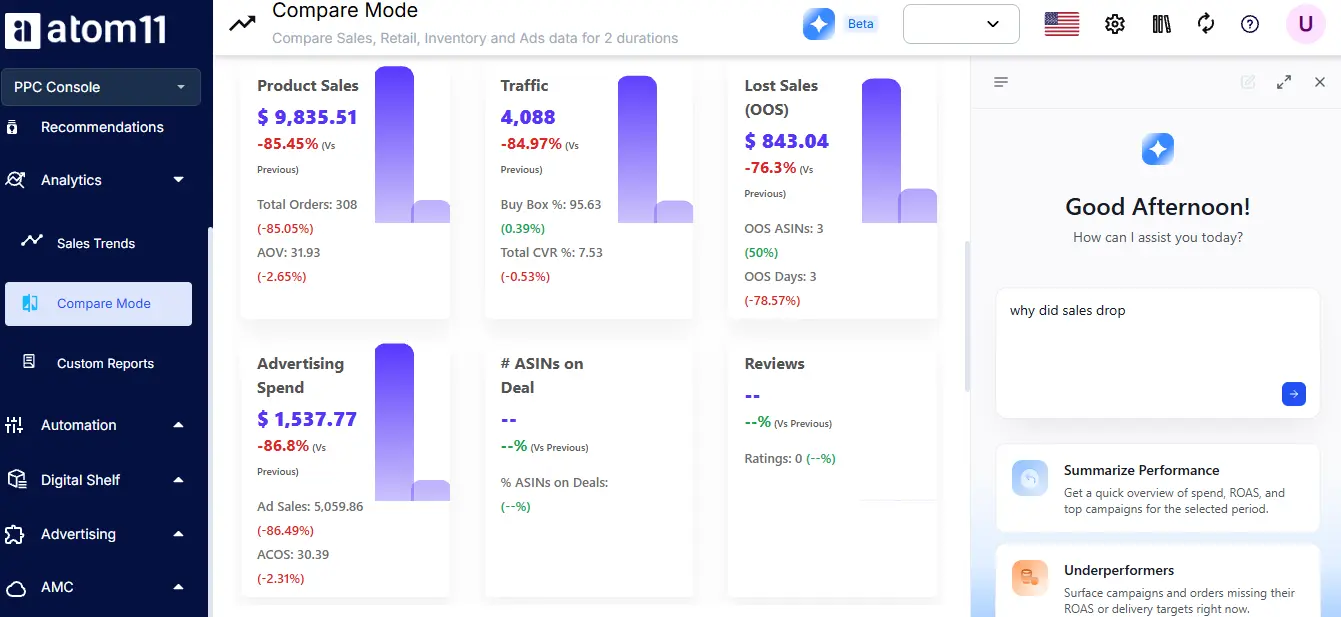
Neo is Atom11's AI analyst, and it's designed to cut data analysis time by 93%, having won the AI Innovation Award at the 2025 Amazon Ads Partner Awards. It reads Sponsored Ads, DSP, Amazon Marketing Cloud and Amazon Marketing Stream data together, so a Buy Box loss, a stockout, a competitor price cut and an organic rank slip four different problems that look identical on an ACoS chart each get correctly diagnosed instead of blurred into one generic "ACoS went up" alert.
Neo works in three modes: Ask answers direct questions from a client's own data, like a root-cause breakdown of a ROAS or sales change.
Consult works backward from a goal, such as how to hit a target ACoS or lift conversion for a specific ASIN group; and Task (coming soon) lets you set up agents that carry out multi-step work on their own, such as reading an inventory report and cutting bids only on the ASINs that are actually low in stock.
For an agency, this matters at a different scale than for a single seller: it's one AI layer a specialist can point at any client's account and get a straight answer from, instead of manually digging through four separate dashboards per client, every time something changes.
Before/After Proof, Ready for Every Client Call
Every automation Atom11 runs keeps a before-and-after performance record, so an agency isn't asking a client to trust a black box. When a bid rule, a dayparting schedule or an inventory-aware pause changes a client's numbers, the record is right there to pull into the renewal conversation instead of reconstructed from memory or a separate spreadsheet.
Version control adds the other half of that trust: bids and budgets can be saved before a major event and rolled back in one click afterward, across every account a specialist manages so if a client asks "what did we change before Prime Day and did it work," the answer is a few clicks away, not a dig through change logs.
For an agency, this is less about any single result and more about what it replaces: the recurring, account-by-account work of manually documenting what changed and why, every time a client asks.
Onboarding Built for Agencies
Connect Seller Central or Vendor Central for each client account, with historical ad and retail data imported automatically rather than starting from zero. A guided setup call gets the first account live with rules running, and support response times are measured in minutes rather than hours or days which matters more, not less, once an agency has many client relationships riding on the same support queue.
Explore Atom11 for agencies or book a demo.
Conclusion
Agencies and individual sellers are running the same kind of campaigns, but at a different structural scale and software built for one rarely survives contact with the other. The tell isn't a missing feature here or there; it's that single-account tools quietly force agencies to redo manually, per client, exactly the work automation was supposed to remove.
If you're evaluating tools, don't start with "can it manage PPC well." Start with "can it manage PPC well across every account we run, with our branding, and with a record of who did what." That's the question seller-grade software was never built to answer. Want to see what agency-built PPC software actually looks like in practice? Book an Atom11 demo.
FAQs
Why can't agencies just use the same PPC software as individual sellers?
Single-account software forces agencies to repeat every action, bid changes, reporting, rule setup once per client, since it has no concept of managing many accounts at once. That erases most of the time savings automation is supposed to provide.
What is multi-account Amazon PPC software?
It's software that lets you manage, monitor and apply changes across several separate Amazon ad accounts from a single dashboard, instead of logging into each one individually and repeating the same work per account.
What is white-label reporting?
White-label reporting means client-facing reports carry the agency's own branding rather than the software vendor's name, so the deliverable looks like the agency's own work product.
How many client accounts justify moving to agency-grade software?
There's no hard cutoff, but the pain typically becomes obvious once an agency is juggling more than five to ten accounts and repeating the same manual steps across each one. Atom11, for example, is built specifically for teams running ten accounts or more.
Is agency PPC software more expensive than seller software?
Not necessarily. Flat-fee agency software can end up cheaper at scale than percentage-of-ad-spend pricing, since a percentage fee rises automatically as CPCs climb, while a flat fee doesn't move with spend.
