Blog
/
Amazon Ads Agent: What It Is and How It Actually Works
Amazon Ads Agent: What It Is and How It Actually Works
Nivesh J.
In November 2025, Amazon quietly changed what "managing your Amazon ads" means. At its annual unBoxed conference, Amazon Ads introduced Ads Agent, a conversational AI built directly into the advertising console that can plan, launch, and adjust campaigns from a plain language prompt instead of a dozen manual clicks. Three months later, Amazon opened a second, related piece of infrastructure, the Ads MCP Server, that lets outside AI tools like Claude, ChatGPT, and Gemini do much the same thing from outside the console entirely.
Amazon Ads Agent is Amazon’s conversational AI for managing advertising campaigns through natural-language instructions. But it is only one part of Amazon’s growing AI advertising ecosystem. This guide explains what Ads Agent does, how it works, and how it differs from MCP Server and Creative Agent.
What Is Amazon Ads Agent?
Ads Agent is a conversational AI assistant built into the Amazon Ads console. Amazon describes it as an always on companion that simplifies how advertisers plan, launch, and optimize campaigns, combining agentic AI with Amazon's own first party shopping data to carry out advertising tasks through natural language rather than manual navigation, according to Amazon's official Ads Agent product page.
The word "agentic" is doing real work here. Amazon draws a line between generative AI, which writes or creates content, and agentic AI, which makes decisions and takes action toward a goal with limited human intervention at each step. Ads Agent sits in the second category. Rather than only answering questions about your account, it proposes campaign structures, targeting, and bulk changes, then waits for your approval before anything goes live.
Ads Agent launched in open beta on November 11, 2025, at Amazon Ads unBoxed, initially available on select pages inside Amazon Marketing Cloud and Multimedia Solutions with Amazon DSP, per Amazon's launch announcement.
What Ads Agent Actually Does
Amazon groups Ads Agent's capabilities into a few core skills:
Campaign creation at scale. Upload a media plan and Ads Agent builds the campaign structure and ad groups for you, or describe a goal in plain language and let it draft the setup.
Bulk optimization. Adjust pacing, budgets, and delivery rates across hundreds of campaigns through a single conversational instruction rather than editing them one at a time.
Intelligent targeting. Ads Agent reviews tens of thousands of Amazon audience segments and surfaces the ones most likely to convert for a given product, which you then review and apply.
AMC integration. Ask a question in plain English, such as which audiences purchased within 14 days of viewing an ad, and Ads Agent writes and runs the Amazon Marketing Cloud SQL query for you, no analyst required.
Amazon's own example prompt from the launch announcement is worth using to see how this actually works under the hood: "pause all campaigns with return on ad spend less than 2." The formula behind that instruction is simple:
ROAS = Attributed sales ÷ Ad spend
A campaign that spent $500 and generated $1,200 in attributed sales has a ROAS of 1,200 divided by 500, which is 2.4. Ads Agent calculates that ratio for every campaign in scope, filters for anything below the threshold you named, and queues those campaigns for pause, pending your review. You are not writing the formula or clicking into each campaign, you are stating the outcome, and the agent runs the underlying math and proposes the action.
Ads Agent vs Creative Agent
Amazon shipped two separate AI agents at the same event, and they are frequently confused because both use a conversational interface.
Ads Agent | Creative Agent | |
|---|---|---|
What it does | Plans, targets, and optimizes campaigns | Generates ad creative, images, video, voiceover |
Lives in | Campaign Manager, Amazon Marketing Cloud, DSP | Creative Studio |
Input | Media plans, natural language prompts | Product pages, brand guidelines |
Output | Campaign structures, audience lists, pacing changes | Video ads, display assets, storyboards |
The two are designed to work together, Full Funnel Campaigns can pull creative that Creative Agent produced directly into a structure that Ads Agent built, but if someone says "I'm using Amazon's AI," it is worth asking which one they mean, since the access requirements and the job each does are different.
Who Can Access It, and What It Costs
Amazon calls Ads Agent free, and in the narrow sense of a license fee that is accurate. Access, however, is gated by two other products, so the practical picture depends heavily on your account type:
Brand registered sellers with Sponsored Ads history can generally reach the Amazon Marketing Cloud natural language query layer and Campaign Manager's guidance cards, which surface click to apply recommendations for bids, budgets, and targeting.
Full campaign creation, bulk pacing across DSP portfolios, and audience optimization for streaming placements require Amazon DSP multimedia access, which in practice means a meaningful DSP spend commitment rather than a Sponsored Products account alone.
So a small seller running Sponsored Products only will see a partial version of Ads Agent, mainly the AMC querying and some Campaign Manager recommendations, while a DSP active brand gets the fuller toolkit Amazon built the feature around. There is no separate subscription fee either way. Normal ad spend, DSP fees, and AMC usage costs still apply.
Ads Agent vs the Amazon Ads MCP Server
This is the distinction most coverage of "amazon ads agent" leaves out, and it is the more consequential one if you use any AI assistant outside Amazon's own console.
Ads Agent lives inside the Amazon Ads console. It is Amazon's tool, running on Amazon's interface, and you interact with it there. Three months after Ads Agent launched, Amazon opened a separate piece of infrastructure called the Ads MCP Server, in open beta from February 2, 2026, built on the Model Context Protocol, an open standard for how AI systems talk to external tools. Where Ads Agent is a built in assistant, the Ads MCP Server is a connection layer that lets any MCP compatible AI agent, including Claude, ChatGPT, and Gemini, connect to Amazon Ads functionality directly, without a custom integration for each tool, according to Amazon's own announcement of the MCP Server open beta.
In practice this means you do not have to be inside the Amazon Ads console to have an AI assistant create campaigns, pull reports, or adjust budgets on your account. You can do it from whichever AI tool you already use day to day, provided that tool has connected through the MCP Server with your account credentials. Amazon has been explicit that this is a deliberate second chapter to Ads Agent, extending agentic capabilities beyond its own console rather than keeping them locked inside it.
The two matter differently depending on your setup. If you only ever work inside Amazon Ads, Ads Agent covers you. If your team already lives inside Claude, ChatGPT, or a similar assistant for other parts of the business, the Ads MCP Server is what lets that same assistant reach into your Amazon Ads account rather than requiring a separate trip to the console.
What Ads Agent Doesn't See
Ads Agent optimizes toward metrics that live inside the ad account: ACoS, ROAS, impressions, reach. It does not have visibility into your landed margin per SKU, your current inventory position, whether you currently hold the buy box, or whether a competitor just cut price in a way that is about to tank your conversion rate.
That gap is structural, not a bug to be patched later. A bid increase that looks efficient against a CPA target is the wrong move if the product it is spending on will be out of stock in five days, or if you lost the buy box yesterday and are now paying for clicks that convert to a competitor's listing instead of yours. Ads Agent has no way to know either of those things, because neither sits inside Amazon's advertising data.
This is the practical argument for keeping a human, or a tool that reads retail data alongside ad data, in the loop for decisions where context outside the ad account matters more than scale inside it.
The New Agent Policy Sellers Need to Know About
Separate from Ads Agent itself, Amazon updated its Business Solutions Agreement with a new Agent Policy, announced February 17, 2026 and effective March 4, 2026. The policy formally defines "Agent" as automated software or AI systems accessing Amazon Services, and requires any such agent to clearly identify itself as automated, comply with the policy continuously, and stop accessing Amazon Services immediately if Amazon requests it, as reported by PPC Land's coverage of the policy update.
This applies broadly, not only to Ads Agent. Any repricer, PPC automation tool, or custom script that touches your Seller Central or Amazon Ads account through automated means falls under it, and continued use of Amazon's selling services after the effective date counts as acceptance of the updated terms. If you run any third party automation alongside Ads Agent, it is worth confirming directly with that vendor that their tool complies.
Atom11 and the MCP Layer Beyond Amazon's Console
Atom11 is a full funnel Amazon PPC platform for sellers, vendors, and agencies, and it illustrates one way the gap described above, ads data without retail context, tends to get closed by third party tools.
Atom11 integrates advertising data with seller central signals, inventory levels, pricing, buy box status, and organic rank, so a bid or budget decision accounts for stock position and competitive standing rather than ad metrics in isolation. Its AI layer, Neo, is built to explain performance changes rather than only adjust bids, comparing ad and retail signals across a time period to surface a root cause for a sales or ACoS swing. Atom11 also offers its own MCP connection, so account data, retail signals, and Neo's underlying logic can be queried directly from Claude, ChatGPT, or Cursor, reading from the live account rather than an export, with access limited to whatever the connected user already has permission to see inside the platform, and revocable at any time from account settings.
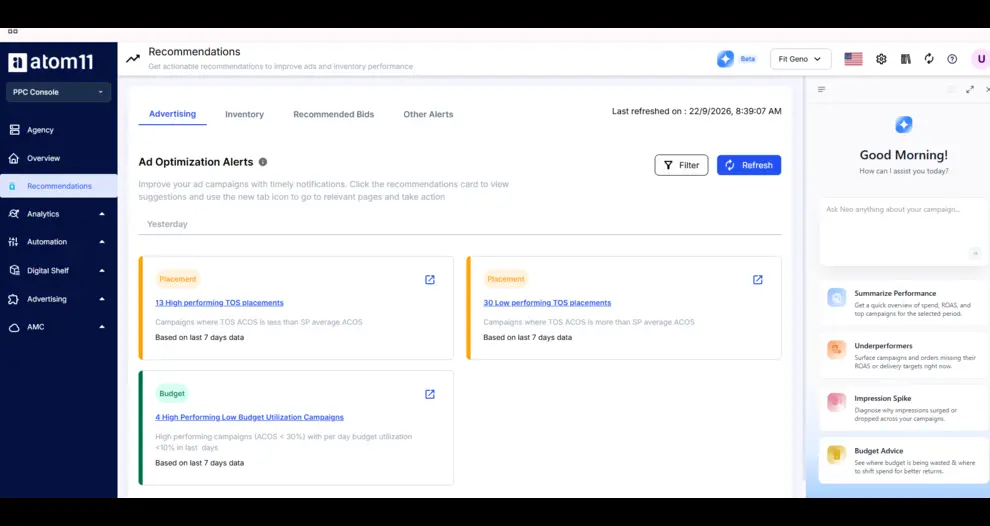
This is not a claim that a retail aware layer replaces Ads Agent, the two solve different problems. Ads Agent is well suited to the tasks that break down at scale inside the ad account itself, audience discovery, bulk pacing, AMC query writing. A platform that also reads inventory, pricing, and buy box data is suited to the decisions where that outside context changes what the right bid actually is. Several vendors in the Amazon PPC space take a similar retail aware approach, and the right combination of native and third party tools depends on how much of your account activity is decided by ad metrics alone versus by what is happening in your warehouse and your buy box.
How to Start Using It Without Losing Control
A few practical guardrails are worth setting before turning on any part of Ads Agent, based on how the beta access tiers and approval flow are structured:
Start with the lowest risk entry point. Querying AMC in natural language carries no execution risk, since it only reads data. Use it to answer questions you have been meaning to ask and never got around to running as SQL.
Treat every proposed bulk action as a draft, not a decision. Ads Agent surfaces a change and asks for approval, it does not execute silently. Read what it proposes and why before approving, especially for pacing or budget shifts across a large number of campaigns at once.
Test on a limited slice of your portfolio first. Apply new targeting or pacing recommendations to a sub set of campaigns rather than your top revenue SKUs, and give it a defined window, such as 30 days, before deciding whether to expand it.
Keep inventory and margin checks outside the workflow. Since Ads Agent cannot see stock levels or landed margin, cross check any bid or budget change it proposes against those numbers separately before approving, particularly during periods of stock volatility.
Conclusion
Amazon Ads Agent is a genuine shift in how campaign management works inside the Amazon Ads console, turning tasks that used to require a PPC manager and a data analyst into a single reviewed conversation. It is not, on its own, the whole picture. The Ads MCP Server extends similar capability to AI assistants outside Amazon's console entirely, Creative Agent handles a separate job around ad creative, and a new Agent Policy now governs every automated tool touching an Amazon account, not just Amazon's own. What Ads Agent optimizes toward, ad account metrics like ACoS and ROAS, is also, by design, what it cannot see beyond: inventory, margin, and buy box status stay outside its view, which is where a retail aware layer, whether that is careful manual oversight or a platform built to read both ad and retail data together, still earns its place.
Book a demo with Atom11 to see how a retail-aware dashboard, Neo's root-cause analysis, and Atom11's own MCP connection fit alongside whatever combination of native and third-party tools you're already running.
FAQs
Is Amazon Ads Agent free to use?
There is no separate license fee. Access is gated instead by Amazon Marketing Cloud eligibility and, for the full campaign creation toolkit, Amazon DSP multimedia access, which in practice requires a meaningful DSP spend commitment. Normal ad spend and platform fees still apply.
What's the difference between Ads Agent and Amazon's automatic campaigns?
Automatic campaigns let Amazon's algorithm choose keywords and ASINs inside a single campaign. Ads Agent works a level above that, building campaign structures, recommending audiences, adjusting pacing across a portfolio, and writing AMC queries. The two are complementary rather than substitutes.
Does Ads Agent set bids automatically without approval?
No. Every proposed change, whether a bid adjustment, pacing shift, or budget reallocation, is surfaced for review before it executes. Ads Agent proposes the action and the reasoning behind it, and a human approves or rejects it.
What is the Amazon Ads MCP Server and how is it different from Ads Agent?
Ads Agent is Amazon's built in assistant inside the Amazon Ads console. The Ads MCP Server, opened in beta on February 2, 2026, is separate infrastructure that lets outside AI tools such as Claude, ChatGPT, or Gemini connect to Amazon Ads functionality directly, without needing to work inside Amazon's own interface.
Do I need a third party tool if I already use Ads Agent?
It depends on what decisions you need to make. Ads Agent handles tasks that break down at scale inside the ad account, such as bulk pacing and audience discovery. It has no visibility into inventory, margin, or buy box status, so if those factors regularly affect your bidding decisions, a retail aware platform or careful manual oversight still has a role alongside it.
