Blog
/
Amazon Ads Full Funnel Campaigns: What They Are and How to Run Them
Amazon Ads Full Funnel Campaigns: What They Are and How to Run Them
Deepika Thakur
Key Takeaways
Amazon Ads full funnel campaigns combine Sponsored Products, Sponsored Brands, Sponsored Display and DSP to reach shoppers at every stage, not just the moment they search.
The same phrase also names a newer, specific thing: Amazon's AI-powered Full Funnel Campaigns feature, announced at unBoxed 2025 and still rolling out. This guide covers both, clearly separated.
Upper-funnel ads carry lower ROAS by design. They build the brand recognition that makes lower-funnel ads convert better later.
Budget splits shift with brand maturity: new brands should weight conversion heavily, established brands can push more into awareness and consideration.
Amazon Marketing Cloud is the layer that ties spend across ad types back to a single customer journey, so you can see whether the strategy is actually working.
Atom11 runs Sponsored Ads and DSP from one dashboard, so you can manage and measure a full-funnel strategy without stitching together two separate tools.
If you only run Sponsored Products on exact-match keywords, you're capturing demand, not creating it. Amazon Ads full funnel campaigns reach shoppers before they search, while they compare, and at the moment they buy. This guide explains what that means today, including a new AI feature that shares the exact same name.
What Is a Full Funnel Campaign on Amazon?
Amazon Ads full funnel campaigns combine multiple Amazon ad types to reach shoppers across the entire path to purchase, rather than only when they type a search term.
Modern consumers interact with a brand through 20 or more touchpoints before buying, and most consumers see at least one irrelevant ad every day, so meeting shoppers only at the bottom of the funnel means missing most of that journey.
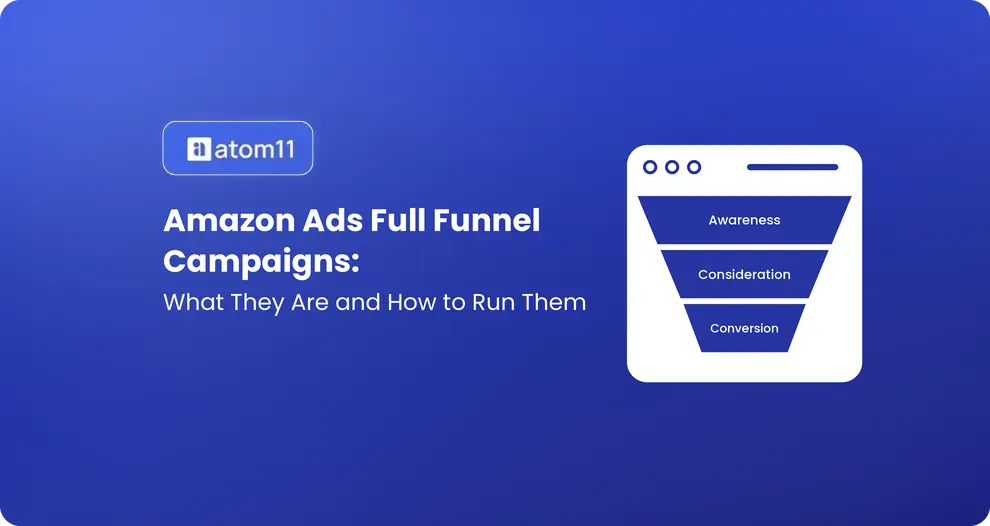
The Three Funnel Stages: Awareness, Consideration, Conversion
Awareness ads reach people who aren't searching yet. They're shown based on interests, life events or browsing behavior.
Consideration ads reach people who are shopping in your category but don't know your brand exists yet.
Conversion ads reach people who've typed a specific, high-intent search and are ready to buy. Most advertisers over-invest in the last stage and skip the first two, which works until competitors show up, costs-per-click rise, and there's no brand recognition to fall back on.
Amazon's New "Full Funnel Campaigns" AI Feature
Separate from the strategy above, Amazon announced a specific product also called Full Funnel Campaigns at its unBoxed 2025 event in November 2025. It's a single campaign type meant to unify Sponsored Products, Sponsored Brands, Sponsored Display and streaming TV under one AI-managed plan.
What Ads Agent Does
The feature runs on Ads Agent, Amazon's AI tool that plans, launches and optimizes DSP and Sponsored Ads campaigns by automating targeting, media planning and data analysis. Amazon's SVP of Ads, Paul Kotas, described full-funnel campaigns as the simplest way to grow brand awareness, attract new customers and drive conversions, powered by combining Amazon's ad supply and signals with AI.
Availability and What's Still Unclear
As of this writing, rollout is US-first, with international markets expected to follow through 2026. Some reports describe the feature as newly live inside the Ads console for a subset of advertisers, while others still describe it as in progress. If you don't see it in your account yet, that's expected. Check your own Ads console or your Amazon Ads rep for current availability rather than assuming from any single article, including this one.
Why Run a Full-Funnel Strategy?
Advertisers running Amazon Ads full funnel campaigns reportedly see meaningfully better results than sellers who only run Sponsored Products or Sponsored Brands. According to figures Amazon has shared, full-funnel advertisers see about 21% more new-to-brand sales, and roughly 8% higher month-over-month sales growth. Detail page views can rise around 250% and add-to-cart actions about 200% when upper- and mid-funnel ads run alongside lower-funnel ones. Full-funnel advertisers have also been reported to see about 190% more ad-attributed Subscribe & Save enrollment, a sign the approach helps with repeat purchases, not just first sales.
Which Ad Type Fits Each Funnel Stage
Stage | Ad types | Goal | Typical ROAS expectation |
Awareness | Sponsored Display (life events, interests, in-market audiences), DSP link-out | Introduce the brand to people not yet searching | Low; this is brand building, not direct response |
Consideration | SD and SP category targeting, SB category targeting, broad keywords | Get in front of shoppers already browsing your category | Moderate and variable |
Conversion | Exact-match keywords, product targeting on competitor pages, remarketing | Close the sale with high-intent shoppers | Highest; this is where most budget still belongs |
Product targeting on competitor detail pages deserves a special mention: it puts your ad in front of a shopper your competitor already worked to attract, often at a lower CPC than search placements.
How to Build Amazon Ads Full Funnel Campaigns
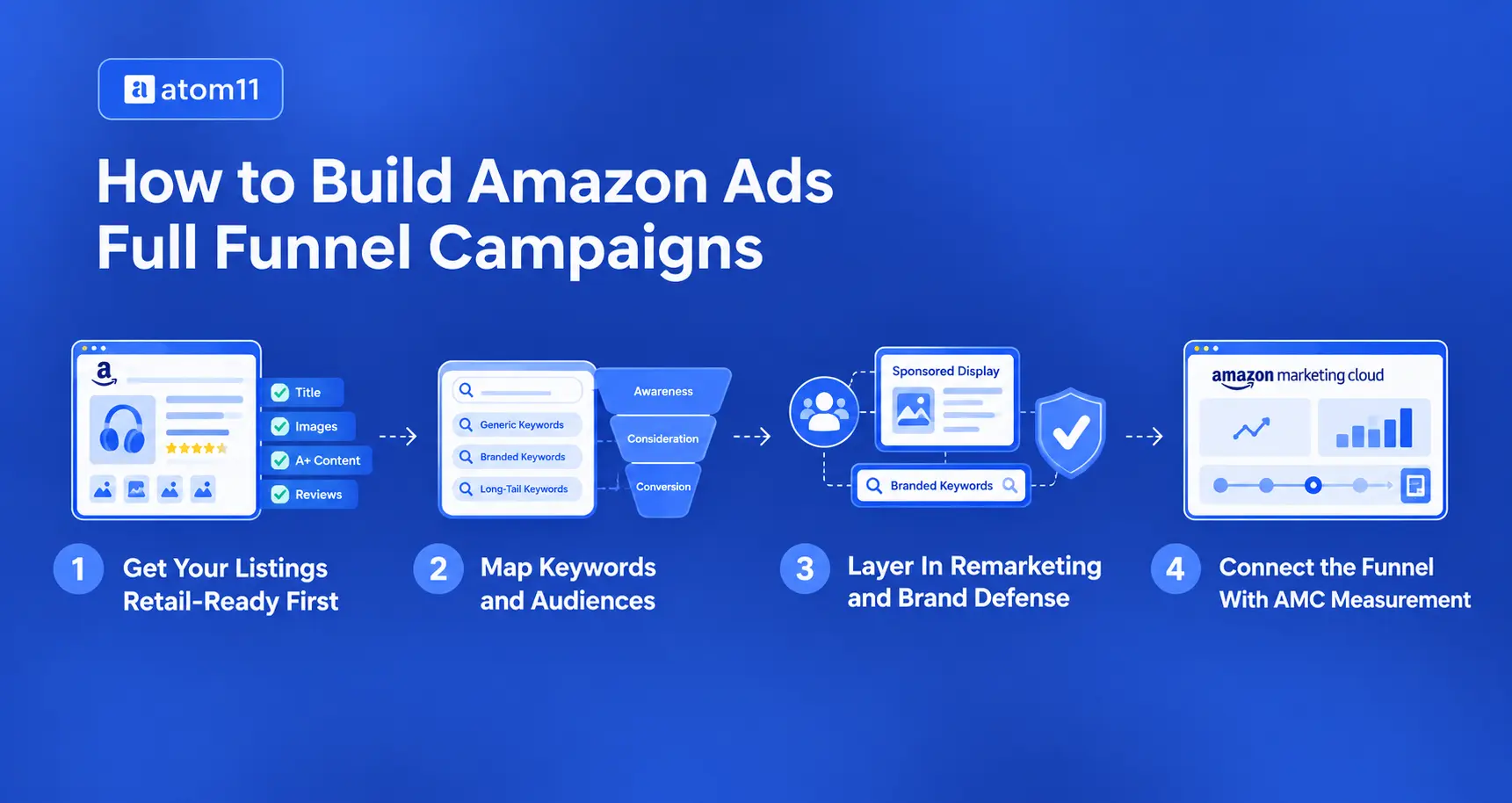
1. Get Your Listings Retail-Ready First
Upper-funnel ads send unfamiliar shoppers to your listing. If the title, images, A+ content and reviews aren't strong, you're paying to send new visitors to a page that won't convert them.
2. Map Keywords and Audiences to Each Stage
Pull your search term report and reverse-ASIN research from competitors. Map broad, generic terms to awareness and consideration. Map branded and long-tail, high-converting terms to conversion. The same keyword list can serve every stage; the match type and placement change what it does.
New brands should still weight conversion heavily. As recognition builds, shift more budget upward, that's what compounds into a lower ACOS and better organic rank over time.
3. Layer In Remarketing and Brand Defense
Shoppers who viewed but didn't buy, and past customers who might buy again, are the most underused audience on Amazon. Customers are roughly nine times more likely to buy from a brand they've already purchased from. Pair that with brand defense: run branded keyword campaigns and target your own ASINs with Sponsored Display so a competitor can't sit on your own product page or branded search term.
4. Connect the Funnel With AMC Measurement
Amazon Marketing Cloud is what turns "we ran ads at every stage" into "here's what each stage actually contributed." AMC combines event-level data across ad types so you can see path-to-conversion, which upper-funnel messages drove mid-funnel engagement, and where a shopper actually entered your funnel. Without it, you're running a full-funnel strategy on faith.
Common Full-Funnel Mistakes to Avoid
Judging upper-funnel ads by ROAS alone. They're not supposed to convert at the same rate as exact-match keywords; judge them by their effect on downstream conversion and NTB sales instead.
Skipping brand defense. Winning new customers upper-funnel while losing branded search to a competitor cancels out the gain.
Mapping keywords once and never revisiting them. Search terms migrate between funnel stages as a brand's recognition grows.
Treating the new Full Funnel Campaigns AI feature as the whole strategy. It's one path to execute full-funnel advertising, not a replacement for understanding the three stages yourself.
How Atom11 Supports Full-Funnel Amazon Advertising
Running Amazon Ads full funnel campaigns means managing Sponsored Ads and DSP together. Most tools force you into two separate places to do it. Atom11 runs both from one dashboard.
Bulk DSP Campaign Setup
Atom11 gives you 15,000+ pre-built audiences, built on Amazon's first-party shopper data. You can also build and save custom Amazon Marketing Cloud audiences for more precise upper-funnel targeting.
Bulk-create orders and line items instead of building each one by hand. Apply targeting and budgets across all of them at once, then set frequency caps and cross-order pacing toward a single monthly target.
Unified Reporting Across the Funnel
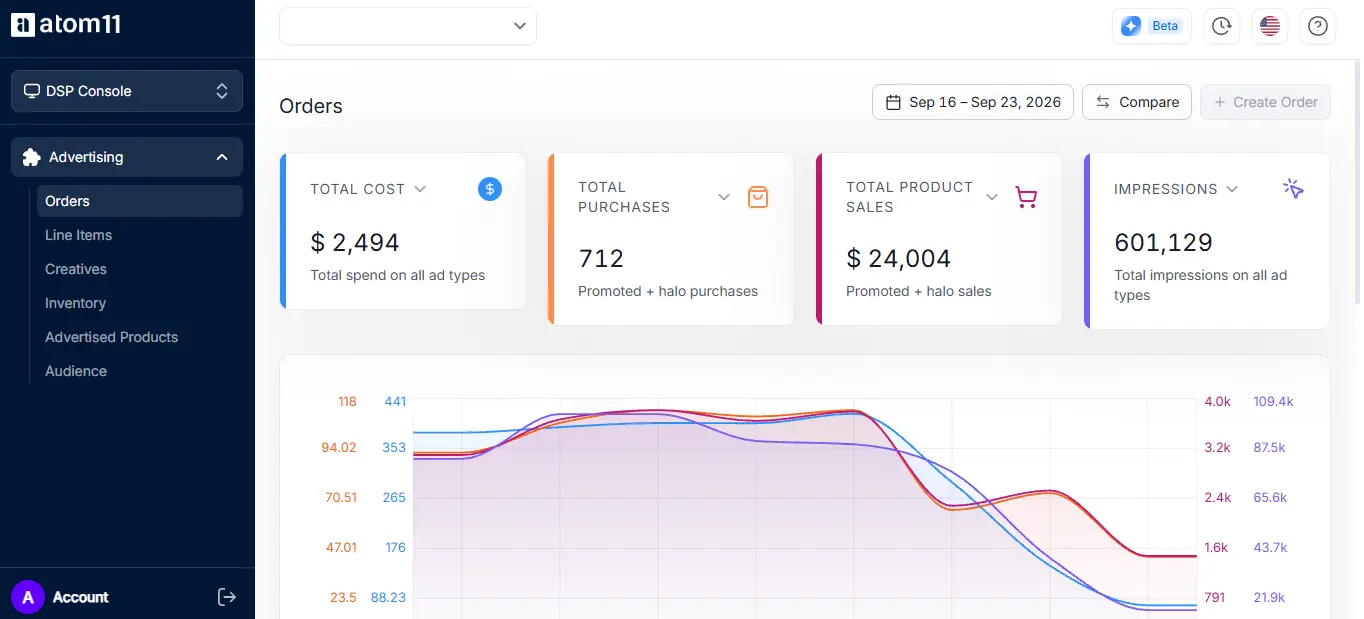
DSP and Sponsored Ads reporting live in the same dashboard, with promoted, halo and combined metrics in one view. You can see how upper-funnel DSP activity connects to lower-funnel Sponsored Products performance, instead of reconciling two exports by hand.
Root Cause Analyzer
When performance shifts, the Root Cause Analyzer flags which metrics actually moved and which didn't. If sales drop, it can show you that ad spend and organic page views fell while everything else held steady — so you're not scanning ten reports to find the one that matters.
Compare Mode
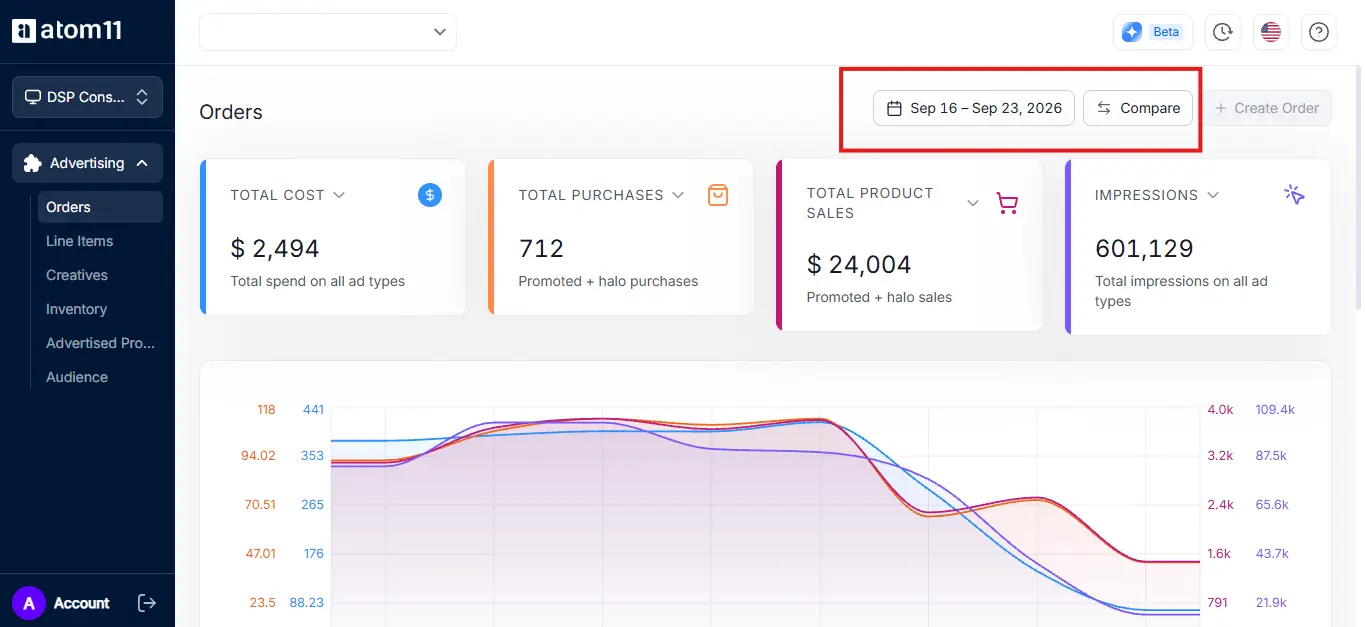
Set two time periods and get a detailed, ASIN-level comparison. Useful for checking whether a funnel-stage budget shift actually moved the numbers, or comparing this year's Prime Day to last year's.
Ask Neo
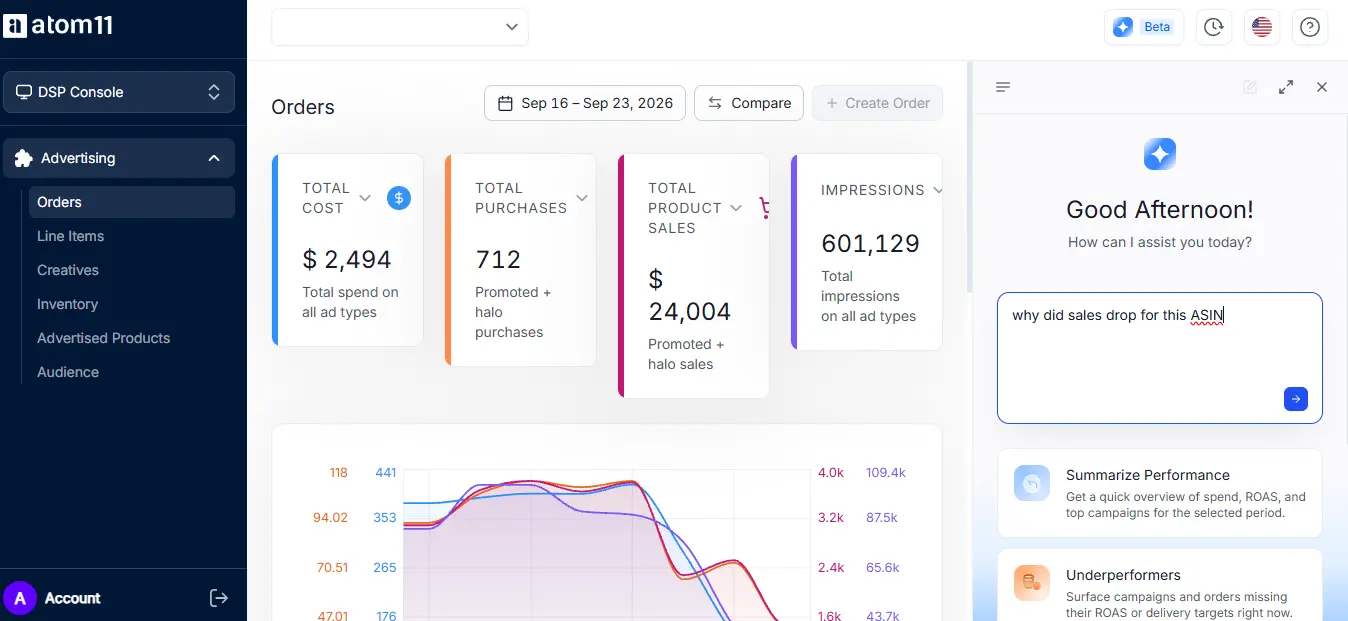
Neo is Atom11's AI copilot. Ask a plain-language question like "why did sales drop for this ASIN" and get an answer in seconds, across both ads and retail data, instead of pulling reports yourself.
Built for Agencies and Multi-Account Teams
Agencies running full-funnel programs for multiple clients manage it all from one login. More than 2,000 brands and agencies in 18+ countries run their Amazon advertising on Atom11.
A Full-Funnel Workflow Example
Here's how the pieces fit together for a brand running a Prime Day push:
Awareness: Bulk-create Sponsored Display and DSP orders targeting in-market and lookalike audiences, using Atom11's pre-built audience library.
Consideration: Build a custom AMC audience of shoppers who viewed a detail page but didn't purchase, and target them with Sponsored Display retargeting.
Conversion: Run Sponsored Products on exact-match, high-intent keywords, with bids set from the weekly search term report.
Monitor: Use Compare Mode to check this week's funnel performance against last week's, and let the Root Cause Analyzer flag any unexpected drop before it becomes a bigger problem.
Ask: If something looks off, ask Neo why — instead of opening three separate reports to find out.
Protect: Save a version of all bids and budgets before Prime Day, then roll back to it the moment the event ends.
Conclusion
Using Sponsored Products, Sponsored Brands, Sponsored Display and DSP together helps reach shoppers at every stage of the path to purchase.
Amazon also has a new, AI-powered Full Funnel Campaigns product, powered by Ads Agent, still rolling out through 2026.
The expected upside is more new-to-brand sales, higher month-over-month growth, and better repeat-purchase behavior, based on figures Amazon has shared. Budget is typically conversion-heavy for new brands, shifting toward awareness and consideration as a brand matures.
AMC ties it together by showing what each funnel stage is actually contributing.
The mistake most sellers make isn't ignoring the top of the funnel. It's judging it by the wrong number. An upper-funnel campaign with a 130% ACOS isn't failing; it's doing a different job than a bottom-funnel exact-match campaign.
The practical fix is to separate measurement by stage before you separate budget by stage. Track new-to-brand sales, detail page views and repeat-purchase rate for upper-funnel spend, and track ACOS and direct conversions for lower-funnel spend.
Once those numbers live in different columns, the budget conversation gets a lot easier, and a lot less emotional.
Ready to run Sponsored Ads and DSP from one place? Book an Atom11 demo.
FAQs
What is a full-funnel Amazon advertising strategy?
A full-fledged Amazon advertising strategy combines multiple ad types, such as Sponsored Products, Sponsored Brands, Sponsored Display and DSP, to reach shoppers at every stage of their path to purchase, not just when they search with high intent.
What's the difference between full-funnel strategy and Amazon's new Full Funnel Campaigns feature?
The strategy is a general approach any advertiser can build manually. Amazon's Full Funnel Campaigns feature is a specific, newer AI-powered campaign type announced in late 2025 that automates planning and optimization across ad types using Ads Agent. You can run a full-funnel strategy without ever using the new feature
Which Amazon ad types cover the awareness stage?
Sponsored Display audiences built on life events, interests and in-market behavior cover awareness, along with DSP link-out campaigns that can drive traffic to your website or other off-Amazon properties.
How much budget should go to upper-funnel ads?
New brands typically put 5–10% of budget into upper-funnel ads, rising to 15–20% for established brands. The rest is split between consideration and conversion, with conversion still getting the largest share even for mature brands.
Do upper-funnel ads hurt my ACOS?
Yes, and that's expected. Upper-funnel ads are shown to people who aren't actively searching, so they convert at a lower rate than exact-match keyword ads. Judge them by new-to-brand sales and downstream conversion lift instead of ACOS alone.
