Blog
/
Amazon DSP Best Practices: A Practical Playbook for Brands and Agencies (2026)
Amazon DSP Best Practices: A Practical Playbook for Brands and Agencies (2026)
Nivesh J.

Amazon DSP best practices come down to five disciplines: one clear objective per order, clean audience segmentation with exclusions, frequency caps sized to the audience, creative matched to funnel stage, and patient measurement that respects the 14 day conversion window. Get those right and the platform's algorithms do most of the heavy lifting. Get them wrong and DSP turns into an expensive impression buying exercise.
Amazon DSP is Amazon's programmatic advertising platform. It lets brands buy display, video, audio and streaming TV ads on Amazon owned properties (Amazon.com, Prime Video, Fire TV, Twitch) and on third party sites and apps, targeted with Amazon's first party shopping signals. If you are new to the platform, start with our primer on how the Amazon demand side platform works.
The stakes keep rising. Amazon's ad business passed $68 billion in revenue in 2025, with Q4 alone reaching $21.3 billion, up 22% year over year, and the company credits its full funnel strategy for a large share of that growth. More advertisers in the same auctions means sloppy DSP setups get punished faster.
This guide goes beyond the usual checklist. You will find the formulas we use to size budgets, set frequency caps and judge incrementality, plus worked examples you can copy.
Key Takeaways
Set one goal and one KPI per order, then enable Amazon's automated optimization for that goal.
Separate prospecting, consideration and remarketing into different ad groups (formerly line items), with exclusions so they never compete for the same shopper.
Size remarketing budgets to the audience, not to your wish list. Small audiences cannot absorb big budgets without overexposure.
Wait 5 to 7 days before the first optimization on campaigns running a month or longer, and 1 to 2 weeks before judging conversion data.
Measure DSP with Totals metrics, new to brand sales and incrementality, not with last click ROAS alone.
Check retail readiness (stock, Buy Box, reviews) before you spend a dollar sending shoppers to a detail page.
Before You Launch: Is Your Brand Ready for Amazon DSP?
DSP amplifies whatever is already on your product detail page. If the page converts poorly, DSP simply pays to show more people a page that does not sell.
Retail Readiness Checklist
Reviews and rating: Amazon's own creative guidance suggests aiming for at least a 3.5 star rating with 15 or more positive reviews before advertising a product.
Inventory depth: You need enough stock to survive the traffic you are buying (see the days of cover formula below).
Buy Box ownership: Retargeting a shopper to a listing where a reseller holds the Buy Box sends your ad dollars to someone else's sale.
Detail page quality: Title, images, A+ content and video should already be converting well from Sponsored Products traffic.
Sponsored Ads foundation: Most brands get better results when DSP is layered on top of profitable Sponsored Products and Sponsored Brands, because DSP creates demand that search ads then capture.
Formula: Break even ROAS
Know your floor before you set any target.
Break even ROAS = 1 ÷ Profit margin %
Example: A product sells for $40. After cost of goods, referral fees, FBA fees and returns, you keep $14 before advertising. Contribution margin is 14 ÷ 40 = 35%. Break even ROAS is 1 ÷ 0.35 = 2.86, which is the same as a break even ACOS of 35%.
Remarketing ad groups should clear this number. Prospecting ad groups usually will not on a last touch basis, which is why they need different KPIs (covered in the measurement section).
Formula: Days of inventory cover
Days of cover = Units available ÷ Average daily units sold
Example: You have 900 units and sell 45 a day. Days of cover is 20. If your replenishment lead time is 30 days, you are already heading for a stockout, and pushing DSP traffic now will accelerate it. Throttle remarketing and pause prospecting for that ASIN until the inbound shipment lands.
This is one of the most overlooked Amazon DSP best practices. Most guides treat DSP purely as a media problem. In practice, the fastest way to waste DSP budget is to drive shoppers to an ASIN that is out of stock, suppressed, or losing the Buy Box.
How to Access Amazon DSP (and Which Route Fits You)
The route you choose shapes what you can control and what data you can see.
Access route | Best for | What to watch |
Amazon managed service | Large brands that want Amazon's team to run campaigns | Highest spend commitments; less hands on control |
Self service seat (your own account) | Brands and agencies with in house programmatic skill | Needs trained operators; you get full control and seat level AMC access |
Agency seat | Brands that want expertise without their own seat | Ask for read access to your own advertiser data |
Technology partner | Teams that want tooling plus DSP access | Fee models vary, often a percentage of spend |
Entry thresholds have come down over the past two years, but they change often and vary by route, so confirm current terms with Amazon or your partner before you plan your budget.
One practical point on data: Amazon Marketing Cloud (AMC) instances sit at the seat level. If you run inside someone else's seat, you usually cannot get full AMC access without the seat holder exposing other advertisers. If AMC driven audiences and path to purchase analysis matter to you, factor that into the route decision.
Amazon DSP Campaign Structure Best Practices
A clean structure makes every later decision easier: reporting, budget shifts, exclusions and handoffs between team members.
Use one objective per order
When you create an order, Amazon asks you to choose a goal and KPI. Amazon recommends enabling all available automated optimization for that goal. This only works if the order has a single job. Mixing awareness and conversion tactics in one order confuses the optimizer and your reporting.
Funnel stage | Typical tactics | Primary KPI | Secondary KPI |
Awareness | Streaming TV, online video, lifestyle audiences | Reach, viewable impressions, video completion rate | Branded search lift, new to brand |
Consideration | Display and video to in market and contextual audiences | Detail page view rate, CTR | Cost per detail page view |
Conversion | Remarketing with responsive ecommerce creative | ROAS, CPA | New to brand %, Totals ROAS |
Loyalty | Past purchaser cross sell and replenishment | Repeat purchase rate, ROAS | Subscribe and Save signups |
Build ad groups around one audience and one supply type
Amazon now calls line items "ad groups" and creatives "ads". Each ad group should isolate one audience, one supply source and one creative family. That way, when an ad group underperforms, you know exactly what to change.
Adopt a naming convention your whole team can read
Agencies managing many advertisers lose hours every week decoding vague names. Use a fixed pattern such as:
Brand_Market_Stage_Tactic_Audience_Lookback_Supply_Creative
Example: Acme_US_CONV_REM_ViewedNotPurchased_L30_AmazonOO_REC
That single name tells anyone the order is a US conversion remarketing ad group, targeting shoppers who viewed but did not buy in the last 30 days, running on Amazon owned supply with responsive ecommerce creative. Our guide to Amazon campaign naming conventions covers the Sponsored Ads side of this.
Formula: How many ad groups can your budget support?
Over segmentation is the most common structural mistake. Each ad group needs enough conversions to learn.
Maximum ad groups = Monthly budget ÷ (Target CPA × Conversions needed per ad group per week × 4.3)
Example: Monthly budget is $6,000, target CPA is $25, and you want at least 10 conversions per ad group per week to read results. $6,000 ÷ ($25 × 10 × 4.3) = 5.6. Run five conversion ad groups, not fifteen. Consolidate first, then split winners once you have data.
Audience Targeting Best Practices with Examples in Amazon DSP
Audiences are DSP's real advantage over open web platforms, because they are built from actual shopping, browsing and streaming behavior.
Start broad enough to learn, then refine
Begin with Amazon's prebuilt in market and lifestyle audiences for prospecting, and product view and purchase audiences for remarketing. Narrow into sub segments only after you have performance signals. Starting too narrow starves the algorithm.
Layer audiences for intent, not for vanity
Layering (for example, in market for your category plus Prime members plus past purchasers of a complementary category) can raise conversion rates, but every layer shrinks reach. Check the estimated audience size after each layer. If it drops below what your budget needs to deliver (see the spend ceiling formula below), remove a layer.
Use exclusions so your own ad groups do not compete
Audience overlap drives up CPMs because your own ad groups bid against each other. A simple exclusion matrix prevents it:
Ad group | Include | Exclude |
Prospecting | In market, lifestyle, lookalike | Brand viewers L30, brand purchasers L180 |
Consideration | Category and competitor viewers | Brand purchasers L30 |
Remarketing | Brand product viewers L30 | Brand purchasers L14 |
Loyalty and replenishment | Brand purchasers L90 to L365 | Purchasers of the same ASIN inside its natural reorder cycle |
Adjust the lookback windows to your category. A product people buy monthly needs a different purchaser exclusion than a product people buy once every two years.
Build smarter segments in AMC
AMC lets you create audiences you cannot build in the standard console, such as shoppers who were exposed to your streaming TV ads but never viewed a detail page, or high value customers who bought twice. These can be pushed into DSP for activation. Here is how to build AMC custom audiences step by step.
Formula: Remarketing spend ceiling
Remarketing pools are finite. Put too much money against a small audience and the system either underdelivers or hammers the same people.
Maximum daily spend ≈ Audience size × Share reachable per day × Daily frequency cap × CPM ÷ 1,000
Example: Your "viewed not purchased, last 30 days" audience holds 60,000 shoppers. Roughly half are online and reachable on a given day. Your cap is 3 impressions per day and your CPM is about $6.
60,000 × 0.5 × 3 × $6 ÷ 1,000 = $540 per day
If you assign $1,500 a day to this ad group, the extra budget has nowhere productive to go. Move it to prospecting, which is what refills the remarketing pool in the first place.
Amazon DSP Frequency Capping Best Practices
Frequency caps control how often one shopper sees your ads. Too low and you never build recall. Too high and you pay for impressions that no longer change behavior.
Set caps at both the order and ad group level
The order level cap protects the whole campaign from overexposure. Ad group caps let you give remarketing more room than prospecting.
Starting points (then calibrate with data)
Ad group type | Suggested starting cap |
Prospecting display | 1 to 2 per day, 5 to 7 per week |
Streaming TV and online video | 3 to 4 per week per household |
Remarketing | 3 per day |
Loyalty and cross sell | 1 per day |
These are starting points, not rules. Your category, price point and purchase cycle will move them.
Formula: Find your real frequency ceiling with AMC
AMC can break down reach and purchases by how many times each user saw your ads. Use it to calculate the marginal cost of each extra exposure.
Marginal CPA at frequency n = Additional spend to reach frequency n ÷ Additional purchases gained at frequency n
Example:
Exposures | Users | Purchase rate | Purchases | Marginal CPA |
1 to 2 | 100,000 | 0.8% | 800 | $12 |
3 to 5 | 60,000 | 1.4% | 840 | $18 |
6 to 9 | 30,000 | 1.6% | 480 | $41 |
10+ | 12,000 | 1.7% | 204 | $95 |
If your target CPA is $30, returns collapse somewhere between 6 and 9 exposures. A weekly cap of around 5 to 6 captures most of the value and frees up budget for new shoppers.
Rotate creative as frequency rises
Frequency and creative fatigue are linked. When a shopper sees the same banner for the tenth time, a fresh message (a review callout instead of a feature callout, for example) extends the useful life of that audience.
Bidding and Budget Best Practices
Let automation run, but set guardrails
Amazon's bidding and budget optimization works best when you give it a clear KPI, realistic base and max bids, and enough time. From Amazon's DSP optimization guidance:
Activate budget optimization so the system can move remaining budget into the best performing ad groups.
If you manage budgets manually, move money to strong ad groups only when their delivery rate is above 95%.
To fix underdelivery, raise the maximum average CPM in increments of $0.50 to $1.00, add ad sizes, or loosen viewability tiers.
Avoid large budget increases near a campaign's end date. Add no more than 10% incremental budget at first and scale gradually only if performance holds.
Use bid adjustments for the value the model cannot see
Bid adjustments above 1 tell the system certain impressions are worth more than it predicts. Values between 0 and 1 tell it they are worth less. Amazon notes that the relative scale matters more than extreme values, and that a 0 adjustment does not fully exclude those impressions.
Example: If your AMC analysis shows Fire TV viewers convert at twice the rate of the average for your remarketing audience, a bid adjustment of 1.3 to 1.5 on that device type is a reasonable test. Going straight to 3.0 usually just inflates CPM.
Split budget by funnel stage and brand maturity
There is no universal split, but this framework gives you a defensible starting point:
Brand stage | Remarketing | Prospecting and consideration | Awareness and testing |
New to DSP | 60% | 30% | 10% |
Growing | 40% | 40% | 20% |
Established category leader | 25% | 45% | 30% |
As remarketing pools hit their spend ceiling, the extra budget should flow up the funnel. For a deeper look at how streaming fits in, see our guide to ads on Prime Video.
Creative Best Practices
Creative is where most accounts leave easy wins on the table. Amazon's creative guidelines for DSP set the baseline.
Match the message to the funnel stage
Awareness: Educational content that shows product benefits in context.
Consideration: One strong benefit or competitive advantage and a clear call to action.
Conversion: Offers, savings and responsive ecommerce creative (REC) or dynamic ecommerce ads that pull price, rating and Prime eligibility automatically.
Give the system enough sizes and variations
Upload the standard display sizes (300x250, 320x50, 728x90, 160x600, 300x600, 970x250) so the ads can serve across more supply. Amazon notes that mobile ad groups often lead on CTR, with 320x50 and 300x250 performing best in mobile app inventory. Isolating high impact sizes such as 300x600 or 970x250 into their own ad groups can help optimization.
Design video for sound off viewing
Many placements autoplay muted. Put your logo and the product in the first three seconds, use on screen captions, and never rely on voiceover alone to carry the message.
Avoid the most common rejection reasons
Amazon's list of top rejections includes a landing page that does not match the ad, a missing or vague CTA, no border on light background creative, poor image quality, illegible text, and animation longer than 15 seconds. Prime Day branding is also not permitted in creatives. A one pixel border on white backgrounds and a clear CTA fix most of these before they happen.
Formula: Plan your creative refresh cycle
Rather than refreshing on a fixed calendar, watch for fatigue.
Refresh trigger = CTR this week ÷ CTR in the first two weeks of the creative's life
When this ratio falls below roughly 0.7 (a 30% drop from launch CTR) while frequency is stable, rotate in a new variation. Large accounts often hit this every 2 to 4 weeks. Smaller audiences fatigue faster.
Optimization Timing and Cadence for Amazon DSP Campaigns
Changing things too early is as damaging as never changing them. The algorithm needs data, and Amazon's reporting needs time to settle.
According to Amazon's own optimization guidance:
For flights of one month or longer, make the first round of optimizations 5 to 7 days after launch.
For flights of one week or less, make the first changes 2 to 3 days after launch.
Give each performance change 4 to 7 days before making another.
Wait at least 24 to 48 hours to measure the impact of any change, since the console data refreshes only 2 to 3 times a day.
Amazon also advises waiting 1 to 2 weeks for modeled conversion rates to stabilize before adjusting campaigns, because conversions are attributed over a 14 day lookback window and reported numbers shift during that period.
A 30 day launch and optimization plan
Day | What to do | What not to do |
0 | Launch with goal, KPI, caps, exclusions and all ad sizes in place | Launch with a single creative size |
2 to 3 | Check delivery and pacing only; fix underdelivery with CPM, sizes or supply | Judge ROAS |
7 | First performance review: CTR, detail page view rate, early CPA by ad group | Pause ad groups with fewer than a handful of conversions |
10 to 14 | Remove weak supply and segments; shift budget to strong ad groups | Make several changes to the same ad group at once |
14 to 21 | Read modeled conversions and Totals ROAS; review frequency in AMC | Scale budgets by more than 20% to 30% in one step |
21 to 30 | Refresh fatigued creative, test new top segments from the audience segmentation report | Rebuild the structure from scratch |
Amazon DSP Measurement and Attribution Best Practices for Brands and Agencies
DSP measurement fails when teams hold every ad group to the same last click ROAS target. Upper funnel ads create demand that often converts later through a branded search or a Sponsored Products click.
Use Totals metrics, not only promoted metrics
Amazon recommends Totals metrics as the best measure for reporting and optimization, because they capture the full value delivered by your brand's advertising, including halo sales of products you did not directly promote. Add every relevant ASIN to the order so all related sales show up.
Track new to brand and blended efficiency
New to brand sales show whether DSP is actually expanding your customer base. Pair that with account level efficiency:
TACOS = Total ad spend ÷ Total sales (ad attributed plus organic)
If DSP is working, TACOS should hold steady or fall over a quarter even when DSP's own last touch ROAS looks modest. Here is more on how to use TACOS alongside ACOS.
Formula: Incremental ROAS
Attributed ROAS tells you what DSP touched. Incremental ROAS tells you what DSP caused.
iROAS = (Conversion rate of exposed group minus Conversion rate of holdout group) × Exposed users × Average order value ÷ Ad spend
Example: 200,000 exposed shoppers convert at 1.2%. A matched holdout group converts at 0.8%. Average order value is $45 and spend is $12,000.
(0.012 minus 0.008) × 200,000 × $45 ÷ $12,000 = 3.0
Attributed ROAS might have shown 4.5, but only 3.0 of that is truly incremental. That is the number to compare against your break even ROAS when deciding whether to scale. AMC and Amazon's lift studies are the usual ways to create the holdout. Our guide to multi touch attribution explains how to credit each touchpoint.
Measure awareness with awareness metrics
Streaming TV and video should be judged on reach, completion rate, branded search lift and new to brand sales over a longer window, not on 14 day direct ROAS.
Common Amazon DSP Mistakes (and How to Fix Them)
Mistake | Fix |
Treating DSP like keyword advertising | Plan around audiences and funnel stages, not search terms |
Judging awareness campaigns on ROAS | Use reach, completion rate, new to brand and iROAS |
Prospecting and remarketing in one ad group | Split them and add exclusions |
No purchaser exclusions | Exclude recent buyers from remarketing unless you are cross selling |
Overfunding small remarketing pools | Apply the spend ceiling formula |
Too many small ad groups | Consolidate until each can reach about 10 conversions a week |
Optimizing daily | Follow the 5 to 7 day first review and 4 to 7 days between changes |
Blocking all Amazon owned inventory | Keep Amazon supply unless data shows a reason to cut it |
Running DSP to out of stock ASINs | Check days of cover and Buy Box before and during flights |
One creative, one size | Upload all standard sizes and at least two message variations |
How Atom11 Helps Brands and Agencies Run DSP More Efficiently
Every practice above is manageable for one advertiser with three orders. It becomes hard at scale. An agency running DSP for fifteen brands, or a brand running dozens of orders across markets, spends much of its week building flights, checking pacing, exporting reports and stitching DSP data together with Sponsored Ads data.
Amazon itself is moving in this direction. At unBoxed 2025 it unified the Ads Console and Amazon DSP into a single media buying tool and made its conversational Ads Agent available in DSP. Beyond the native console, third party tools can save more time. Whichever you evaluate, look for these capabilities:
Bulk creation and editing: Build orders, ad groups and flights across many campaigns at once, and copy proven flights forward.
Cross order pacing: Pace several orders toward one monthly budget instead of checking each one by hand.
Frequency control by audience: Set caps per audience rather than one blanket setting.
Unified reporting: See DSP and Sponsored Ads side by side, with promoted, halo and total metrics, so you can judge the full funnel in one view.
AMC integration: Build and activate custom audiences without writing SQL for every request.
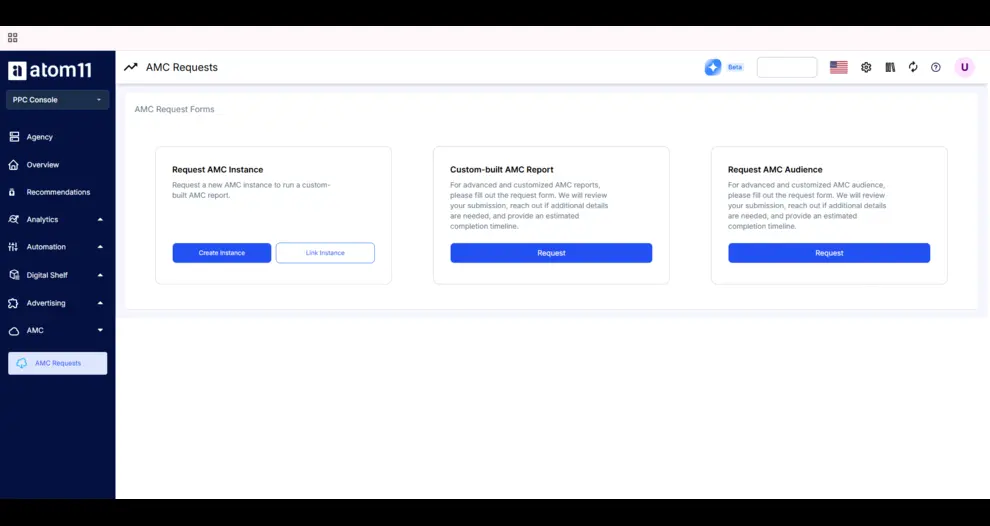
Retail signals: Connect ad decisions with inventory, pricing and Buy Box data so you stop spending on products that cannot convert.
AI analysis: Ask plain language questions of your data to find why performance changed.
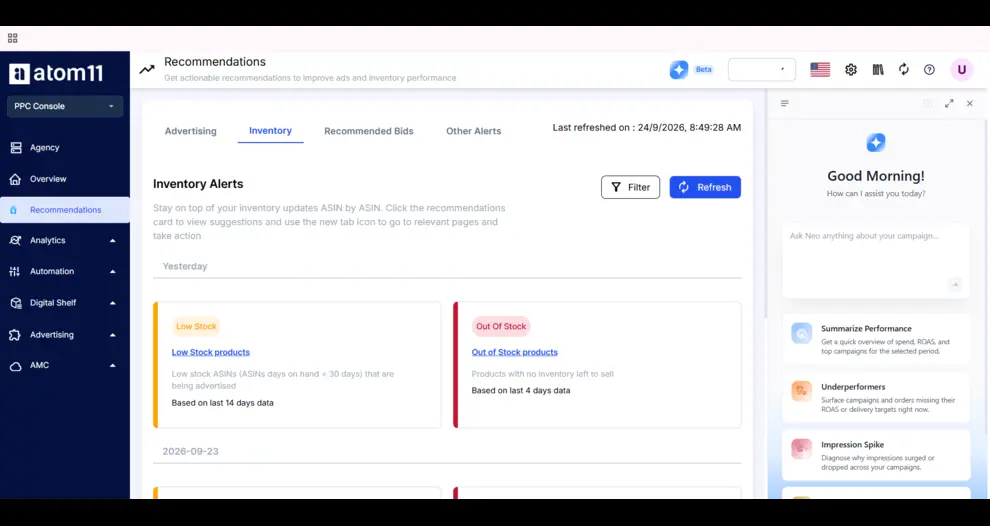
Atom11 is one example of this category. Its Amazon DSP module lets teams bulk create orders and ad groups, pace across orders toward a monthly target, set frequency caps per audience, use AMC audiences, and report on DSP and Sponsored Ads with promoted, halo and combined metrics in one dashboard. Teams can also connect their data to AI assistants through the Atom11 MCP. For agencies in particular, that kind of consolidation is where most of the hours come back.
The right choice depends on how many advertisers you manage, whether you need your own seat and AMC instance, and how much of your team's time currently goes into manual setup and reporting. Trial any tool against your own workflow before committing.
Conclusion
The brands that win with Amazon DSP are rarely the ones with the biggest budgets. They are the ones with the cleanest structure and the most patience. Give each order one goal. Keep audiences separate with exclusions. Size remarketing to the pool you actually have. Cap frequency using your own AMC data rather than a guess. Match creative to the funnel stage. Wait for the data before you react, and judge results by incrementality, new to brand growth and total account efficiency rather than last click ROAS alone.
Above all, remember that DSP sends shoppers to a product page. Check stock, Buy Box and reviews first, and your media spend will have something worth buying at the end of it.
FAQs
What are the most important Amazon DSP best practices?
Set one goal and KPI per order, separate prospecting from remarketing with exclusions, use frequency caps at both the order and ad group level, upload multiple creative sizes, wait 5 to 7 days before the first optimization, and measure with Totals metrics and new to brand sales rather than last click ROAS alone.
How long should I wait before optimizing an Amazon DSP campaign?
For campaigns running a month or longer, Amazon recommends the first optimization 5 to 7 days after launch, and 4 to 7 days between further performance changes. For conversion decisions, wait 1 to 2 weeks for modeled conversions to stabilize, since they are attributed over a 14 day window.
What is a good frequency cap for Amazon DSP?
A reasonable starting point is 1 to 2 impressions per day for prospecting display and around 3 per day for remarketing. The right cap for your brand is the point where the marginal cost per purchase from extra exposures rises above your target CPA, which you can calculate from AMC frequency reports.
What is a good ROAS for Amazon DSP?
It depends on your margins and the funnel stage. Remarketing should clear your break even ROAS (1 divided by your contribution margin). Prospecting and awareness campaigns should be judged on new to brand sales, incremental ROAS and total account efficiency, since their impact often shows up later through search.
How is Amazon DSP different from Sponsored Display?
Sponsored Display is self service, runs from the Sponsored Ads console and uses simpler targeting. Amazon DSP offers programmatic buying across Amazon and third party inventory, streaming TV and audio, deeper audience options, AMC audiences and more controls over frequency, supply and bidding. Here is a full Amazon DSP vs Sponsored Display comparison.
