Blog
/
Amazon DSP for Vendors: DVA+ Access, Billing and ROAS
Amazon DSP for Vendors: DVA+ Access, Billing and ROAS
Deepika Thakur

Quick answer: Vendors can still run what used to be called Amazon DSP. Amazon retired the name on September 29, 2026 and moved programmatic buying into Amazon Ads Agent, where it now sits under DVA+ advanced settings. Amazon’s FAQ says vendors, book vendors, Brand Registry sellers and agencies can access the full range of campaign types. What does not change for vendors is the economics: you earn the wholesale price, your reports show sales at the shopper’s price, and Amazon controls your stock through purchase orders. That makes your break even ROAS higher than a seller’s, and it makes inventory a bigger risk for any flight that runs for weeks.
Amazon’s rollout of DVA+ is still in stages, so confirm current access with your Amazon Ads or vendor manager before you plan a budget.
Key Takeaways
Same engine, new name. Amazon DSP is now part of Amazon Ads Agent. Programmatic controls for experienced buyers sit in DVA+ advanced settings.
Vendors qualify. Amazon says vendors can access the full range of campaign types. Existing programmatic advertisers get both DVA+ and advanced settings, and Sponsored Ads advertisers can request advanced settings through their account manager.
Billing is the open question. Amazon’s vendor guide lists credit card and Deduct from Payment for sponsored ads. It does not say how programmatic billing works for vendors, and DVA+ is invoice only during closed beta.
Your break even ROAS is higher. On a $40 product with a 23.5% net margin, break even ROAS is about 4.26, against 2.86 for a seller at a 35% margin.
Check stock before you set a flight length. A four week flight on a product with 3.2 weeks of cover can sell out before the next purchase order arrives.
Does Amazon DSP Still Exist for Vendors?
The product is the same, but the name has changed. On September 29, 2026 Amazon merged its Ads console and Amazon DSP into Amazon Ads Agent. Amazon’s own FAQ says DSP “is no longer a standalone product” and that its capabilities are available in DVA+ under advanced settings. Our guide to DVA, DVA+ and Full Funnel Campaigns covers the new names in detail.
Two practical points for vendors:
You do not need to move anything today. Amazon says existing campaigns, audiences, reports and permissions carry forward without action.
Keep searching for the old name. Most vendors, agencies and tools still say “Amazon DSP.” We use it here for that reason, and we say DVA+ when we mean the new product. One more source of confusion: “Amazon DSP” is also the name of Amazon’s Delivery Service Partner program, which has nothing to do with advertising.
Can Vendors Use Amazon DSP? Who Gets What
Amazon’s FAQ says sellers enrolled in Brand Registry, book vendors, vendors and agencies can access the full range of campaign types in Amazon Ads Agent. For DVA+ specifically, Amazon’s DVA+ page adds the following.
You are | What Amazon says you get |
|---|---|
A vendor with an existing programmatic seat | Both DVA+ and advanced settings |
A vendor that only runs Sponsored Ads | DVA+, with advanced settings available by request through your account manager |
An agency with existing entity access | Both DVA+ and advanced settings |
A brand that sells on Amazon only through third party accounts | DVA+ with an Amazon Ads Agent account |
A brand that does not sell on Amazon | DVA+ with an Amazon Ads Agent account |
Two things are not stated. Amazon does not say how a brand that holds both a vendor account and a seller account should expect its programmatic access to work. It also does not publish a minimum spend for DVA+. Amazon’s FAQ says managed service typically needs a minimum that varies by country. Our guide to how much Amazon DSP costs covers the pricing information that is public.
DVA+ itself is still in extended closed beta in the US, with open beta expected in late October 2026 and general availability targeted for Q1 2027. Check your own account before assuming you have it.
Vendor Central vs Seller Central: What Changes for DSP
The advertising tools are largely shared, but four things differ for vendors and they change how you should run a flight.

Figure 1: Four differences that affect a vendor DSP flight.
Vendor | Seller | |
|---|---|---|
What you earn per unit | Wholesale price, less allowances | Retail price, less fees |
Who sets retail price | Amazon | You |
Who controls inventory | Amazon, through purchase orders | You |
Reports show sales at | Shopper’s price | Shopper’s price |
The key row is the earnings gap. Your ad reports show sales at the retail price, but you only keep the wholesale price minus allowances. A report that looks healthy to a seller can be break even or worse for you. If you want the same logic for non advertising work, our guide to Seller Central vs Vendor Central covers the account differences.
How Amazon DSP Is Paid for as a Vendor
This is the least clear part of the topic, and most guides skip it. Here is what is actually published.
For sponsored ads, Amazon’s vendor guide lists two payment options. Amazon’s guide for vendors says vendors can pay by credit card or by Deduct from Payment (DFP), an automated method that uses your Amazon retail proceeds, so it needs no separate advertising budget. DFP is not available to third parties managing payments for clients, or to accounts with no retail activity in the last six months.
For programmatic, the vendor guide does not say. The guide does not mention DSP at all, and Amazon’s FAQ does not address DSP billing, invoicing or DFP.
For DVA+ during closed beta, payment is invoice only. Credit card payment is targeted for Q1 2027.
So do not assume the sponsored ads rules apply. Ask your Amazon Ads or vendor manager these three questions in writing:
How will programmatic spend be billed to my vendor entity?
Is Deduct from Payment available, and if so, for which products?
Can any marketing or advertising allowance in my vendor terms be applied to programmatic spend?
We could not find a published answer to the third question. Treat any claim that cooperative advertising money can fund DSP as unverified until your own vendor manager confirms it for your agreement.
Vendor Break Even ROAS: Why Your Bar Is Higher
Because you earn less per unit than a seller, you need more sales per dollar of ad spend to break even.
The formula:
Net margin per unit = Wholesale price minus Cost of goods minus Allowances
Break even ROAS = 1 ÷ (Net margin per unit ÷ Retail price)
Worked example (illustrative, consistent with our Vendor Central MCP guide). A product retails for $40. Amazon pays you $26 wholesale. Cost of goods is $14. Cooperative advertising and other allowances take 10% of the invoice, which is $2.60.
Net margin per unit = $26 minus $14 minus $2.60 = $9.40.
Margin as a share of retail price = $9.40 ÷ $40 = 23.5%.
Break even ROAS = 1 ÷ 0.235 = 4.26.
A third party seller selling a comparable product at a 35% contribution margin breaks even at a ROAS of 1 ÷ 0.35 = 2.86.

Figure 2: The same product needs a higher ROAS for a vendor.
Now compare that with a campaign reading. If a DSP report shows a ROAS of 2.5 on first orders, the seller breaks even and is slightly profitable. The vendor in the example loses money on every first order, because 2.5 is below 4.26. That does not make the campaign wrong, because DSP is often bought for awareness and new customers, but it means you must decide in advance how much of the shortfall you are willing to fund and why.
A simple rule for deciding. Before the flight, write down what you are buying. If it is new to brand customers, estimate how many repeat orders each one needs to cover the first order shortfall. Our DVA guide shows this test step by step for Full Funnel Campaigns, and the same method works for any DVA+ flight.
Stock Check: How Long Can a Flight Run Before You Sell Out?
For a seller, running out of stock is a problem they can fix by shipping more. For a vendor, you cannot always fix it, because Amazon issues the purchase orders. A DSP flight that lifts demand can burn through stock faster than the next purchase order arrives.
Formula: Weeks of cover = Sellable on hand units ÷ Forecast units per week
Worked example (illustrative). You have 4,800 sellable units, and Amazon’s forecast is 1,500 units a week, so cover is 4,800 ÷ 1,500 = 3.2 weeks. You plan a four week flight and expect it to lift weekly demand by 20%, which is 1,800 units a week. Cover under the lifted demand is 4,800 ÷ 1,800 = 2.7 weeks. An open purchase order for 2,000 units is expected in week 4. The product runs out around week 2.7, more than a week before the purchase order lands.

Figure 3: Cover with a 20% lift against a four week flight.
The rule: Do not plan a flight longer than your weeks of cover at the lifted demand, unless a purchase order is confirmed to land before the stock runs out. The same logic applies to ad spend: pause or shorten any flight on products that are about to run short. Our Vendor Central MCP guide shows how to monitor cover and purchase orders with AI.
How Reporting Differs for Vendors
Vendor and seller sales are measured against different views of the business. Your vendor reports show what you sold to Amazon, and Amazon’s manufacturing view also includes units Amazon bought from other suppliers, so numbers rarely match across tools. Before you compare a DSP report with your vendor sales:
Ask which sales view the report uses. Do not assume it matches your invoices.
Check which ASINs are included, especially if you run both a vendor and a seller account for the same brand.
Keep attribution windows consistent when comparing flights.
Treat recent days as provisional. Attributed sales keep changing after the day ends.
Moving from Vendor to Seller: What Happens to Your DSP Plans
Some brands move all or part of their catalog from Vendor Central to Seller Central. If you are planning a move, three things are worth settling before you fund a DSP flight.
Margin changes. Your break even ROAS will move, because you will earn the retail price less fees, not the wholesale price less allowances.
Inventory ownership changes. You will control your stock, which makes flight length easier to manage.
Reporting changes. Seller sales and vendor sales are different data sets. Do not compare pre move and post move flights without adjusting for that.
If you run a hybrid model, with some ASINs sold as a vendor and others as a seller, keep a separate break even ROAS for each group of products.
Seven Questions to Ask Before a Vendor Programmatic Flight

Figure 4: Seven questions to settle before you spend.
Do I have DVA+ and advanced settings? Check your Amazon Ads Agent account and ask your account manager.
How is programmatic billed to my vendor entity? Get the answer in writing.
Can any allowance in my vendor terms fund it? Do not assume.
Which sales view does the report use? Confirm it before comparing with invoices.
Which ASINs are in scope, and how are vendor and seller orders for the same product handled?
What is my cover on these ASINs at the lifted demand? Set the flight length from that.
What is my break even ROAS, and how much shortfall am I funding for new customers?
What About Agencies and Tools?
If an agency or software manages your programmatic account, two extra points matter for vendors.
Access. Amazon says agencies with existing entity access get both DVA+ and advanced settings. For vendors, agency access has historically needed approval from the vendor’s Vendor Central account holder, so keep that contact current.
API and tools. Amazon says campaign creation for DVA+ is currently only in Amazon Ads Agent, with API access targeted for Q1 2027. Until then, outside tools may not be able to create or report on DVA+ campaigns. Ask every vendor of software the same question: what can you do today, and what is waiting for the API?
Our guide to Amazon DSP agencies covers how to choose a partner.
How Atom11 Fits for Vendors
Atom11 is an Amazon Ads Partner platform built on the Amazon Ads API for sellers, vendors and agencies. Vendor advertising has a few jobs that a seller account does not: spending against a tighter margin, protecting stock you cannot always replenish quickly, and reading reports that sit on a different sales view from your invoices. Here is how Atom11 supports each one.
Running the DSP flights. The Amazon DSP module lets teams bulk create orders and ad groups, pace several orders toward one budget, and set frequency caps per audience. That helps when you plan a flight by product line and want spend to follow the plan without daily manual changes.
Audiences and holdouts. AMC audience activation gives you a way to build the exposed and holdout groups that the break even and new to brand tests in this guide depend on.
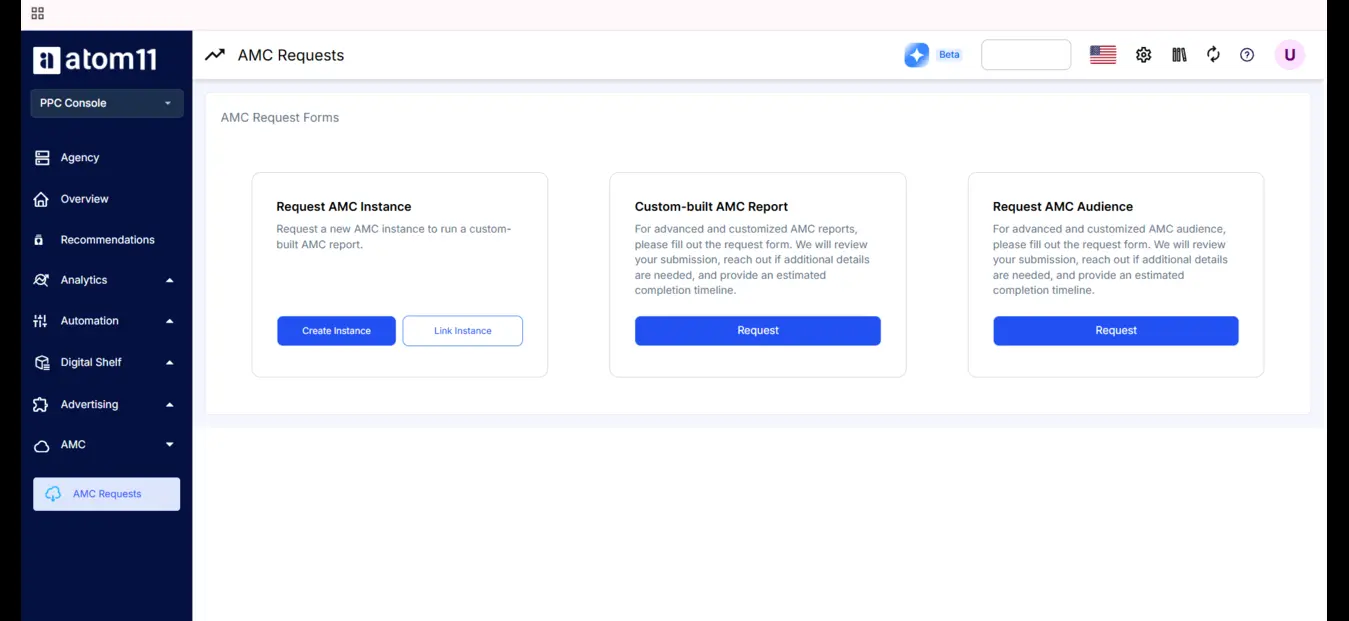
DSP and Sponsored Ads in one view. Side by side reporting, with promoted, halo and combined metrics, shows how programmatic and search work together, so you can check whether a flight is adding customers or taking credit from search.
Stock aware rules. This is where vendors usually see the most value. Atom11’s retail aware rules use inventory, price, Buy Box and organic rank next to ad metrics, so Sponsored Ads spend can slow when cover is short. That fits the stock cover check in this article, where an advertised product can run out before the next purchase order lands.
Safety nets for big events. Version control lets you save bids and budgets before an event and roll them back afterward, and the Performance Monitor keeps a before and after record for each automation.
Questions in plain language. The Atom11 MCP connects AI assistants such as Claude and ChatGPT to your ad accounts with user level permissions, live reads, and writes that need confirmation. Setup takes about five minutes. Neo, Atom11’s AI analyst, compares periods across more than 15 ad and retail signals, which helps when you want to know why sales or ACOS moved.
Want to see how your DSP setup holds up for a vendor account? Book an Atom11 demo.
Conclusion
For vendors, the DSP question is less about whether you can run it and more about whether the numbers work. Amazon says vendors can access the full range of campaigns, the old DSP controls now live in DVA+ advanced settings, and your existing campaigns carry forward. What Amazon has not published is how programmatic is billed to a vendor, so get that in writing before you plan a budget.
Then do two calculations that a seller can skip. Work out your break even ROAS from net margin and retail price, because reports at the shopper’s price flatter a vendor. And set your flight length from weeks of cover at the lifted demand, because you cannot always restock fast. A vendor who knows both numbers before the flight starts will read the results more honestly than one who trusts the dashboard.

FAQs
Can Amazon vendors use Amazon DSP?
Yes. Amazon’s FAQ says vendors, book vendors, Brand Registry sellers and agencies can access the full range of campaign types in Amazon Ads Agent, where the old DSP controls now sit in DVA+ advanced settings.
Is Amazon DSP still called DSP?
Amazon retired the name on September 29, 2026. Programmatic display, video and audio buying is now called DVA, with the AI campaign builder called DVA+. Most people still search for and say “Amazon DSP.”
How do vendors pay for Amazon DSP?
Amazon has not published a vendor specific answer. For sponsored ads, its vendor guide lists credit card and Deduct from Payment. DVA+ is invoice only during closed beta, with credit cards targeted for Q1 2027. Ask your account manager in writing.
Can I use my vendor allowances to pay for DSP?
We could not find a published answer. Do not assume it is allowed, and ask your vendor manager whether any allowance in your agreement can apply to programmatic spend.
Why is my DSP ROAS not enough as a vendor?
You earn the wholesale price, less allowances, while reports show sales at the retail price. In our example, the vendor needs a ROAS of about 4.26 to break even on first orders, against 2.86 for a seller.
