Blog
/
DVA+ and Full Funnel Campaigns: What Replaced Amazon DSP
DVA+ and Full Funnel Campaigns: What Replaced Amazon DSP
Deepika Thakur

Quick answer: Amazon did not shut Amazon DSP down. It renamed and folded it into a new platform. On September 29, 2026, Amazon merged the Ads console and Amazon DSP into Amazon Ads Agent, started calling programmatic display, video and audio buying DVA, and launched two AI campaign products: DVA+ (one objective, one budget, one campaign across display, video, audio and streaming TV) and Full Funnel Campaigns (one campaign across sponsored ads, display, video and streaming TV, with a $100 a day minimum, available to US advertisers). Existing campaigns keep running, and the old DSP controls now sit under “advanced settings” in DVA+.
Last updated October 23, 2026. Amazon is rolling these products out in stages, so check the status table below and Amazon’s own pages before you plan a budget.
Key Takeaways
The engine is the same, the front door changed. Amazon says the programmatic capabilities of Amazon DSP are available in DVA+ advanced settings, and that your campaigns, audiences and reporting continue without disruption.
Two different products, two different trade offs. DVA+ gives you a simple mode with a manual mode behind a toggle. Full Funnel Campaigns lets you approve creative but not pick channels or audiences.
Most of it is not generally available yet. DVA+ is in extended closed beta in the US, with open beta expected in late October 2026 and general availability for 35 markets targeted for Q1 2027.
Judge Full Funnel on booked sales first. A $100 a day minimum means at least $3,000 over 30 days. This guide gives you a repeat purchase test so you can decide whether Amazon’s long term sales figure justifies the spend.
Tools and reports need a check. Amazon says DVA+ campaigns are created only in Amazon Ads Agent for now, with API access targeted for Q1 2027, and reports keyed to old campaign names will need new mapping.
What Amazon Announced on September 29, 2026
At its unBoxed 2026 event in San Francisco, Amazon renamed its unified buying platform. AdExchanger reports that the Ads console and Amazon DSP were merged and rebranded as Amazon Ads Agent and that “Amazon DSP” was replaced by a product name, DVA, short for display, video and audio. MediaPost summarizes Amazon’s wording this way: Amazon Ads Agent “replaces the former Ads Console and Amazon DSP experience,” and it holds three campaign types: sponsored ads, DVA+ and Full Funnel Campaigns.
Amazon’s own DSP page now says Amazon DSP “has evolved into Amazon Ads Agent.” The assistant itself is not new. Amazon introduced Ads Agent in November 2025 as a conversational helper, and Amazon’s unBoxed 2026 roundup describes it as now powering the whole buying experience, with its conversational features in expanded closed beta.
If you read our earlier guides, nothing in them is wrong about how programmatic buying works. The names and the front end are what changed. Our Amazon DSP guide covers the fundamentals, and the sections below translate them into the new vocabulary.
Old Name, New Name: A Translation Table
Search results and vendor pages mix old and new names, which makes the news hard to follow. This table maps one to the other.

Figure 1: Old names and new names.
Before | Now | Note |
|---|---|---|
Amazon DSP | DVA (display, video and audio), with DSP style controls in DVA+ advanced settings | Amazon retired the DSP name but says the programmatic capabilities remain |
Ads console plus Amazon DSP | Amazon Ads Agent | One platform for sponsored ads, DVA+ and Full Funnel Campaigns |
Sponsored Display, Sponsored TV and programmatic display, video and audio | DVA+ | One objective, one budget, one campaign across media types |
Performance+ and Brand+ | Optimization engines inside DVA+ | Amazon introduced them in March 2025 as AI tools inside Amazon DSP |
Not available before | Full Funnel Campaigns | New campaign type that mixes sponsored ads, display, video and streaming TV |
Sponsored Products and Sponsored Brands | Unchanged as campaign types | Amazon says sponsored ads remain cost per click with no minimum spend |
One detail trips people up. Performance+ and Brand+ are not new. Amazon announced them on March 21, 2025 as AI optimization tools within Amazon DSP, with Performance+ aimed at conversions and Brand+ at awareness and reach. What is new is that DVA+ picks between them for you, based on your objective. In advanced settings, you can choose Brand+, Performance+ or neither.
What Is Live, What Is in Beta and What Is Still a Target
Most coverage of this launch blurs three different states. This status board separates them, with the source for each row.
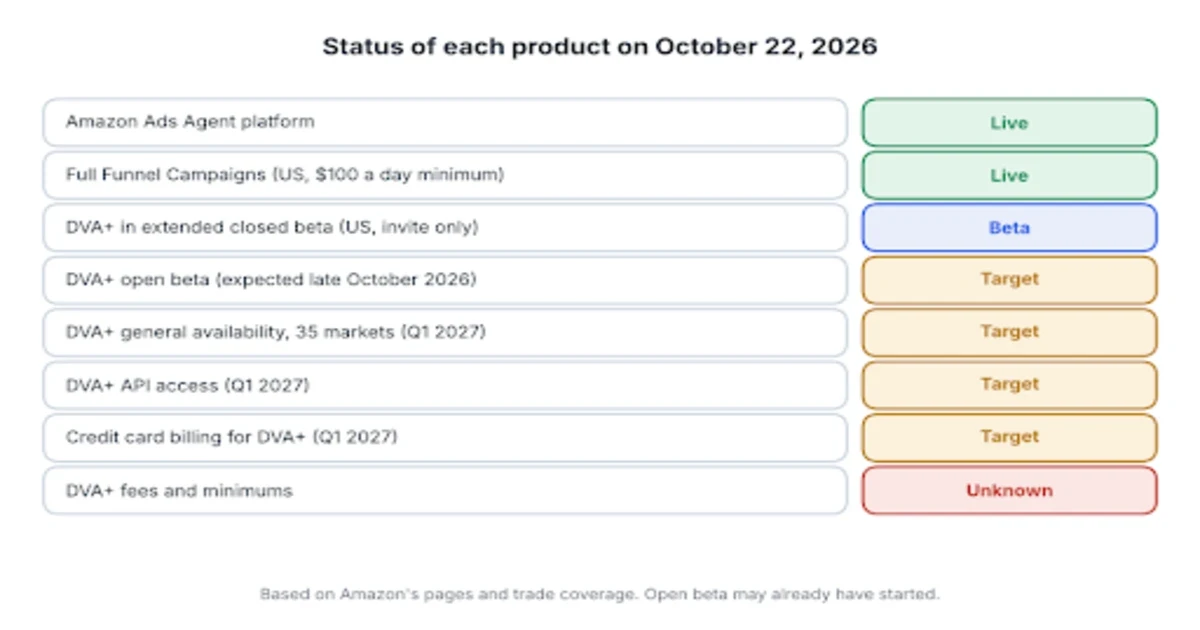
Figure 2: Status of each product as of October 22, 2026, based on Amazon’s pages and trade coverage.
Item | Status | Source |
|---|---|---|
Amazon Ads Agent as the new unified platform | Announced September 29, 2026 | Amazon and trade coverage |
Full Funnel Campaigns | Available to all US advertisers, $100 minimum daily budget | Amazon, as reported by MediaPost |
DVA+ | Extended closed beta in the US, invite only | |
DVA+ open beta | Expected late October 2026 | Amazon |
DVA+ international expansion | Planned through Q4 2026 | Amazon |
DVA+ general availability | Targeted for 35 markets in Q1 2027 | Amazon |
DVA+ API access | Targeted for general availability in Q1 2027 | Amazon |
DVA+ billing | Invoice only during closed beta, credit cards planned Q1 2027 | Amazon |
Conversational planning, targeting and analytics | Rolling out over the coming months, no dates | Amazon |
Fees, pricing and minimums for DVA+ | Not published | None found |
Two cautions. First, “late October” is close, so DVA+ may have moved to open beta by the time you read this. Second, Amazon has not published a minimum spend or a fee change for DVA+, and says current pricing carries forward, including self service and managed service options. For what that pricing looks like, see our guide to how much Amazon DSP costs.
DVA+ Explained: Simple Mode and Advanced Settings
DVA+ is a four step builder. You pick an objective such as sales, traffic, awareness or leads, choose products or a brand URL, review AI generated creative, and set a budget. Amazon says campaigns launch in minutes across all available media types, on Amazon and the open internet.
The important design choice is the default. In simple mode, Amazon’s AI handles targeting, bidding, inventory, creative and format selection. The conventional levers sit behind a toggle. Amazon’s own comparison shows the split.
DVA+ simple mode | Advanced settings | |
|---|---|---|
Targeting | Managed by AI | Manual, lookalikes, retargeting, suppression |
Bidding | AI optimized | Manual bid strategies, format level CPM |
Inventory | AI optimized | Publisher lists and deal activation |
Creative | AI generated, editable or uploaded | Full management, dynamic creative optimization |
Budget | Set once | Format level allocation, flighting, frequency caps |
Structure | Single campaign | Multiple ad groups |
Guidance | Real time scoring | Health score, What If analysis, pre flight checks |
Amazon says some of the advanced features, such as drafts, bulk management and pre-flight validation, are still rolling out.
Who gets which mode
Amazon’s DVA+ page lists the following eligibility: sellers, vendors and brands that do not sell on Amazon, all with an Amazon Ads Agent account. Existing programmatic advertisers get both DVA+ and advanced settings. New advertisers and Sponsored Ads advertisers get DVA+, and can request advanced settings through their account manager. Agencies with existing entity access get both.
The practical effect is that a seller who never used DSP starts in the AI default. Defaults shape behavior, so if you want to keep control, ask your account manager for advanced settings early.
Full Funnel Campaigns Explained
Full Funnel Campaigns is the most automated product in the lineup. You give Amazon products, creative and a budget. Amazon’s AI plans the channel mix across sponsored ads, display, video and streaming TV, and extends to open internet inventory, optimizing toward new to brand customers and long term sales. Amazon’s Ads Agent page says it is available now to all advertisers in the United States, and you approve creative before launch.
What you give up is the control. According to Digiday, advertisers cannot select individual channels or specific audiences, and reporting is at the format level, not the placement level. Amazon told the publication it is working on more audience transparency.
Amazon reports that beta advertisers saw 67% higher long term ROAS and 29% lower cost to acquire new to brand customers. Those are Amazon’s own figures from its beta, with no published method or independent audit, so treat them as a claim to test, not a benchmark.
The Control Ladder: Which Option Fits Which Advertiser
Think of the new lineup as four rungs, from most control to least.

Figure 3: Four rungs, from most control to least.
Option | You control | You hand to Amazon | Best fit |
|---|---|---|---|
Sponsored ads | Keywords, bids, budgets | Auction mechanics | Capturing existing search demand |
DVA+ advanced settings | Audiences, bids, deals, publishers, frequency | Little | Experienced programmatic teams and agencies |
DVA+ simple mode | Objective, budget, creative | Targeting, bidding, inventory | Advertisers new to programmatic who accept AI defaults |
Full Funnel Campaigns | Budget and creative approval | Channels, audiences, bidding, mix | Smaller advertisers who want one hands off campaign |
A useful rule of thumb: the further down the ladder, the more your results depend on measurement you run yourself. A less controllable product needs a stricter test, which is what the next section sets up.
The $3,000 Test: Is Full Funnel Worth It?
At $100 a day, a 30 day month costs at least $3,000, or about $36,500 over a year. PPC Land calculates the same $3,000 minimum for a 30 day month. For many sellers that is a real share of the ad budget, so test it with a rule written before you start.
Amazon’s headline metric is long term sales. Amazon defines Long Term Sales as an estimate of the incremental sales value your brand can expect over the next 12 months, based on the historical 12 month return of a customer engagement. That makes it partly a forecast. Judge the booked sales first, and ask what the forecast would need to be true.
The formula:
Break even ROAS = 1 ÷ contribution margin before ads
First order shortfall = Spend minus (Booked sales × contribution margin)
Repeat contribution needed per new customer = First order shortfall ÷ New to brand customers
Worked example (illustrative). You spend $3,000. The campaign reports $7,500 in booked sales from 250 orders at a $30 average order value, and 120 of those buyers are new to your brand. Your contribution margin before ads is 25%.
Break even ROAS = 1 ÷ 0.25 = 4.0. The campaign delivered 7,500 ÷ 3,000 = 2.5, so the first orders lose money.
First order contribution = $7,500 × 0.25 = $1,875. Shortfall = $3,000 minus $1,875 = $1,125.
Repeat contribution needed = $1,125 ÷ 120 = $9.38 per new customer.
Now compare that with your own repeat behavior. If a repeat order earns $7.50 contribution (25% of $30), a new customer must place about 1.25 repeat orders within the window to earn $9.38. If only 20% of new customers reorder once in 12 months, the expected value is 0.2 × $7.50 = $1.50, far below $9.38. In that case, a long term sales figure that looks good does not rescue the test.
The same test works for any budget. Replace $3,000 with your spend and the numbers with your own margin and repeat rate. A consumable with a 60% reorder rate could pass where a one time purchase would fail.
A three step way to run it
Write the pass rule first. For example: booked ROAS above 2.0 and required repeat value below what your own data supports.
Set a holdout. Keep one comparable product or region out of the campaign, so you can compare sales trends and not just attributed sales.
Report booked and long term sales separately. Check new to brand figures against your own order data, because Amazon both runs and scores these campaigns.
For more on attribution windows and the metrics in DSP reports, see our guide to Amazon DSP attribution.
What Happens to Your Existing DSP Campaigns
Amazon’s answer is reassuring. On its DSP page, Amazon says campaigns, audiences and reporting continue without disruption, and that settings, audience segments, creatives, deals and performance history carry forward. Login credentials, account structure and team permissions stay the same, and existing Amazon DSP certifications remain valid, with updated Amazon Ads Agent courses available in Amazon Ads Academy. Current pricing carries forward, including self service and managed service options.
What Amazon has not said:
Migration of Sponsored Display and Sponsored TV. Coverage notes that how existing campaigns of those types are handled or migrated is not described.
Whether DVA+ campaigns appear as ordinary line items in the old console. PPC Land notes Amazon does not say whether they can be edited there.
Any end date for the old workflow. No legacy end of life date has been published.
Our advice: do nothing urgent. Keep existing flights running, do not pause planned tests while you wait, and use the checklist further down to confirm your account is in order.
What It Means for Agencies, Tools and Reporting
This is the part most coverage skips, and it matters if you run many accounts or use software on top of Amazon’s APIs.
Campaign creation is manual for now. Amazon says DVA+ campaigns are created only through Amazon Ads Agent at advertising.amazon.com, and API access is targeted for general availability in Q1 2027. Until then, outside tools cannot create DVA+ campaigns or pull their data through the API. Existing DSP style workflows are a separate question, and Amazon has not described how they relate to the DVA+ API.
Reports keyed to old names will break. Amazon says DVA+ reports show where each impression served, by publisher, format and geography. If your dashboards rely on old campaign names or structures, plan a mapping.
Agencies keep access. Agencies with existing entity access get both DVA+ and advanced settings, according to Amazon.
Billing is invoice only in closed beta, which affects smaller advertisers who pay by card until Q1 2027.
Ask every tool vendor the same five questions: Which DVA+ features can you read today? When will you create DVA+ campaigns, given the Q1 2027 API target? How do you handle existing DSP style orders in the meantime? Will my historical reports survive the naming change? What is the fee impact, if any? Our guide to managing Amazon DSP covers the operating routines these answers should support.
Seven Things to Check in Your Account This Week
Can you sign in as before? Amazon says logins, account structure and permissions are unchanged.
Are existing campaigns delivering normally? Compare spend and impressions this week with last week.
Which entry points do you see? Check whether DVA+ and advanced settings appear for your account, and what your account manager says about access.
What is your billing method? DVA+ is invoice only during closed beta.
Which reports use old names? List dashboards and exports that need remapping.
Who owns measurement? Decide how you will check new to brand and long term sales against your own data.
What do your tools support? Get the vendor answers above in writing.
Who Should Do What Now
You are | What to do |
|---|---|
A brand with an existing DSP seat | Keep running as is, and use advanced settings for anything you want to control. Pilot DVA+ on one product with a holdout. |
A seller using only Sponsored Ads | Do not rush. Ask your account manager about DVA+ access, and run the $3,000 test only if you can afford the downside. |
An agency | Keep entity access current, map reports to the new names, and build a client conversation around control versus automation. |
A brand that does not sell on Amazon | Amazon says off Amazon brands qualify for DVA+ with an Ads Agent account. Check access and billing before you plan. |
An advertiser outside the US | Full Funnel Campaigns is US only, and DVA+ general availability is targeted for 35 markets in Q1 2027. Plan around that date. |
How Atom11 Fits While This Settles
Atom11 is an Amazon Ads Partner platform built on the Amazon Ads API. Its Amazon DSP module lets teams bulk create orders and ad groups, pace several orders toward one monthly budget, set frequency caps per audience, activate AMC audiences, and report on DSP and Sponsored Ads side by side with promoted, halo and combined metrics. Those are the jobs that stay useful whichever buying interface you use.
Atom11 DSP pricing starts at $499 a month for accounts spending under $50K and is 2% of ad spend above that, with the MCP and Neo included.
Because Amazon has said DVA+ API access is targeted for Q1 2027, contact us to learn how DVA+ campaigns and existing DSP style orders will be handled in the meantime. The same advice applies to any vendor.
Want to see how your DSP setup holds up under the new structure? Book an Atom11 demo.
Conclusion
The rebrand is real, but it is less dramatic than the headlines. Amazon DSP is not gone. Its programmatic engine now lives inside DVA+, behind a simple mode that hands decisions to AI and an advanced mode that keeps the controls you know. Full Funnel Campaigns goes one step further and asks you to trust Amazon with the channel mix.
The right response is measured. Keep running what works, get access to advanced settings if you want control, and treat every Amazon reported result as a claim to test. For Full Funnel, write the pass rule before you spend the $3,000, hold out a comparison group, and ask what repeat behavior the long-term sales forecast needs. The advertisers who benefit most will be the ones who know their own margin and repeat rate before Amazon’s dashboard tells them how well it is going.
FAQs
Is Amazon DSP shut down?
No. Amazon retired the Amazon DSP name and merged the console and DSP into Amazon Ads Agent, but says the programmatic capabilities remain available in DVA+ advanced settings. Existing campaigns, audiences and reporting continue.
What does DVA stand for?
DVA stands for display, video and audio. It is the name Amazon now uses for its programmatic display, video and audio buying, which replaces the Amazon DSP name.
What is DVA+?
DVA+ is Amazon’s AI campaign builder for display, video, audio and streaming TV. You choose an objective, products or a brand URL, creative and a budget, and Amazon handles targeting, bidding and inventory. Advanced settings give experienced buyers manual control. It is in extended closed beta in the US, with open beta expected in late October 2026.
What are Full Funnel Campaigns and what do they cost?
Full Funnel Campaigns is a campaign type that spans sponsored ads, display, video and streaming TV, with Amazon choosing the channel mix. It has a $100 minimum daily budget and is available to US advertisers, which works out to at least $3,000 over 30 days.
Do I need to migrate my DSP campaigns?
Amazon says no action is needed to keep existing delivery running, and settings, audiences, creative, deals and performance history carry forward. Amazon has not published a timetable for migrating Sponsored Display or Sponsored TV campaigns.
