Blog
/
Amazon Marketing Cloud AI: SQL Generator, Ads Agent, MCP
Amazon Marketing Cloud AI: SQL Generator, Ads Agent, MCP
Deepika Thakur
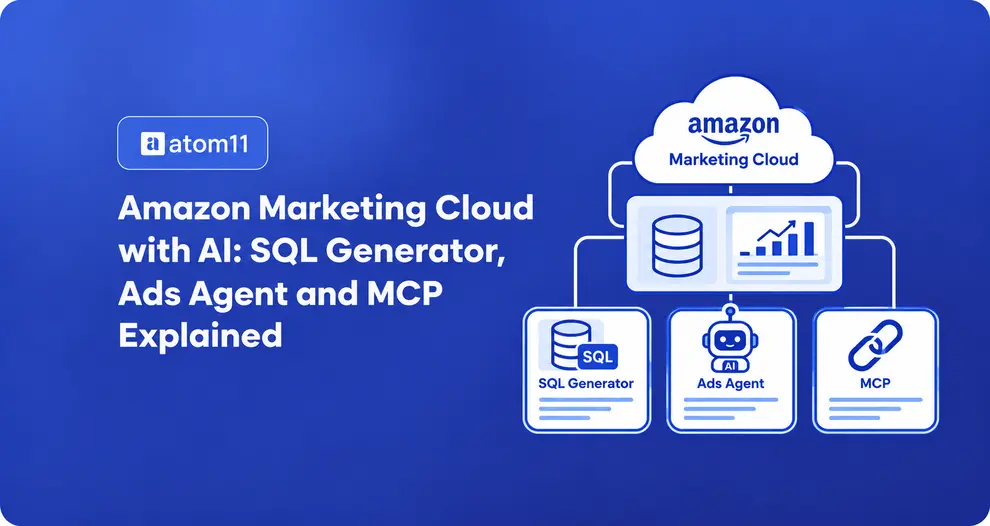
Quick answer: Amazon Marketing Cloud (AMC) now has AI at three levels. Ads Agent inside AMC can write, explain and fix SQL from plain language, available to anyone with AMC access. The AMC Expert Tool on the Amazon Ads MCP server does the same for AI assistants, but is in US closed beta, with broader availability planned for early 2027. And general AI assistants can draft SQL if you give them your schema, though they cannot run it. AI removes the SQL writing barrier. It does not remove the need to check the query, which is where most wrong AMC answers come from. This guide gives you the timeline, a way to choose a route and a seven point review checklist.
Amazon is rolling these features out in stages, so confirm what your account can use.
Key Takeaways
AMC AI is not new, but it keeps expanding. Amazon announced an AMC SQL generator in January 2025 and has added to it four times since, most recently on September 29, 2026.
Three routes, different trade offs. Ads Agent in AMC is the easiest. The MCP expert tool suits AI assistant workflows but is closed beta. A general assistant is the most flexible and the least safe.
Review every AI written query. Check the date range, attribution window, filters, grouping and how orders and units are counted before you act on the numbers.
Empty results are usually a threshold, not a bug. AMC only returns aggregated, anonymous outputs, so small audiences can return nothing.
AI helps most with questions you already know how to judge. Use it for overlap, new to brand cohorts, path to purchase and holdout comparisons.
What Is Amazon Marketing Cloud and Why Does AI Matter?
Amazon describes AMC as a secure, privacy safe, cloud based clean room built on AWS Clean Rooms. It combines signals from Amazon, your own pseudonymized data and your campaign data so you can analyze them together. Amazon says AMC is available at no cost to eligible advertisers, and that you can only access aggregated and anonymous outputs.
That last point matters for AI, and we return to it below. AMC’s power has always been limited by SQL, the language used to ask it questions. Many brands and agencies have access but no one on the team who writes the queries. AI changes that by turning a plain language question into SQL, which is why Amazon has built it into several places.
For a general introduction, see our Amazon Marketing Cloud guide. This article focuses on the AI features.
Amazon Marketing Cloud AI Features: A Timeline

Figure 1: Five steps in Amazon’s AMC AI rollout.
Date | Feature | What it does | Status |
|---|---|---|---|
January 2025 | AMC SQL generator | Turns an audience description into SQL | Announced for all AMC customers in early 2025 |
July 24, 2025 | AI audience generator and product support | Chat interface that generates audience SQL and answers AMC questions | Beta, for all AMC users |
November 11, 2025 | Ads Agent skill for AMC | Generates analytics SQL from natural language | For anyone with AMC permissions |
March 31, 2026 | Ads Agent query editor controls | Edit, explain and fix SQL, with a change review | For anyone with AMC access |
September 29, 2026 | AMC Expert Tool on the MCP server | Turns natural language into AMC SQL for AI assistants | US closed beta, broader availability planned for early 2027 |
AMC SQL generator: the January 2025 launch
Amazon’s press release describes a generator where advertisers describe the audience they want and receive a SQL query and the steps used to build it. The example is an audience of shoppers who viewed product pages and saw streaming TV ads but did not buy in 30 days. Amazon says it cuts query development from hours to minutes.
AI audience generator: July 2025
Amazon added a chat interface in beta that generates SQL for custom audience segments and answers questions about AMC products. Amazon does not describe accuracy checks or how the SQL should be reviewed.
Ads Agent analytics skill: November 2025
At unBoxed 2025, Amazon announced an Ads Agent skill that generates analytics SQL and gives guidance on datasets and best practices. Access is through “Ask AI for AMC help” in the AMC navigation bar. The trade coverage notes that time savings depend on query complexity, and that natural language can hide technical details that affect how results should be read.
Ads Agent query editor controls: March 2026
Amazon’s March announcement added right click AI controls in the query editor to edit, explain and fix queries, a way to open AI generated SQL in the editor, and a side by side difference view with accept and reject controls for query and date range changes. That change view is the first built in review step Amazon provides.
AMC Expert Tool on the Amazon Ads MCP server: September 2026
On September 29, 2026, MediaPost reported that the AMC Expert Tool launched in US closed beta, the first of Amazon’s expert tools on the Amazon Ads MCP server. It translates natural language requests into what Amazon calls validated AMC SQL queries, with broader availability planned for early 2027. Our Amazon MCP guide explains the server itself.
Which AI Route Should You Use for AMC SQL?

Figure 2: Three routes to AI written AMC SQL.
Ads Agent in AMC | MCP expert tool | General AI assistant | |
|---|---|---|---|
Where it runs | Inside AMC | Inside your AI assistant, through the MCP server | Outside Amazon |
Knows your schema | Yes | Yes | Only what you paste in |
Can run the query | Yes, in the editor | Depends on setup | No, you copy it into AMC |
Status | Available to AMC users | US closed beta | Available now |
Main risk | Over trusting the output | Limited access, new tool | Wrong table or column names |
Best for | Most advertisers today | Teams building AI workflows | Learning and drafting |
Our recommendation. Start with Ads Agent in AMC, because it knows the data and has a change review. Use a general assistant to learn or to draft a query you then paste in, and supply the real table and column names so it does not guess them. Treat the MCP expert tool as one to watch until it leaves closed beta, unless you are already in the program.
Ads Agent in Amazon Marketing Cloud: when it fits
Choose it when you want answers inside AMC without writing SQL. It suits audience building, simple analytics and learning how queries are put together.
Amazon Ads MCP server and AMC: when it fits
Choose it when you want to ask AMC questions from the same AI assistant you use for other ads work, and you have access to the closed beta. Our guide to getting access to the Amazon Ads MCP server covers the access routes.
How to Review AI Written AMC SQL Before You Trust It
AI can produce SQL that runs and returns numbers that are wrong. The query will not warn you. Use this seven point review on any AI written query before you act on its output. You do not need to write SQL to do it, only to read what the query says.

Figure 3: A seven point review for AI written AMC SQL.
# | Check | What to look for |
|---|---|---|
1 | Date range | Does it match the period you asked for, including the end date? |
2 | Attribution window | Which window does it use, and is it the one you want? Ask the assistant to state it. |
3 | Filters | Is it limited to the right campaigns, ASINs, marketplace and ad products? |
4 | Orders or units | Does it count purchases, units or sales, and which did you ask for? |
5 | Grouping | Is the result split the way you need, such as by campaign, audience or week? |
6 | Double counting | Could the same shopper or purchase appear twice across joins? |
7 | Thresholds | Could small groups be hidden, making totals look lower than they are? |
Common mistakes in AI generated AMC queries
A silent default. The assistant picks a window, date range or ad product you did not ask for. Always ask it to list the assumptions it made.
Orders confused with units. A question about “purchases” may be answered in units, which inflates results for multi unit baskets.
The wrong population. A comparison of exposed and unexposed shoppers needs the same date range and filters on both sides.
A plausible but wrong table. A general assistant may invent a table or column. If AMC rejects the query, do not accept a patched version without rereading it.
A review in practice
Say you ask: “Compare new to brand purchases for shoppers who saw my streaming TV ads with shoppers who did not, over the last 60 days.” Before you use the answer, confirm that the query covers 60 full days, uses the same window for both groups, defines exposure the way you intended, counts new to brand the way Amazon does, and does not drop either group because of size. If you cannot tell from reading the query, ask the assistant to explain it line by line, or use the explain control in the editor.
Why Your AMC Query Returns No Results
Empty or partial results are a common frustration, and AI makes it more likely because it is easy to ask about very narrow groups. Amazon says AMC outputs are aggregated and anonymous and that it has built in aggregation thresholds to protect privacy. If a group is too small, AMC will not return it.
Aggregation thresholds in AMC
Amazon’s AMC page does not state a single threshold number, so check the current AMC documentation for your account. What matters in practice is that very narrow filters, such as one ASIN in one week in one small audience, are the most likely to return nothing.
How to fix an empty AMC result
Widen the date range. Move from days to weeks, or weeks to months.
Group more broadly. Report by campaign instead of by ad group, or by brand instead of by ASIN.
Combine small audiences. Merge segments before you ask the question.
Check the filters. An over specific filter can remove everything, with or without a threshold.
Five Plain Language AMC Questions for DSP Measurement
AI is most useful in AMC when you already know what decision a result will drive. These five questions connect AMC to the DSP measurement problems in our other guides.

Figure 4: Five AMC questions and the decisions they support.
Question to ask | Decision it supports | What to verify |
|---|---|---|
Which ad sequences appear most often before purchase? | Which tactics start winning paths, even if they rarely win last touch | The lookback window and ad products included |
How much do my prospecting and remarketing audiences overlap? | Whether to add exclusions | Whether overlap is counted by shopper, not by impression |
How many new to brand customers did each flight bring, and how many reordered? | Whether a flight pays back | The new to brand definition and the cohort window |
How do exposed and unexposed shoppers compare on purchases? | Whether a flight is incremental | That both groups share dates and filters |
How many exposures come before a purchase? | Frequency caps | That exposures and conversions use the same window |
Our guide to Amazon DSP attribution explains the measurement choices these questions test, and our guide to AMC custom audiences covers the audience side.
What the Amazon Ads MCP Server Changes for AMC
The MCP expert tool matters because it moves AMC into the same AI assistant you may already use for other ads questions. A person could, in theory, ask for a performance summary, then follow up with an AMC question, in one conversation, without switching tools.
Three points to keep in mind:
It is closed beta. Amazon has targeted broader availability for early 2027, so most advertisers cannot use it yet.
“Validated” is not “correct for your question.” Amazon says the tool produces validated AMC SQL. Treat that as a check on the query’s form, and still run the seven point review on its meaning.
Access to the server comes first. You need access to the Amazon Ads MCP server before you can use any expert tool.
The Limits of AI for Amazon Marketing Cloud
AI makes AMC easier to start with, but it has limits worth planning for.
Hidden detail. Trade coverage of the Ads Agent skill raised the concern that natural language can hide technical details that decide how a result should be read.
Time savings vary. Amazon says AI cuts query development from hours to minutes. The savings are smaller for simple queries and depend on complexity.
Access still applies. AI does not change who can use AMC. Amazon says sponsored ads advertisers can use AMC self service, and advertisers who want DVA+ advanced settings should ask their Ad Tech Account Executive for access.
Privacy rules stay. Outputs remain aggregated and anonymous, and AMC only accepts pseudonymized inputs.
Measurement design is still yours. AI can write the query. It cannot decide which comparison is fair, which holdout is valid or which window suits your product.
How Atom11 Helps With Amazon Marketing Cloud
Atom11 is an Amazon Ads Partner platform. For AMC, the aim is to give teams the answers without requiring them to write SQL at all. In the Atom11 AMC offering, teams can create reports by dragging and dropping filters, use pre built and canned reports, and request custom reports, which the Atom11 team delivers within the dashboard in about 24 hours. Teams can also create AMC audiences and use them in their campaigns.

That approach avoids two of the risks in this article. A canned report has already been reviewed, so you do not have to check the SQL yourself. And a custom request goes to people who check the logic before you see the result.
Atom11 also offers the Atom11 MCP, which connects AI assistants such as Claude and ChatGPT to your ad accounts with user level permissions, live reads and writes that need confirmation, and about five minutes of setup. Neo, Atom11’s AI analyst, compares periods across more than 15 ad and retail signals. We have not described the MCP as writing AMC queries, so confirm with the Atom11 team what it covers today.
Want AMC answers without writing or reviewing SQL? Book an Atom11 demo.
Conclusion
AI has made Amazon Marketing Cloud easier to start with, and Amazon keeps adding to it: a SQL generator, an audience generator, an Ads Agent skill, editor controls and now an expert tool on the MCP server. What it has not removed is the need to know what you are asking and to check what comes back.
Use Ads Agent inside AMC first, because it knows your data and has a change review. Run the seven point review on every query, especially the date range, the attribution window and how orders and units are counted. Ask questions that map to a decision, such as overlap, new to brand cohorts and exposed versus unexposed comparisons. And when a result comes back empty, check the thresholds before you suspect the data. Done that way, AI gives you a faster path to AMC without making the numbers less trustworthy.
FAQs
Can AI write Amazon Marketing Cloud SQL?
Yes. Amazon has built AI SQL generation into AMC itself, through Ads Agent, and into the Amazon Ads MCP server through the AMC Expert Tool. General AI assistants can also draft SQL if you provide your schema, but they cannot run it for you.
What is the AMC SQL generator?
It is Amazon’s generative AI tool that turns a description of an audience or analysis into an AMC SQL query. Amazon announced it in January 2025, and says it reduces query development from hours to minutes.
What is the AMC Expert Tool on the Amazon Ads MCP server?
It is the first of Amazon’s expert tools on the MCP server. It translates natural language requests into what Amazon calls validated AMC SQL queries. It launched in US closed beta on September 29, 2026, with broader availability planned for early 2027.
Is Amazon Marketing Cloud free?
Amazon says AMC is available at no cost to eligible advertisers. Eligibility varies. Sponsored ads advertisers can access AMC self service, and advertisers who want DVA+ advanced settings should ask their Ad Tech Account Executive.
Do I need to know SQL to use AMC?
Not necessarily. Amazon offers templates, and Ads Agent can generate queries. You still need to review what a query does, because AI generated SQL can run and return wrong numbers.
