Blog
/
Atom11 vs Sellermate: Which Amazon PPC Tool is Worth It?
atom11 vs Sellermate: Which is the Best Amazon PPC Tool?
Neha Bhuchar

Sellers evaluating Amazon PPC software in 2026 are spoilt for choice. Atom11 and Sellermate are two tools that promise to cut wasted ad spend and grow ROAS, but they are built around fundamentally different ideas of what Amazon PPC automation should do.
Sellermate looks at Amazon advertising as an automation and reporting problem. atom11 looks at it as a retail intelligence problem. This atom11 vs Sellermate comparison looks at their core approach to Amazon PPC, automation capabilities, and analytics so you can choose the right Amazon PPC software for your business.
How Does Each Tool Approach Amazon PPC?
Sellermate approaches Amazon PPC as an automation and reporting problem. It uses AI recommendations and rule-based automation to adjust bids, budgets, keywords, and campaign settings based on ad performance metrics such as ACoS, CTR, and spend thresholds. The platform focuses on saving time through automation, bulk campaign management, and reporting dashboards for sellers and agencies.
atom11 approaches Amazon PPC as a retail intelligence problem. Instead of optimizing campaigns using ad metrics alone, it connects advertising decisions to broader retail signals like inventory levels, Buy Box status, competitor pricing, and organic rank. This allows bids and budgets to change based on what is happening across the overall Amazon business, not just inside the ad console.
atom11 vs Sellermate: At a Glance
Feature | Sellermate | atom11 |
G2 Rating | ||
Retail-Aware Automation | Partial (basic inventory triggers) | Yes, full retail signal integration |
Version Control | No | Yes |
Root Cause Analysis | Surface-level via SellerBot | Deep diagnostic via AI Copilot Neo |
AMC Suite | AMC Audiences only | Full no-SQL AMC suite |
Digital Shelf Analytics | ASIN monitoring (BSR, Buy Box, reviews) | Yes, powered by DataWeave |
Inventory-Aware Automation | Basic inventory triggers | Full inventory-integrated logic |
Dayparting | Yes | Yes, with Amazon Marketing Stream hourly data |
AI Copilot | SellerBot (conversational) | Neo (diagnostic and action-oriented) |
Support Channels | Slack, WhatsApp, email | Slack, email, 1:1 onboarding |
Bulk Operations | Limited | Full bulk operations (bulk bid changes, keyword additions, campaign updates) |
| Also Read: 20 Best Amazon PPC tools For 2026 [Detailed Review]
Retail-Aware Automation
Retail-aware automation connects Amazon advertising decisions to live retail signals outside the ad console. This includes signals like inventory levels, Buy Box ownership, competitor pricing, organic rank, and share of voice. Most Amazon PPC automation tools adjust bids using ad metrics such as clicks, ACoS, and ROAS. Retail-aware automation goes further by factoring in the actual retail conditions of the product. This helps prevent wasted ad spend when something changes in the business, such as losing the Buy Box or running low on inventory.
Does Sellermate offer retail-aware automation?
Partially. Sellermate has a few retail-aware features, but it is not the tool’s primary focus. For example, lets you pause campaigns when an ASIN goes out of stock and monitors Buy Box status, BSR, ratings, and reviews. These signals operate as monitoring alerts only and are not connected to the bid engine. Buy Box losses, competitor price drops, and organic rank shifts do not automatically trigger bid or budget changes.
How atom11 handles retail-aware automation
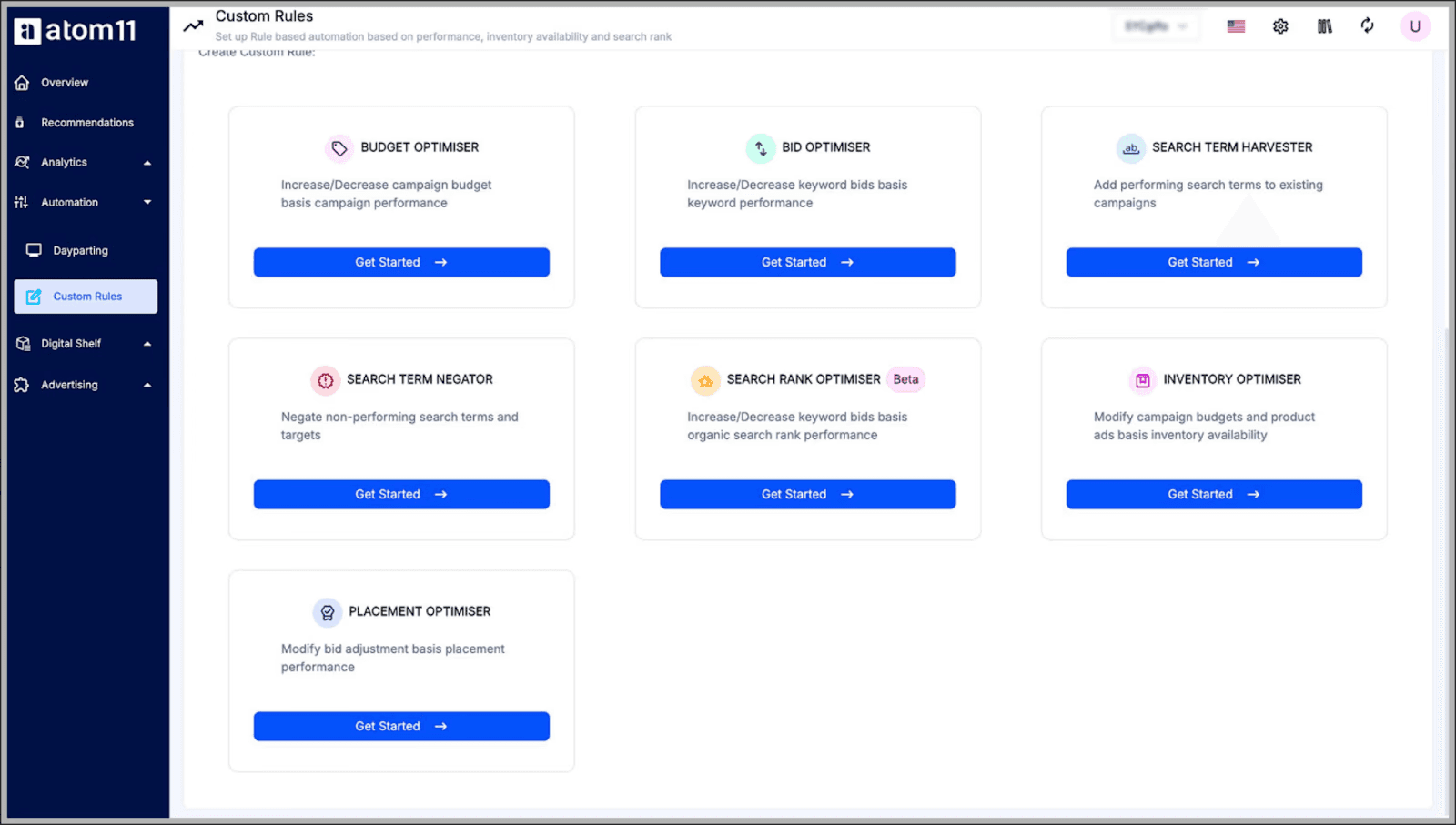
atom11 connects every bid rule and budget adjustment directly to live retail signals, not ad metrics alone. Changes happen automatically, in real time, without manual intervention.
Inventory levels trigger automatic bid reductions when stock falls critically low, stopping campaigns from driving traffic toward a stockout
Buy Box ownership is tracked continuously and factored into every bid decision the moment status changes
Competitor pricing movements are acted on immediately through automated ad rules, not flagged for later review
Organic rank is integrated so ad campaigns do not waste spend cannibalizing listings that are already ranking naturally
Dayparting layers retail signals on top of peak hours, so ads only run when shopper intent and retail conditions align at the same time
Root Cause Analysis
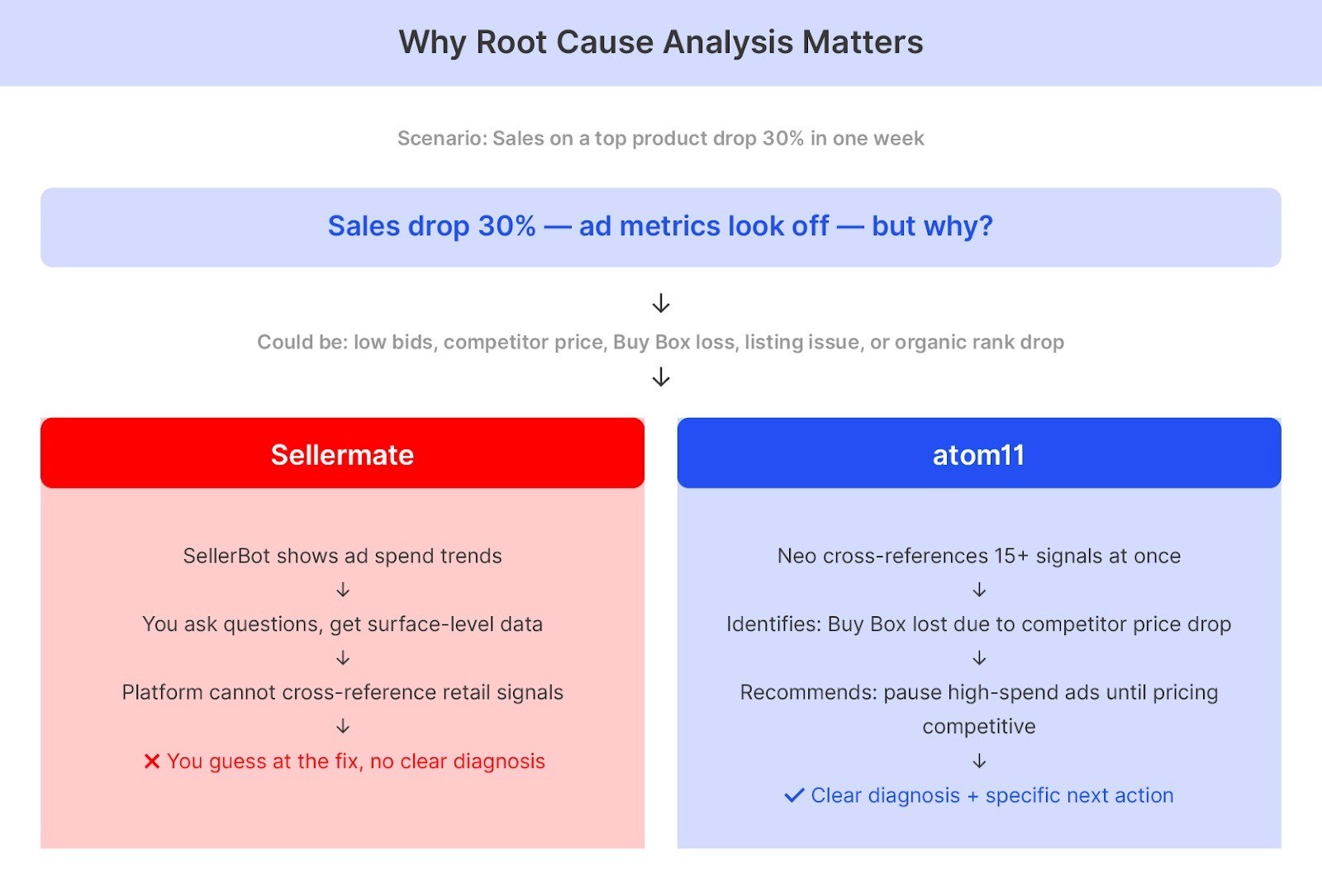
Root cause analysis in Amazon advertising means identifying exactly why campaign performance changed rather than just showing that it changed. A drop in performance is rarely caused by a single factor. It could come from lower bids, Buy Box loss, competitor price changes, inventory issues, or organic rank shifts happening at the same time. A platform with root cause analysis helps sellers quickly diagnose the real issue and take the correct action instead of guessing.
Does Sellermate offer root cause analysis?
No. SellerBot is a conversational assistant that surfaces ad performance data, flags overspending campaigns, and reports on trends. It does not cross-reference ad data with live retail signals. The output quality also depends on how precisely you phrase each question.
How atom11 handles root cause analysis
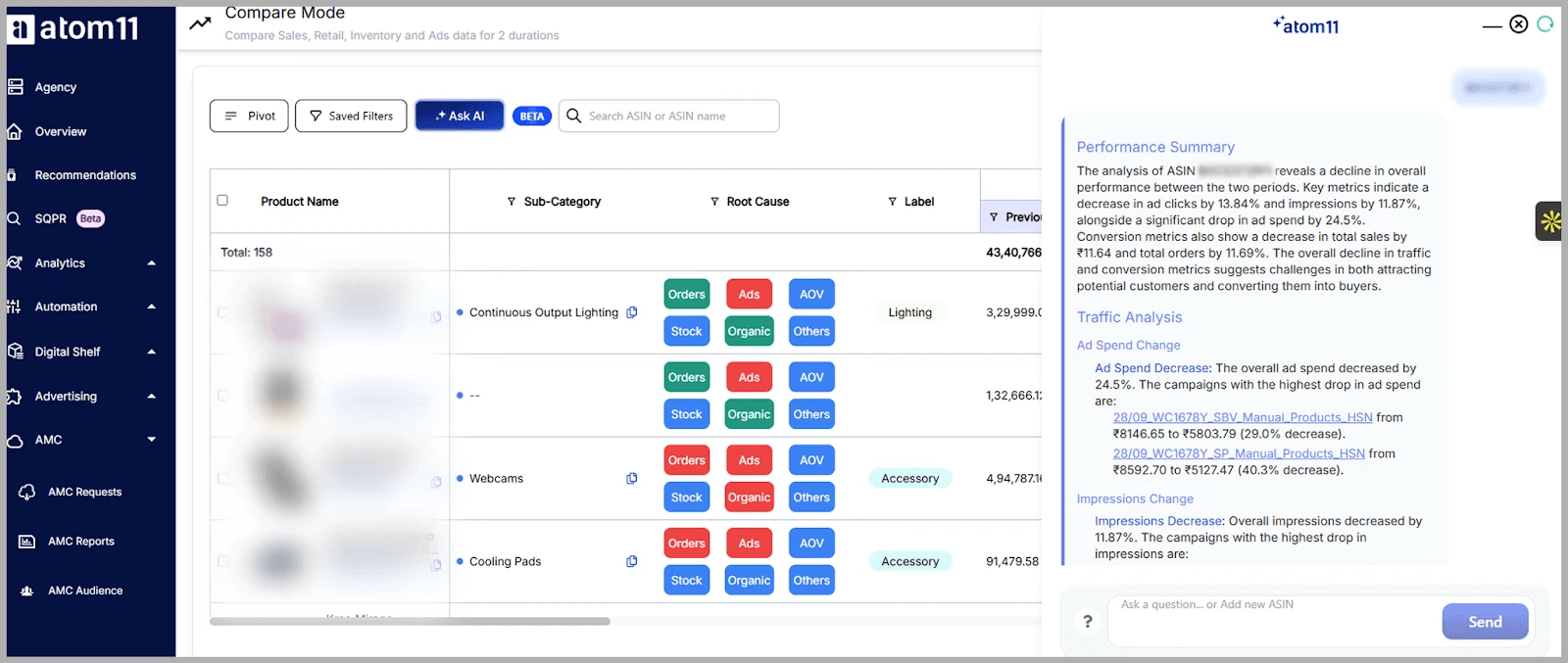
Neo, atom11's AI Copilot, is built specifically to diagnose performance changes rather than just describe them. It cross-references ad metrics and retail signals simultaneously to find the actual cause and recommend a specific fix.
15+ signal cross-reference spans spend, impressions, CTR, ACoS alongside inventory levels, Buy Box status, competitor pricing, and organic rank
Root cause identification pinpoints whether a drop was caused by a bid issue, a Buy Box loss, a competitor move, or a combination
Actionable recommendations follow every diagnosis, for example, pausing high-spend campaigns until pricing is competitive again, not just flagging that performance declined
Amazon Marketing Cloud Integration
Amazon Marketing Cloud is a privacy-safe analytics environment that allows advertisers to analyze their Amazon advertising data across the full customer journey. It supports advanced insights such as multi-touch attribution, path to purchase analysis, time to purchase, and audience segmentation. These insights help brands understand how different ad formats work together to influence conversions rather than evaluating each campaign in isolation.
Does Sellermate offer Amazon Marketing Cloud access?
Partially. Sellermate integrates with AMC Audiences, letting you build audience segments from AMC data. Multi-touch attribution, path to purchase analysis, time to purchase insights, and custom AMC query reporting are not included.
How atom11 handles Amazon Marketing Cloud access
atom11 gives sellers one-click access to the full AMC suite with pre-built templates and ready-made audience segments, no SQL or data team required. Every major AMC use case is covered out of the box.
Multi-touch attribution maps every ad touchpoint across the full customer journey, not just the last click before conversion
Path to purchase analysis shows which campaign types influence conversions before the final Sponsored Products click
Time to purchase data identifies the right remarketing windows based on how long your shoppers actually take to convert
Frequency cap analysis prevents budget waste on audiences that have already been overexposed to your ads
Behavior-based segments cover cart abandoners, lapsed purchasers, product discovery audiences, and competitor page visitors
Amazon Marketing Stream and Dayparting
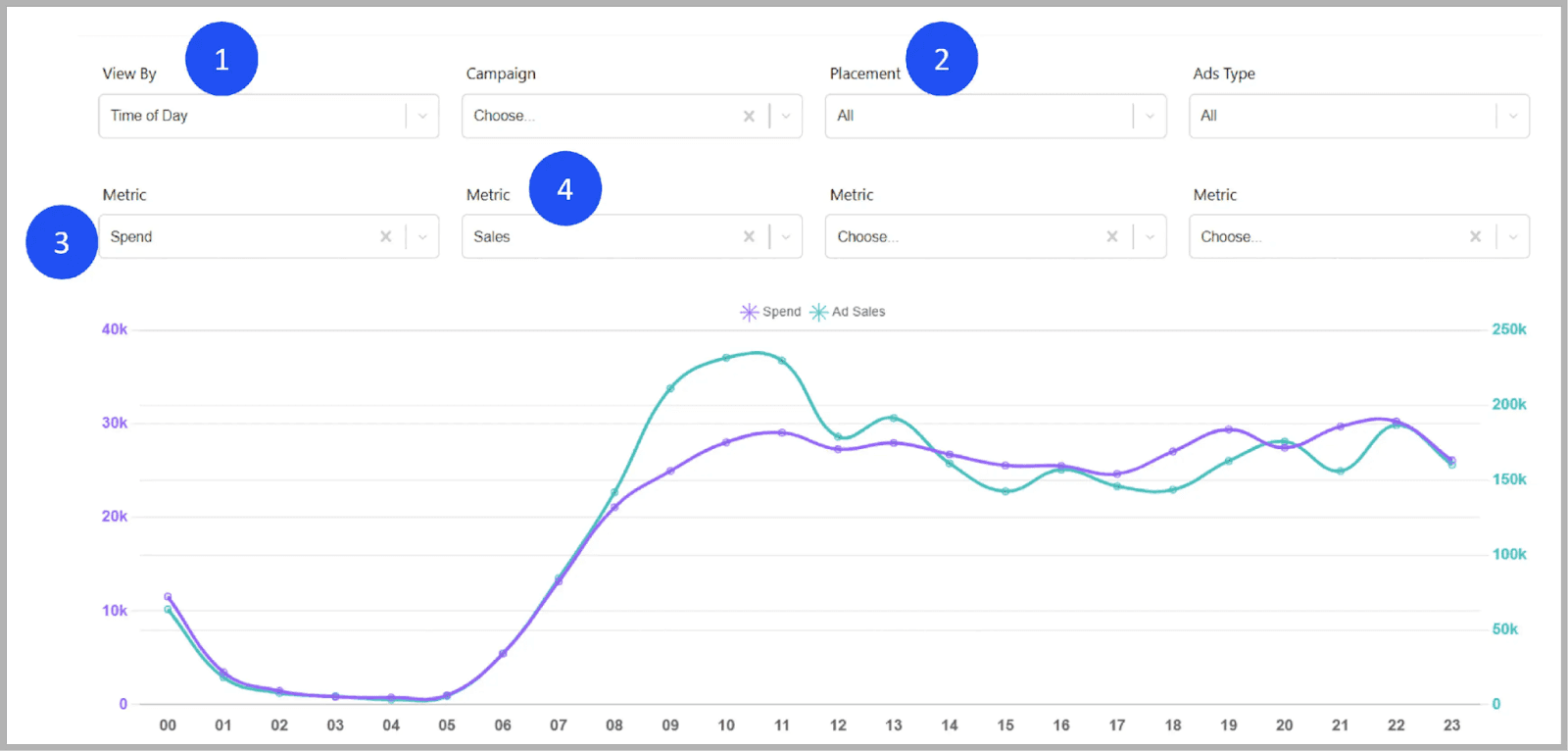
Amazon Marketing Stream is a push-based data pipeline that provides near-real-time hourly campaign metrics for Amazon ads, including impressions, clicks, spend, and conversions. This hourly data allows advertisers to optimize campaigns the same day instead of relying on delayed historical reports. With this level of visibility, bidding strategies and dayparting schedules can react to real performance patterns rather than assumptions.
Does Sellermate offer Amazon Marketing Stream integration?
No. Sellermate supports bid and budget dayparting but does not integrate Amazon Marketing Stream. Dayparting schedules are built on historical data, not real-time hourly signals. The full AMS integration hourly metric ingestion, alert routing, rule execution lives inside atom11's amazon marketing stream tool.
How atom11 handles Amazon Marketing Stream and dayparting
atom11 uses Amazon Marketing Stream to build dayparting schedules that respond to live data rather than assumptions. Campaigns bid aggressively when intent is high and conditions are favorable, and pull back automatically when they are not. The scheduling rules and setup flow live on atom11's dayparting amazon ppc page.
Hourly performance data from Amazon Marketing Stream replaces historical averages, so dayparting reflects what is actually happening today
Retail signal layering means bids also reduce automatically when inventory is low or the Buy Box is lost, regardless of the time of day
Intent-aligned scheduling ensures ad spend concentrates in windows where both shopper behavior and retail conditions support conversion
Performance Monitoring
Performance monitoring in Amazon PPC connects automation rules to their actual impact on advertising performance. When automation changes bids, budgets, or schedules, sellers need to know whether those changes improved metrics such as ACoS, ROAS, or conversions. Without this visibility, automation becomes a black box where rules run continuously but it is unclear whether they are helping or hurting campaign performance.
Does Sellermate offer performance monitoring?
Not at the rule impact level. Sellermate's action logs show which automation rules fired and what changes were made. They do not connect individual rule changes to downstream performance outcomes, so you can see that a bid was adjusted but not whether that specific adjustment helped or hurt results in the days that followed.
How atom11 handles performance monitoring
atom11's Performance Monitor ties every automation rule directly to its impact on KPIs over time, creating a feedback loop that tells you exactly what is working and what is not. No rule runs indefinitely without accountability.
Rule-to-outcome tracking links each bid adjustment, budget shift, and dayparting decision to the performance change that followed
Visible improvement or decline per rule means you are never guessing whether an automation is helping or quietly hurting your account
Continuous optimization loop lets you scale what works and disable what does not, turning the platform into a self-improving system over time
Version Control
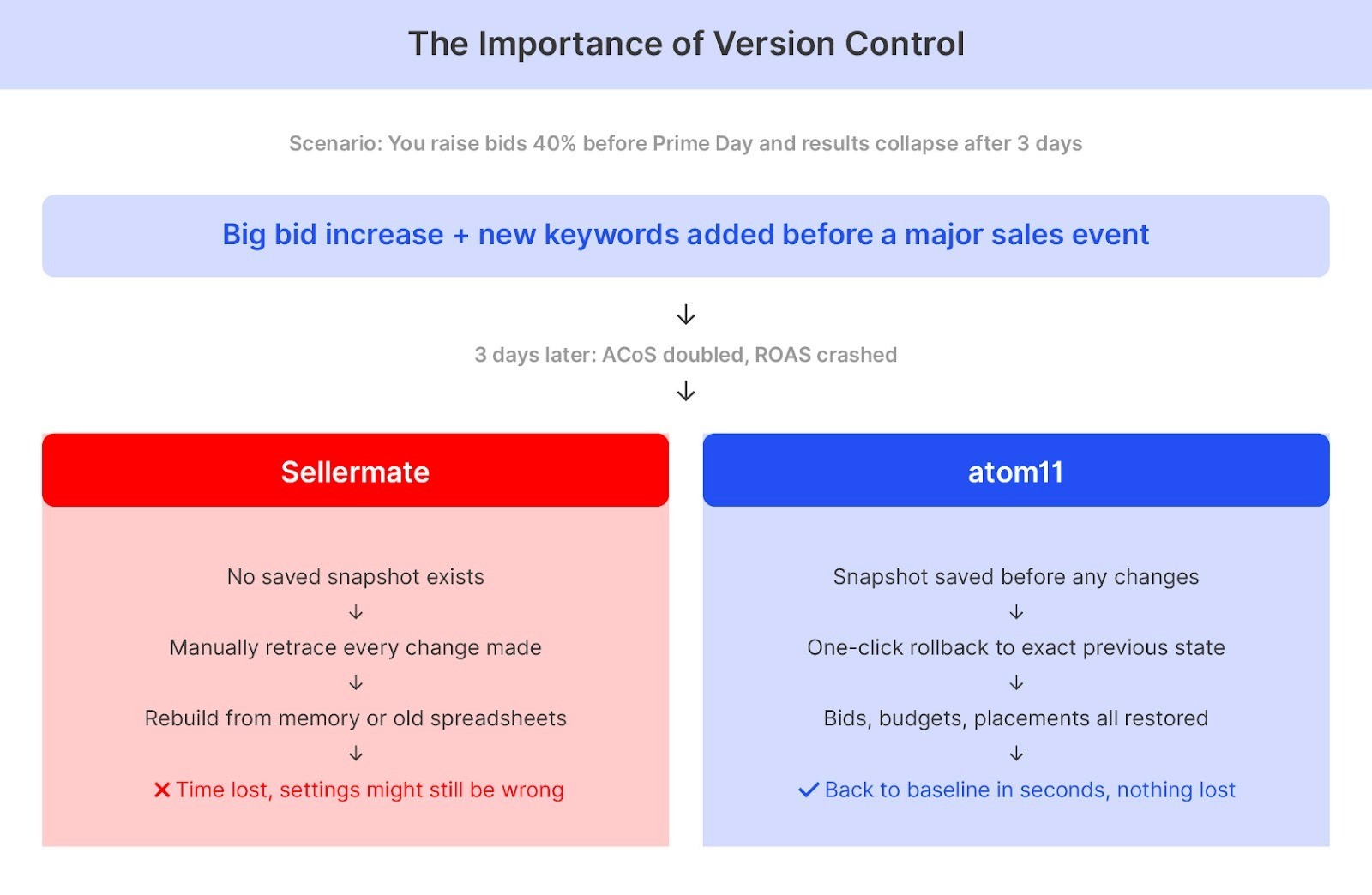
Version control in Amazon PPC means saving a complete snapshot of your campaign settings before making major changes. This includes bids, budgets, placement modifiers, keywords, and automation rules. If a change performs poorly, you can restore the previous configuration instantly. This reduces the risk of testing new strategies and prevents teams from having to manually rebuild campaigns when an experiment fails.
Does Sellermate have version control?
No. Sellermate provides action logs showing what changes were made, but there is no snapshot or rollback system. If a bid strategy backfires, you manually retrace every change without a guaranteed restore point.
How atom11 handles version control
Before any significant change, atom11 saves an exact snapshot of all campaign settings including bids, budgets, and placement modifiers. If results disappoint, one click restores everything to that exact state.
Snapshot saves capture bids, budgets, placement modifiers, and automation rules in a single action before any test begins
One-click rollback restores the previous state completely, with no manual reconstruction or guesswork required
Safe testing means seasonal strategies and aggressive bid experiments carry no permanent risk if they underperform
atom11 vs Sellermate: Side-by-Side
atom11 | Sellermate | |
Best for | Mid-market to advanced Amazon sellers, Amazon brands, agencies | Growth-stage Amazon sellers, brands, agencies |
Automation depth | Retail-aware: connects Amazon ads to retail signals | Ad-console-based rules with basic inventory triggers |
AI capability | Diagnostic: why and what to do via Neo | Conversational: what is happening via SellerBot |
AMC access | Full no-SQL suite with Amazon Marketing Cloud reporting | AMC Audiences only |
Version control | Yes | No |
Amazon Marketing Stream | Yes, integrated into dayparting | No |
Ideal use case | High-stakes, seasonal, multi-ASIN, comprehensive platform needs | Standard PPC automation, PPC management basics |
Conclusion
The atom11 vs Sellermate decision comes down to how deeply you want your Amazon PPC tool connected to your broader retail media operations. Sellermate is a capable PPC management software for Amazon sellers who need clean campaign management and standard PPC automation at an accessible price point.
atom11 is a comprehensive platform built for Amazon brands and sellers who have outgrown basic Amazon PPC automation and need a marketplace optimization platform that treats Amazon ads and retail signals as a single system. With a 4.8 G2 rating and the Amazon Ads AI Innovation Award 2025, atom11 is the direction serious Amazon advertising is heading.
If you’re looking for a focused, retail-aware Sellermate alternative that puts you in the driver’s seat, book a demo with atom11 and see how it compares.
FAQs
Does atom11 have an AI assistant like SellerBot?
Yes. atom11's AI Copilot Neo goes further than a conversational assistant. While SellerBot answers questions about your Amazon PPC account data, Neo actively diagnoses performance changes by cross-referencing 15+ Amazon advertising and retail signals and recommends specific corrective actions. It is built for Amazon sellers who need answers, not just ad performance data or product research dashboards.
Is atom11 Better Than Sellermate for Amazon PPC Automation?
Determining which platform is better ultimately depends on your specific use case. This atom11 vs Sellermate comparison shows that Sellermate offers capable PPC automation for standard campaign management. However, if you are an advanced user needing a lot of controls, deep retail signals integration, and diagnostic intelligence, then you should use atom11.
Which Tool Is Better for Amazon Agencies?
In the atom11 vs Sellermate agency comparison, both PPC management tools support agency workflows. The atom11 vs Sellermate difference becomes clearest at high ad spend levels. Sellermate offers white-label reporting and dedicated strategists for agencies. atom11's version control, Performance Monitor, and retail-aware Amazon ads automation make it more powerful for agencies managing high-spend Amazon brands who need precision at scale.
Does atom11 support inventory-aware ad automation?
Yes. atom11 automatically reduces bids when inventory levels fall below a set threshold and pauses ad campaigns on ASINs that have gone out of stock. This is integrated directly into the PPC automation bid logic engine, not just a monitoring alert, making it fundamentally more actionable than Sellermate's inventory monitoring feature.
Can I manage multiple Amazon seller accounts with atom11?
Yes. In the atom11 vs Sellermate multi-account comparison, atom11 supports multi-account PPC management, making it suitable for agencies and Amazon brands managing multiple Amazon marketplaces from a single comprehensive platform with centralized reporting and Amazon ad automation rules.
Does atom11 offer onboarding and support?
Yes. atom11's Professional plan includes a guided 4-week onboarding program where an atom11 specialist sets up core Amazon PPC automation, analytics, dayparting, and Amazon Marketing Cloud configurations with Slack support throughout. The team is built by former Amazon experts using machine learning and deep platform knowledge.
Is atom11 or Sellermate better for reducing ACoS?
In the atom11 vs Sellermate comparison, atom11's retail-aware approach addresses PPC performance and ACoS at the root cause level. If ACoS is rising because of a Buy Box loss or low inventory levels, Neo identifies the cause and recommends the right fix rather than simply reducing bids. For Amazon brands that want to diagnose and fix PPC optimization problems rather than just react to ad performance metrics, atom11 is the stronger choice in any atom11 vs Sellermate evaluation.
FAQs
Does atom11 have an AI assistant like SellerBot?
Yes. atom11's AI Copilot Neo goes further than a conversational assistant. While SellerBot answers questions about your Amazon PPC account data, Neo actively diagnoses performance changes by cross-referencing 15+ Amazon advertising and retail signals and recommends specific corrective actions. It is built for Amazon sellers who need answers, not just ad performance data or product research dashboards.
Is atom11 Better Than Sellermate for Amazon PPC Automation?
Determining which platform is better ultimately depends on your specific use case. This atom11 vs Sellermate comparison shows that Sellermate offers capable PPC automation for standard campaign management. However, if you are an advanced user needing a lot of controls, deep retail signals integration, and diagnostic intelligence, then you should use atom11.
Which Tool Is Better for Amazon Agencies?
In the atom11 vs Sellermate agency comparison, both PPC management tools support agency workflows. The atom11 vs Sellermate difference becomes clearest at high ad spend levels. Sellermate offers white-label reporting and dedicated strategists for agencies. atom11's version control, Performance Monitor, and retail-aware Amazon ads automation make it more powerful for agencies managing high-spend Amazon brands who need precision at scale.
Does atom11 support inventory-aware ad automation?
Yes. atom11 automatically reduces bids when inventory levels fall below a set threshold and pauses ad campaigns on ASINs that have gone out of stock. This is integrated directly into the PPC automation bid logic engine, not just a monitoring alert, making it fundamentally more actionable than Sellermate's inventory monitoring feature.
Can I manage multiple Amazon seller accounts with atom11?
Yes. In the atom11 vs Sellermate multi-account comparison, atom11 supports multi-account PPC management, making it suitable for agencies and Amazon brands managing multiple Amazon marketplaces from a single comprehensive platform with centralized reporting and Amazon ad automation rules.
