Blog
/
How to Evaluate an Amazon PPC Agency: A Practical Hiring Checklist
How to Evaluate an Amazon PPC Agency: A Practical Hiring Checklist
Nivesh J.
Key Takeaways
Ask who actually touches your account day to day, the senior strategist on the sales call often hands off to a junior analyst once the contract is signed.
Verify every case study against a named brand, a stated baseline, and a specific time period; an unverifiable percentage claim is one of the clearest red flags in this industry.
Compare pricing models carefully, flat retainers, percentage-of-ad-spend, and hybrid fees each reward different agency behavior, and one of them may quietly reward spending more, not spending better.
Look past the ad console itself: platforms like Atom11 connect bidding decisions to inventory, Buy Box status, and pricing, which catches wasted spend that a PPC-only view misses entirely.
Get reporting cadence, contract length, and exit terms in writing before you sign — not after your first invoice arrives.
Choosing an Amazon PPC agency is about more than finding someone who can launch campaigns and adjust bids. The right agency should understand your business goals, know how to turn Amazon Ads data into actionable decisions, communicate clearly, and show exactly how its work contributes to your growth.
So, how do you choose an Amazon PPC agency in 2026? Start by evaluating five things: Amazon advertising expertise, strategic approach, reporting and transparency, pricing and contract terms, and the technology the agency uses to manage and optimize campaigns. You should also look beyond promises and ask for evidence of how the agency handles your account, measures performance, and responds when campaigns underperform.
This checklist breaks down the key factors to evaluate before signing an agency contract. Use it to compare potential partners, ask better questions during discovery calls, spot red flags, and choose an agency that fits your goals, budget, and level of involvement.
Quick Answer: What to Look for When Hiring an Amazon PPC Agency
If you only have five minutes, here's the short version. A trustworthy Amazon PPC agency will:
Tell you exactly who manages your account day-to-day (not just who sold you the contract)
Show reporting that ties ad spend to actual profit, not just ACoS
Offer verifiable case studies with named brands, baselines, and dates
Explain their pricing model in plain terms and what happens if you leave
Use or at least understand technology that connects PPC to inventory, pricing, and Buy Box status, not just keyword bids
The rest of this article walks through each of these in detail, plus the red flags and discovery-call questions that separate a real partner from a reseller of your own ad budget.
Step 1: Match the Agency Type to What You Actually Need
Not every Amazon seller needs the same kind of help, and this is where most evaluations go wrong before they even start, comparing a $2,000/month PPC specialist to a $10,000/month full-service agency as if they're interchangeable.
Agency Type | Best For | Typical Monthly Cost | What's Usually Excluded |
PPC-only agency | Sellers who already have strong listings and just need campaign management | 2,000–5,000 + % of ad spend | Listing optimization, brand strategy, DSP |
Full-service Amazon agency | Brands needing PPC, SEO, content, and account health together | 3,500–12,000+ (higher for enterprise) | Often locks you into longer contracts |
Audit / consulting engagement | Sellers who want a one-time diagnosis before committing to ongoing management | $500 (advertising-only audit) to $1,000 (full 75-point account audit) — varies by scope and agency | Ongoing optimization |
Tech-enabled / managed service | Brands and agencies that want visibility and control alongside expert management | Tiered software fee starting around $199/month, plus optional managed-service fee | Fully hands-off "black box" management |
Note on pricing sources: these figures are self-reported ranges pulled from named agencies' own public pages and comparison content, not an independent third-party pricing survey. Treat them as directional benchmarks, and confirm current pricing directly with any agency before budgeting.
Before you take a single discovery call, decide which row you're actually shopping for. A brand doing $40K a month on Amazon rarely needs (or can afford) the same engagement as one doing $2M a month, and agencies that serve one end of that spectrum well often serve the other end poorly, because the operating rhythm is different.
Step 2: The Core Amazon PPC Agency Evaluation Checklist
This is the part that actually determines outcomes. Work through each point with every agency you're considering, and don't accept a vague answer on any of them.
1. Who Actually Manages Your Account
The person on the sales call is rarely the person optimizing your bids next Tuesday. Ask directly: how many accounts does my day-to-day manager handle, and can I meet them before signing? An account manager juggling 25+ accounts is running templates, not strategy, there simply isn't time to do otherwise.
Atom11 pairs a structured onboarding with a dedicated account contact, but every automated bid or budget change still runs against your guardrails and shows a preview first, so control never disappears into an anonymous account-manager queue.
2. Depth of Amazon-Specific Expertise
"We run Amazon ads" isn't a qualification. Ask how the agency approaches Sponsored Products, Sponsored Brands, Sponsored Display, and Amazon DSP as distinct disciplines, and whether they have hands-on experience with Amazon Marketing Cloud (AMC) for cross-campaign attribution. Agencies that only know Sponsored Products will hit a ceiling once your account matures past a certain spend level.
Atom11's automation covers Sponsored Products, Sponsored Brands, Sponsored Display, and DSP, with direct Amazon Marketing Cloud access for cross-campaign attribution, the same disciplines this checklist point asks any agency to prove hands-on expertise across.
3. Reporting Transparency and Cadence
Ask to see a sample report before you sign anything. A good report explains why metrics moved, not just what they are. Watch for agencies that report ACoS in isolation, without tying it back to TACoS (total ad spend as a percentage of total revenue) or actual contribution margin, you can "improve" ACoS while your real profitability stays flat or drops.
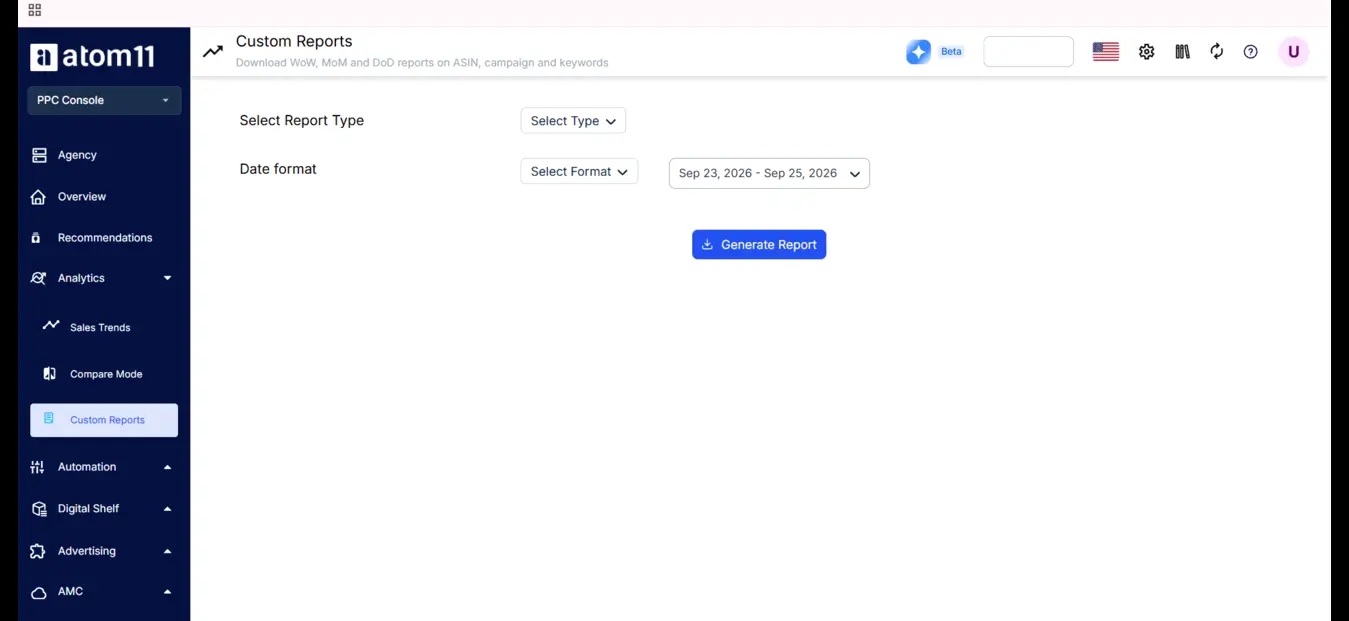
Atom11's dashboards are drag-and-drop and fully customizable, with downloadable ASIN, keyword, and campaign reports at daily, weekly, or monthly cadence, plus Power BI, Looker, and Google Sheets integrations, so you're never waiting on a once-a-month PDF.
4. The Technology Behind the Optimization
This is the point most evaluation checklists skip, and it's arguably the most important one in 2026. Ask what system the agency actually uses to manage bids: is it manual spreadsheet work, a generic rule-based tool, or a platform that connects advertising to retail signals like inventory levels, Buy Box ownership, and competitor pricing? An agency bidding aggressively on a product that's about to go out of stock, or one that keeps spending on an ASIN that's lost the Buy Box, is burning your budget on clicks that can't convert, no amount of keyword strategy fixes that.
This is Atom11's core design: bid and budget automation runs against live inventory levels, Buy Box status, and competitor pricing, with a change preview and audit trail before anything executes, exactly the retail-awareness this checklist point tests for.
5. Verifiable Case Studies and Proof
Any agency can write "helped a brand grow 200% in 90 days" with no name attached. Push for: the client's name (or at least category), the specific baseline they started from, the exact time period measured, and what else changed during that window (a product launch, a price drop, a seasonal spike). If an agency can't answer these four questions about their own case study, treat the number as marketing copy, not evidence.
Rather than unnamed percentage claims, Atom11 points to verified G2 reviews (4.8/5 across 17 ratings) citing specific outcomes,one reviewer reported a 60% ACoS improvement in three months, another a 15-hour weekly reporting time savings.
6. Pricing Model: Flat Fee vs. Percentage of Spend vs. Hybrid
Model | How It Works | Watch Out For |
Flat monthly retainer | Fixed fee regardless of spend | Less incentive to scale spend efficiently if fee doesn't scale with results |
Percentage of ad spend | Typically 10–15% of monthly spend | Can quietly incentivize spending more, since the agency earns more when your budget grows — even if the extra spend isn't profitable |
Tiered / flat-rate software fee | Fee scales with account size, not with how much you spend on ads | Aligns cost with account complexity rather than budget, which removes the incentive problem above |
Hybrid (retainer + performance bonus) | Base fee plus bonus tied to ROAS/ACoS targets | Only as good as how the performance target is defined — make sure it's tied to profit, not just clicks |
There's no universally "correct" model, but you should be able to name, in one sentence, what behavior your agency's pricing structure rewards. If you can't, ask until you can.
Atom11 sidesteps this dilemma entirely, pricing is tiered by account complexity, not a percentage of ad spend, so the fee doesn't grow just because your budget does, removing the exact incentive misalignment this row warns about.
7. Category and Brand-Stage Fit
An agency that specializes in 20K–500K/month brands often isn't the right fit for a $5M/month enterprise account, and vice versa, the operating cadence, reporting depth, and account structure needed at each stage are genuinely different. Ask how many of their current clients are in your revenue range and category.
Atom11 is used by sellers and agencies across 18+ countries, from single-brand accounts to multi-client agency portfolios, because tiered software pricing (not a percentage of spend) scales with account complexity rather than punishing brands for growing revenue.
8. Contract Terms, Notice Period, and Exit Clauses
Get the cancellation notice period, any minimum term, and what happens to your campaign structure, naming conventions, and historical data if you leave. Agencies that build campaigns in a proprietary, hard-to-untangle structure make switching costly on purpose, that's worth knowing before, not after, you sign.
Per Atom11's published terms, billing is monthly with a three-month cancellation notice period, stated upfront rather than negotiated case-by-case, so you know the exit terms before you sign, not after your first invoice arrives.
9. Communication Cadence and Account Manager Continuity
Ask how often you'll get a live call versus an automated report, and what the agency's account manager turnover has looked like over the past year. High turnover means your account keeps getting handed to someone new who has to relearn your business from scratch.
Atom11 pairs a four-week structured onboarding with a dedicated Slack channel and named account contact, so questions get answered in real time rather than at a scheduled monthly call, and continuity doesn't reset each time headcount shifts.
10. Retail-Awareness Beyond the Ad Console
This ties back to point 4, and it deserves its own line item because it's the single biggest gap between agencies that treat Amazon PPC as an isolated line item and ones that treat it as part of a retail system. Ask specifically: does your reporting or technology account for inventory levels, Buy Box status, and organic rank alongside ad performance, or only ad performance on its own?
Beyond inventory and Buy Box, Atom11 also tracks organic search rank and competitor pricing alongside ad performance in one dashboard, so a ranking drop or a competitor's price move shows up next to the ad data causing it.
Red Flags That Signal You Should Walk Away
Unverifiable case studies. No client name, no baseline, no time period, just a percentage.
Reporting that only shows ACoS, with no TACoS or profit-based view.
A sales rep who can't tell you who manages the account after signing.
Pricing tied purely to a percentage of ad spend, with no explanation of how that aligns with your profitability goals.
Long minimum contract terms with vague exit clauses, especially if the agency is reluctant to put notice periods in writing.
No mention of inventory, Buy Box, or pricing when you ask how they decide what to change, a sign the agency is optimizing ads in isolation from the rest of your business.
Promises of guaranteed rankings or guaranteed ROAS numbers before they've even seen your account, Amazon's auction dynamics make blanket guarantees before an audit a marketing tactic, not a commitment.
Amazon PPC Agency vs. In-House Team vs. Software-Only: Which Fits You?
Approach | Best Fit | Trade-Off |
Full-service agency | Brands without in-house Amazon expertise, or those wanting strategy + execution | Higher cost, less day-to-day control |
In-house team + software | Brands with $1M+ Amazon revenue that want full control and institutional knowledge | Requires hiring and training; slower to scale expertise |
Agency + retail-aware platform (e.g., Atom11) | Brands that want expert oversight with shared visibility into the data and decisions | Requires choosing an agency that's willing to work transparently on shared tooling |
Software-only, self-managed | Smaller sellers with time and willingness to learn PPC hands-on | No strategic guidance; results depend entirely on your own learning curve |
How Atom11 Fits Into This Picture
If you've worked through the checklist above, you've probably noticed a pattern: several of the hardest-to-verify criteria, reporting transparency, technology behind the optimization, retail-awareness, come down to whether you can actually see what's happening in your account, or whether you're trusting an agency's word for it.
This is the gap Atom11 was built to close. Rather than positioning itself as a traditional black-box agency, Atom11 operates as a retail-aware Amazon PPC platform that agencies and in-house teams use to manage bidding, budgets, and reporting with full visibility into what's driving each decision .
A few things worth understanding about how it actually works, in plain terms:
Bid decisions factor in retail reality, not just ad data. Atom11 connects PPC automation to live inventory levels, Buy Box status, and competitor pricing, so bids adjust when a product is about to go out of stock or has lost the Buy Box, the exact scenario described in point 4 and point 10 above, where a pure ad-console view keeps spending on clicks that can't convert .
You keep control, not just visibility. Automations run against guardrails you set, target ACoS/ROAS, budget caps, dayparting windows, and you get a preview of what a rule will do before it runs, rather than an algorithm making silent changes.
A version-control "rewind" feature lets account managers save the exact state of bids, budgets, and placement modifiers before a major event like Prime Day and roll back to that state in one click if something goes wrong, a level of accountability that's hard to get from a spreadsheet-based process.
An AI assistant (Neo) answers plain-language questions about why sales moved, cutting down the hours normally spent pulling data from three different reports to diagnose a dip.
Pricing is tiered by account complexity, not a percentage of ad spend; which directly addresses the pricing-incentive issue flagged in point 6, since the fee doesn't grow just because your budget does.
Reporting is built to be shared, not guarded. Custom, drag-and-drop dashboards and downloadable reports mean brands and the agencies managing their accounts are looking at the same data, in real time, instead of a summary delivered once a month.
Conclusion
Hiring an Amazon PPC agency isn't really about finding the agency with the best pitch deck, it's about finding one whose incentives, technology, and reporting all point in the same direction as your actual profit goals. The checklist above won't make the decision for you, but it will surface the answers (or the silence) that tell you whether an agency is a partner or just another line item pulling from your ad budget. Whichever agency or platform you choose, insist on visibility: into who's managing your account, how pricing actually works, and whether the technology behind your bids understands your business beyond the ad console. That visibility is exactly what a retail-aware platform like Atom11 is built to provide, whether you're managing your account in-house or working alongside an agency.
Book a demo with Atom11 today for quick answers on retail-aware bidding, dashboards, and automation.
Disclaimer: This article is intended for general informational purposes and reflects publicly available data and product information as of the publication date. Pricing, benchmarks, and platform features are subject to change; verify current figures directly with cited sources or the referenced companies before making a purchasing decision. This is not financial or legal advice.
FAQs
What should I look for when hiring an Amazon PPC agency?
Focus on who actually manages your account, how transparent their reporting is, whether their pricing model rewards efficiency or just higher spend, and whether their case studies can be verified with a named client, baseline, and time period.
How much does an Amazon PPC agency cost?
Most PPC-only agencies charge 1,500–5,000 per month plus 10–15% of ad spend, while full-service agencies typically run 3,500–12,000+ per month depending on account size and scope.
What's the difference between ACoS and TACoS, and why does it matter when evaluating an agency?
ACoS measures ad spend against ad-attributed sales only, while TACoS measures total ad spend against total revenue. An agency that only reports ACoS can show "improvement" while your overall profitability stays flat, always ask for both.
Is a percentage-of-ad-spend pricing model a red flag?
Not automatically, but it's worth understanding: this model can create an incentive to grow your budget even when the incremental spend isn't profitable. Ask the agency directly how they guard against that.
Do I need an agency if I already use a platform like Atom11?
It depends on your team's bandwidth and Amazon expertise. Many brands use a platform like Atom11 for visibility, automation, and control, and either manage it in-house or pair it with an agency that works transparently on the same dashboard.
