Blog
/
Quartile Pricing: Costs, Add-Ons & Alternatives For Advertisers
Quartile Pricing Guide: Costs, Add-Ons & Alternatives
Neha Bhuchar

Quartile is a recognized PPC tool known for automating bid updates and handling large accounts. However, it is often critiqued for the large number of campaigns it generates, which can make account-level visibility and any manual intervention outside the platform difficult, especially for teams that prefer hands-on control. launches.
On top of this, Quartile’s opaque pricing remains a major obstacle. With no published plans or cost ranges, sellers often move into the sales process without knowing what they will pay or how pricing scales. This lack of transparency often slows decisions and adds unnecessary friction to the evaluation process, making sellers ponder whether Quartile is really worth their money.
In this guide, we take a clear and structured view of how Quartile pricing works, factors influencing it, and where it stands against the cost-effective pricing plans of alternatives like atom11.
What Is Quartile? Platform Overview & Key Features
Quartile is an AI-driven PPC optimisation platform that helps brands and agencies manage and improve their advertising campaigns, campaign management, and overall marketing performance on Amazon, as well as other marketplaces like Walmart, Instacart, and Criteo.
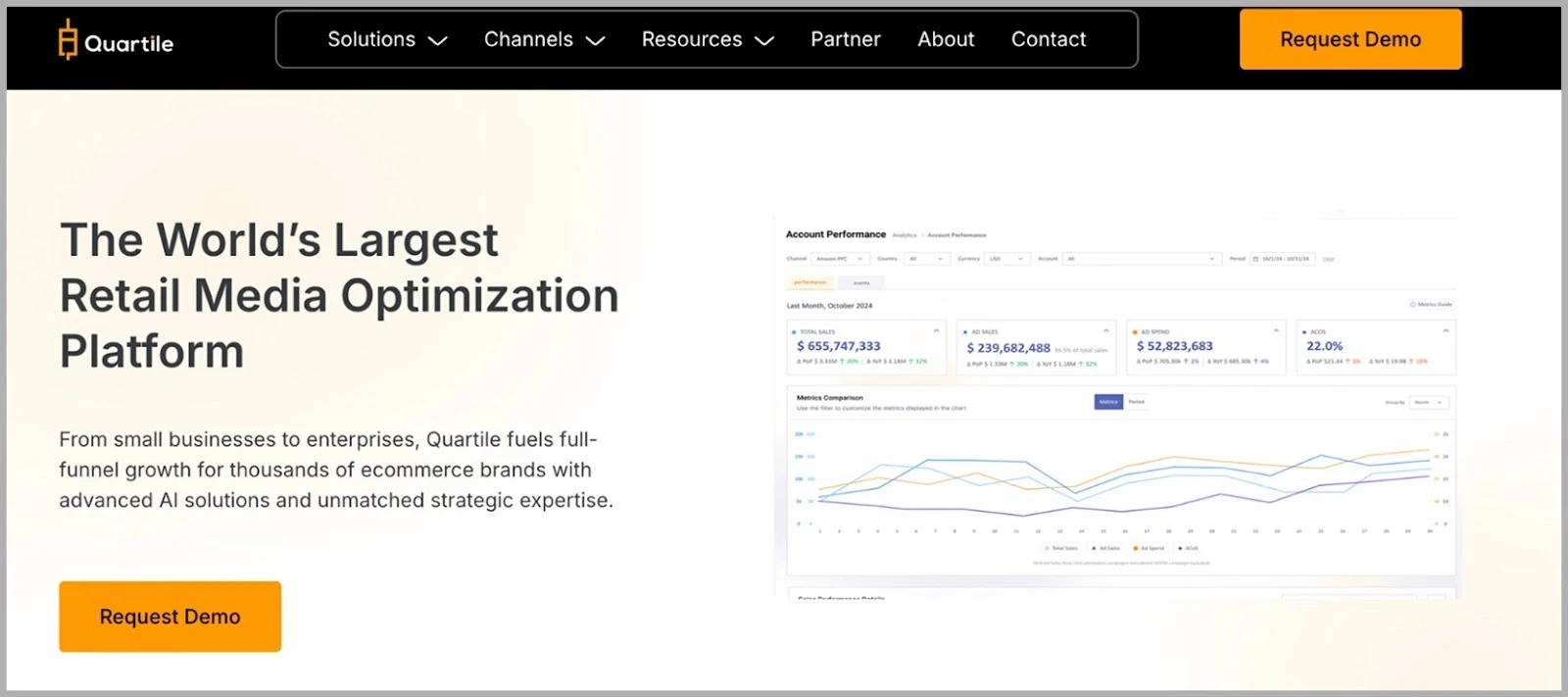
The platform uses artificial intelligence and machine learning to automate, manage, and optimize ad campaigns with automated ad management, performance reporting, and full-funnel strategy implementation.
Key Features of Quartile
Before choosing the platform, it is important to know what Quartile can do. Here are the core features that shape how the tool works and what users can expect.
AI-based bid adjustments: Adjusts bids automatically based on performance data
Automated campaign creation and optimization: Builds campaigns without manual setup and helps improve the cost of sales performance
Keyword and product targeting expansion: Identifies new targets to grow reach and strengthen keyword research
Multi-channel support: Manages ads across Amazon and select additional channels like Google Ads and shopping ads
Performance dashboards: Show clear reports for tracking daily results
Optimization workflows: Applies preset logic to maintain campaign health
Portfolio-level management: Groups campaigns to manage budgets at scale
How Quartile Pricing Works
Quartile pricing structure follows a custom-quote pricing model, so it does not display fixed plans or standard monthly fees on its website. To understand what the platform will cost, users need to request a personalized quote. This is something many new users notice during the onboarding learning curve.
The final price depends on several factors, such as monthly ad spend, the number of channels, account complexity, and any additional services required.
Once you submit your details (including credit card information during signup), Quartile schedules a short discovery call to review your setup. After this discussion, the team shares a tailored quote based on your Amazon business needs.
How can users request a custom quote from Quartile?
Users can request a quote for Quartile through a simple online process. The platform collects basic details first and then reviews your account before sharing a final price. Here’s how the process works:
Step 1: Go to Quartile’s homepage and access the “Request Demo” section.
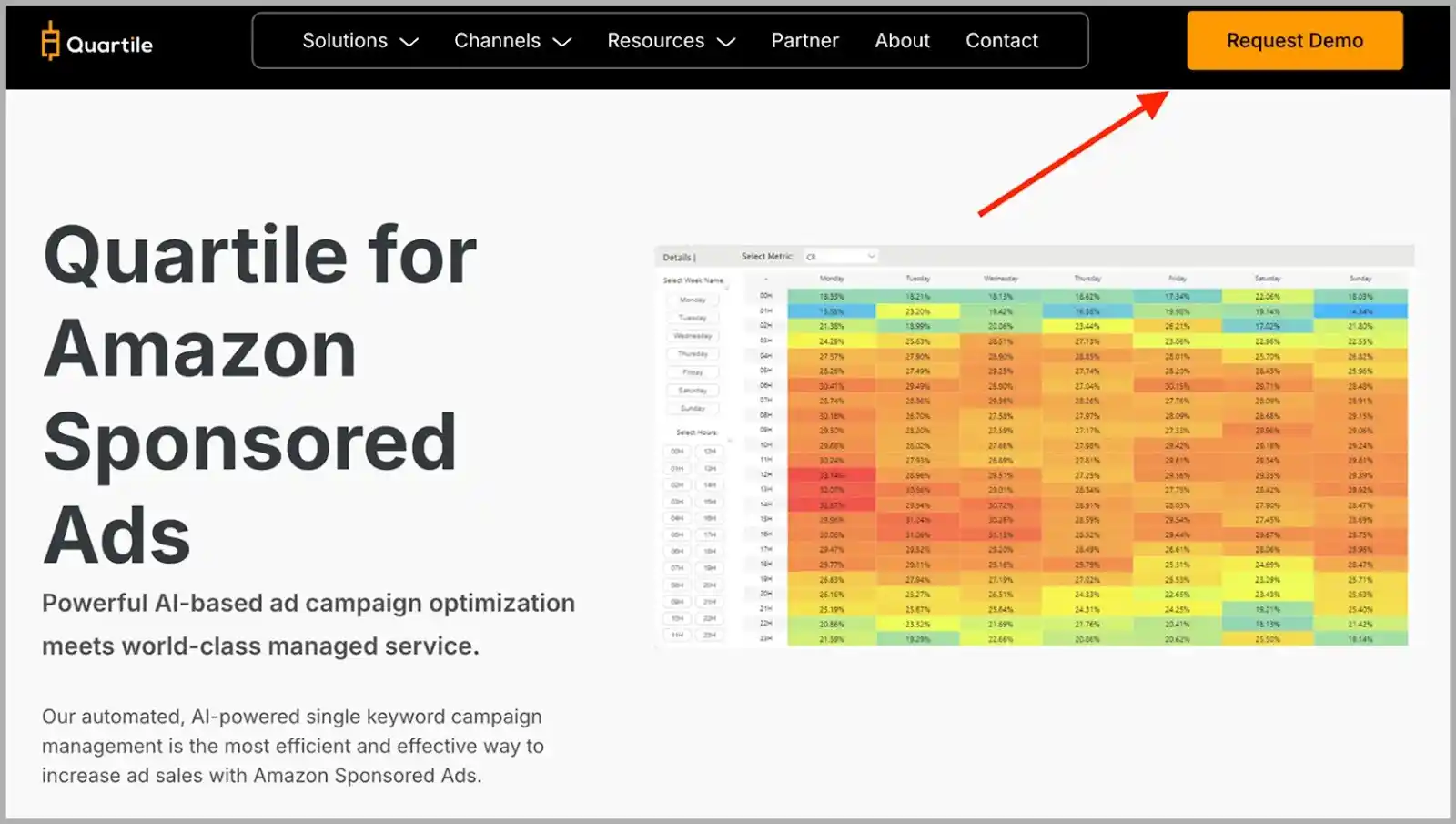
Step 2: Enter basic information about your business, monthly ad spend, and channels you want to manage.
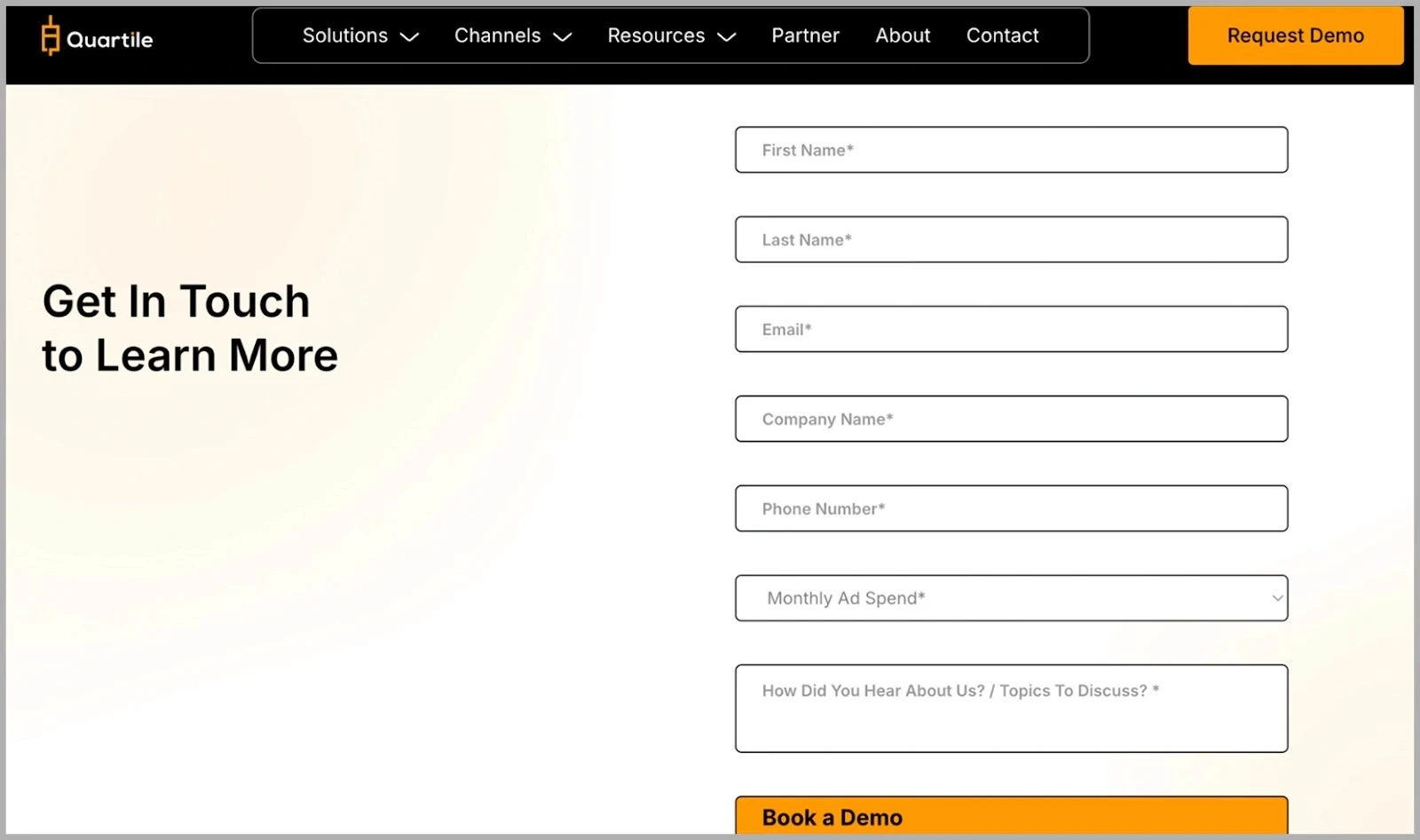
Step 3: Book a demo call. A sales representative contacts you to set up a short call to understand your account structure and goals.
Step 4: Allow the Quartile team to review your current campaigns, data volume, and channel needs.
Step 5: Once the review is complete, the team shares a pricing estimate tailored to your requirements.
Quartile cost analyses from third-party sources and customer feedback
Because Quartile doesn’t publish its pricing, the most reliable way to understand what advertisers actually pay is by reviewing feedback on platforms like G2, Capterra, and other software comparison sites.
These reviews below reveal consistent patterns around overall cost, unexpected add-ons, and how pricing shifts with account needs.

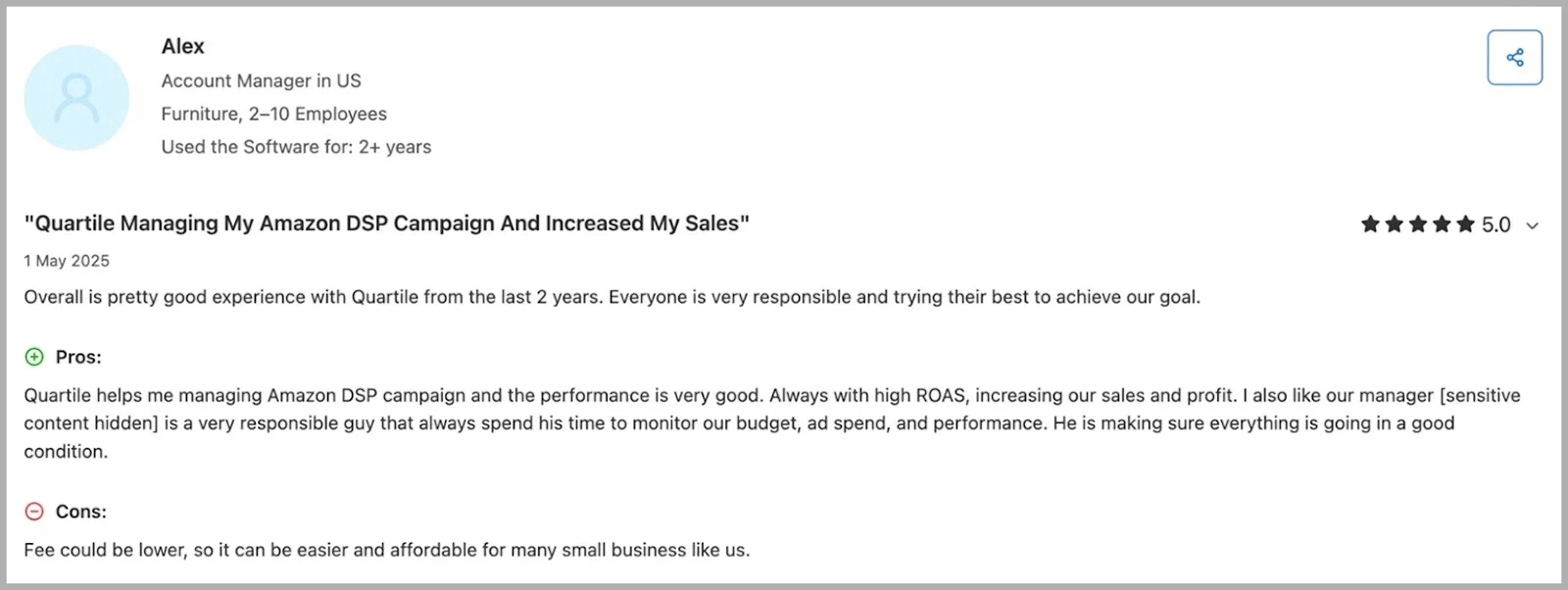
A recurring point in these reviews is related to DSP (Demand Side Platform), Amazon’s programmatic advertising platform for running display, video, and off-Amazon campaigns that support full-funnel advertising beyond Sponsored Ads.
A G2 reviewer noted that Amazon DSP is not included in the core package, meaning advertisers must pay extra if they want Quartile to manage DSP alongside Sponsored Ads. This adds to the total monthly cost for multi-channel users and is an important detail for sellers budgeting for full-funnel advertising.
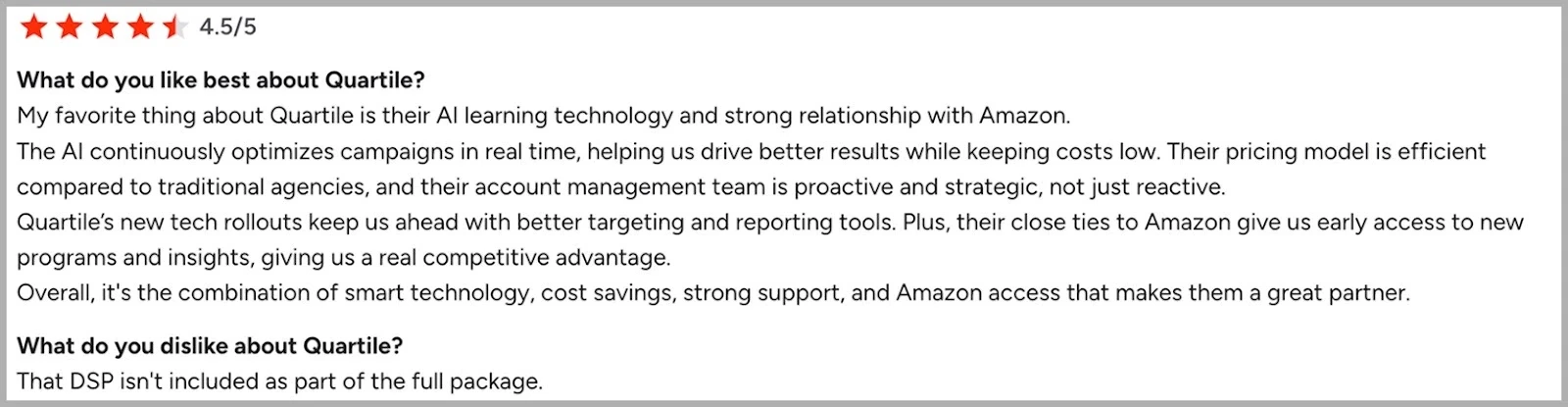
Across platforms, user reviews indicate that:
Quartile works best for advertisers with larger budgets who can handle a longer ROI timeline and a multi-month optimization cycle.
Pricing scales aggressively with spend, causing subscription costs to rise as budgets increase.
Add-on fees, especially DSP, can substantially raise the total monthly cost.
Budget-constrained sellers experience the most friction with Quartile’s pricing model.
What does this mean for advertisers?
Third-party feedback suggests that Quartile offers strong automation capabilities, but its pricing structure, extra fees, and longer ROI window make it a better fit for medium to large advertisers, not early-stage or low-spend sellers who require predictable, upfront pricing.
8 Key Factors That Influence Quartile’s Pricing
Quartile calculates pricing by estimating how much data your account generates and how much automation work the platform must handle each day. The more campaigns, targets, channels, and optimization cycles your setup requires, the higher your quote will be.
The following are the eight factors that directly influence Quartile costs:
Monthly ad spend volume
Your ad spend dictates how many bid updates Quartile must run and how frequently the system needs to optimize your campaigns. For instance,
A seller spending $5,000/month may generate a few thousand bidding decisions per week.
A seller spending $50,000/month can generate tens of thousands.
More spend means more traffic, clicks, and more conversion data, resulting in more optimization cycles.
| Related read: How Much Does Amazon Advertising Cost in 2026?
Number of additional channels or marketplaces
Whether Amazon US, UK, or Canada, every additional marketplace adds its own campaigns, keyword lists, bidding behaviour, and reporting cycles. Quartile must optimize each of these independently.
So when you manage four marketplaces instead of one, the platform handles four times the campaigns, data, and daily bid decisions. This increased workload directly raises your quote.
Amazon DSP integration
Amazon DSP campaigns operate on larger audiences and require different bidding logic, more frequent budget pacing, and impression-level reporting instead of keyword-level insights. This requires more data for Quartile to process, as compared to sponsored ads.
Such a higher volume of targeting, reporting, and optimization work is why DSP almost always comes with an added monthly fee in Quartile pricing.
| Related read: Amazon DSP vs Sponsored Display Ads: All You Need to Know
Account history and data volume
Older accounts carry more data, archived keywords, legacy campaigns, and outdated structures, which Quartile must clean and reorganize before optimization.
The more data Quartile has to handle, the more work the system must perform, which directly influences your quote.
Number of Amazon Seller Accounts connected
Each Seller Account functions as a separate environment with its own budgets, campaigns, targeted ASINs, reporting, and optimization cycles. An agency managing six accounts creates six times the workload of a single-brand setup, which directly increases pricing.
Non-Amazon channels and custom requirements
If you run ads on channels like Walmart, Target, Google Shopping, and Instacart, Quartile must integrate that data and optimize those campaigns too.
Each channel uses different metrics and structures, which increases the required automation logic. Custom rules, special reports, or bespoke campaign workflows also add to the setup time, and therefore to the final price.
Contract length and commitment level
A longer contract, such as a 12-month agreement, gives Quartile more stability, so you may receive better pricing. A shorter, month-to-month contract offers more flexibility for you but usually costs more because it is riskier for the provider.
Additional influential factors
Quartile also considers broader business factors when finalizing your quote. Startups often need more support, while mature brands generate larger data sets that require deeper processing.
Fast-growing accounts trigger more optimization cycles, and businesses with higher revenue, more SKUs, and heavier traffic create larger campaign workloads. These elements increase the ongoing optimization demand, so a fast-scaling brand typically falls into a higher pricing bracket than a stable brand with a fixed setup.
Key Considerations Before You Sign Up for Quartile
Before choosing Quartile, it’s important to understand where the platform performs well and where it may not align with your needs. These points will help you assess whether your business is in the right stage, budget range, and workflow style to benefit from its automation model.
What makes the platform worth your money
✅Works well for advertisers with large product catalogues (e.g. 50,000+ ASINs) spend
✅Delivers stronger results for accounts with steady product lines
✅Reduces manual work for teams that prefer hands-off optimization
✅Built around a proprietary single-keyword, single-ASIN campaign structure
✅Performs better when there is enough data volume for its AI to optimize
When Quartile might not be the right fit
Quartile may not be the best choice if you:
❌ Work with a small or limited monthly ad budget
❌ Need fast or immediate ROI from your ad PPC optimization tool
❌ Prefer retaining the ability to manually adjust bids, targeting, and campaign structure
❌ Best suited for advertisers comfortable with longer-term contracts
❌ Need stable, predictable monthly costs for budget planning
❌ Rely on pricing transparency when choosing software
Quartile vs atom11: Pricing Structure and Costs Comparison
Criteria | atom11 | Quartile |
Pricing transparency | Fully published, tier-based, value-focused | No public pricing; custom quotes only |
Pricing model | Flat monthly fees + optional pay-per-use modules | Tiered monthly fees tied to ad spend; additional charges possible |
Onboarding experience | White-glove onboarding + account manager | |
Automation style | Rule-based, retail-aware, fully transparent | Automation-led approach with minimal manual intervention and limited control |
Reporting detail | Deep retail-aware analytics + custom reporting | Cross-channel advertising data |
Usability | Built for individual sellers and advanced PPC teams seeking precision | Built for advertisers preferring managed service |
Best for | Intermediate to large, advanced advertisers seeking full control over their ads | Mid-market and enterprise brands that do not want any control on ads |
Unlike Quartile, Atom11 offers a transparent, upfront pricing approach that many advertisers value well before they begin a trial. The platform offers a predictable, value-based, tiered pricing so that advertisers are aware of exactly what they’re paying for.
Here’s atom11’s pricing structure:
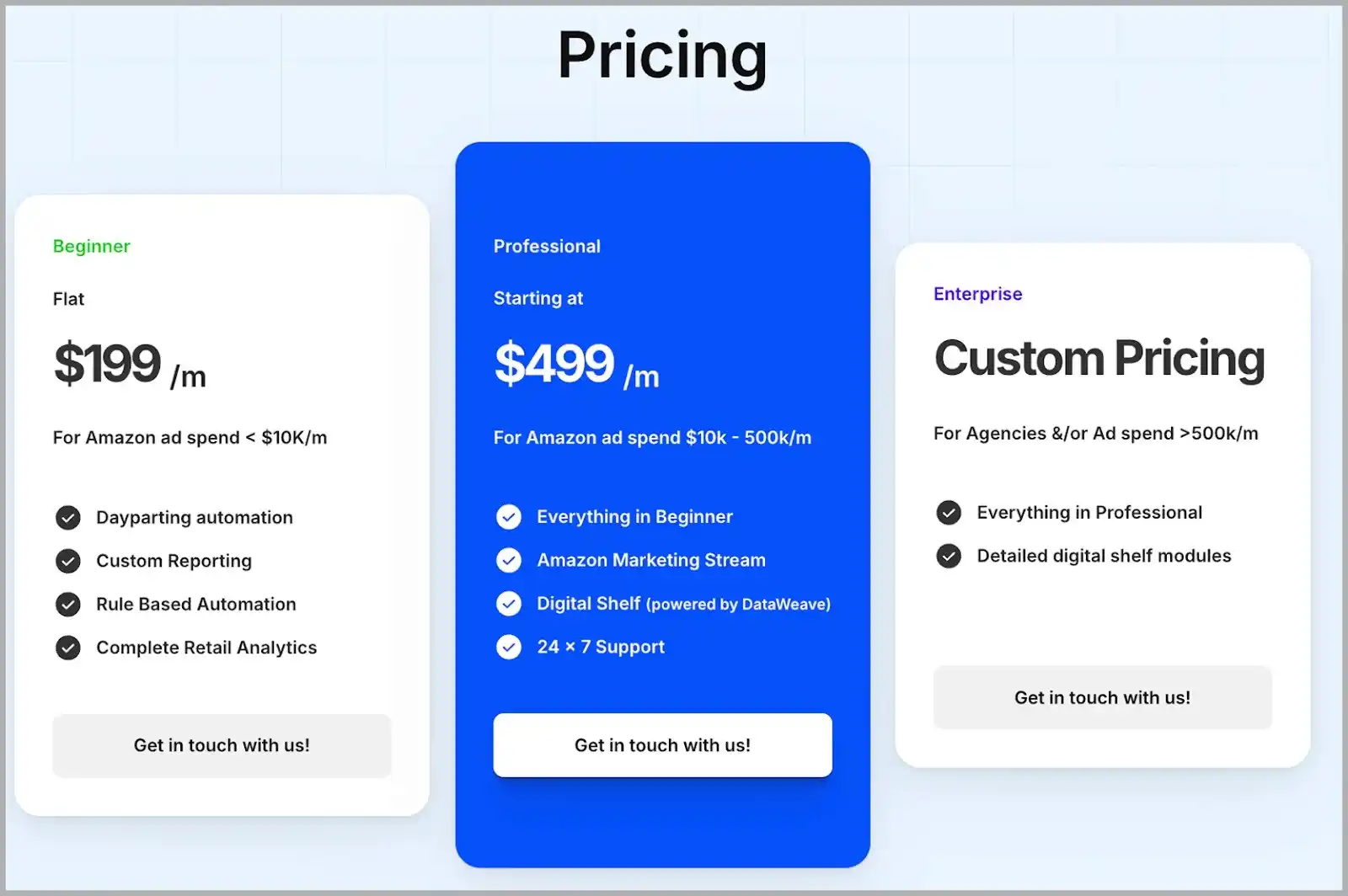
atom11 is priced around retail awareness that combines:
inventory signals
pricing insights
digital shelf visibility
competitor movements
hourly performance data
This creates more contextually accurate automations that don’t rely solely on isolated ad metrics, delivering better efficiency and faster goal achievement.
Sellers neither pay a percentage of ad spend (but a flat fee) nor any hidden add-ons (everything included is published). They also get optional pay-per-use modules (e.g., Power BI & Looker exports at $100/month, additional Digital Shelf usage) that are disclosed upfront. This makes budgeting straightforward, even as your ad spend scales.
You can read more about atom11’s transparent and cost-effective pricing plans by visiting atom11’s pricing page.
Summing Up
atom11’s pricing transparency is particularly valuable for growth-stage brands, agencies managing multiple accounts, as well as small businesses that need predictable operational costs.
On the other hand, Quartile’s AI-driven, hands-off optimization approach makes sense for larger brands that want to delegate PPC execution, but the trade-off is pricing opacity and less granular control.
Conclusion: Making an Informed PPC Platform Decision
Quartile’s opaque pricing makes it difficult for sellers to assess true cost and long-term value, which is why understanding the factors that shape your quote is essential before committing.
If you prefer predictable costs and transparent plans, tools like atom11 offer clearer pricing, stable monthly fees, and strong alignment for growing Amazon businesses. atom11 also provides the right balance of automation with advanced features and control without unexpected budget swings.
Book a demo with us to see how atom11 can support your advertising goals.
FAQs About Quartile Pricing
How much does Quartile actually cost, and what should I expect to pay?
Quartile does not publish its pricing, but based on aggregated third-party sources and customer feedback, you can expect monthly costs to depend on your monthly ad spend, number of channels, and whether you add Amazon DSP. Your final cost may increase if you manage multiple marketplaces or require additional support.
What’s included in each Quartile pricing tier or plan?
As Quartile doesn’t disclose its pricing publicly, users can only request customized pricing by booking a platform demo. The team will revert with the inclusions and add-ons on the call.
What are the current pricing plans for Quartile in 2025?
Quartile doesn’t reveal its costs or pricing tiers publicly.
Are there hidden fees with Quartile (extra channels, DSP, onboarding, long-term contracts)?
Quartile does not hide fees, but the cost escalators are not clearly disclosed upfront, which creates the perception of hidden charges.
Does Quartile offer a free trial or demo for their pricing plans/Are trial options available before committing?
No, Quartile doesn’t offer any free trial options. Platforms like atom11 offer a 7-day free trial without any credit card details.
Is Quartile pricing worth it for sellers spending less than $10K/month on Amazon ads?
For sellers with ad spend under $ 10,000 per month, Quartile may not be cost-efficient. The platform needs higher data volume to optimize effectively, and results may take months to appear, making it more suitable for mid-to-large advertisers.
If your ad spend is below the $10K mark, atom11 offers a clearer and more predictable option at $199/month. You get essential capabilities like dayparting automation, rule-based optimization, custom reporting, and complete retail analytics, without any additional charges. Contact us for more details.
7. What should I ask Quartile’s sales team during the pricing call to avoid overpaying?
To get an accurate and fair quote, you should directly ask:
Base monthly fee for your spend tier
Add-on costs for channels, DSP, or support
Tier changes if your ad spend increases
Minimum commitment and cancellation terms
Timeline for expected performance results
These questions eliminate pricing ambiguity and prevent unexpected escalations as your account scales.
How does Quartile’s pricing compare to transparent competitors like atom11, Pacvue, m19, or Xnurta?
Quartile’s custom-quoted pricing can feel opaque when compared to platforms that publish clear starting prices, such as atom11 (from $199/month), m19, Xnurta, or Pacvue. The transparent pricing offers predictable monthly costs and helps avoid spend-based increases, allowing sellers far more control and clarity as they scale.
FAQs
How much does Quartile actually cost, and what should I expect to pay?
Quartile does not publish its pricing, but based on aggregated third-party sources and customer feedback, you can expect monthly costs to depend on your monthly ad spend, number of channels, and whether you add Amazon DSP. Your final cost may increase if you manage multiple marketplaces or require additional support.
What’s included in each Quartile pricing tier or plan?
As Quartile doesn’t disclose its pricing publicly, users can only request customized pricing by booking a platform demo. The team will revert with the inclusions and add-ons on the call.
What are the current pricing plans for Quartile in 2025?
Quartile doesn’t reveal its costs or pricing tiers publicly.
Are there hidden fees with Quartile (extra channels, DSP, onboarding, long-term contracts)?
Quartile does not hide fees, but the cost escalators are not clearly disclosed upfront, which creates the perception of hidden charges.
Does Quartile offer a free trial or demo for their pricing plans/Are trial options available before committing?
No, Quartile doesn’t offer any free trial options. Platforms like atom11 offer a 7-day free trial without any credit card details.
