Blog
/
Pacvue vs Skai for Amazon Advertising: Which One Is Better?
Pacvue vs Skai (Kenshoo): Which PPC Platform Wins in 2026?
Neha Bhuchar

Introduction
Among the top contenders, Pacvue and Kenshoo (now rebranded as Skai), brands and agencies often struggle to decide which tool delivers better performance on their ad campaigns, automation flexibility, and ROI. Amazon-focused sellers face an even harder question: are these enterprise omnichannel platforms the right fit at all?
The good news? You don't need a $5,000 monthly software budget to access sophisticated PPC automation. The Amazon advertising landscape now offers specialised alternatives that deliver enterprise-level capabilities at accessible prices while actually understanding what makes Amazon unique.
This guide breaks down both platforms across pricing, features, usability, automation depth, and reporting. We'll also reveal how atom11 compares as a retail-aware, rule-based alternative built specifically for Amazon sellers who want real spend efficiency without the enterprise complexity.
What Are Pacvue and Skai (Kenshoo)?
Pacvue Overview
Pacvue launched in 2016 as an enterprise-grade commerce acceleration platform focused on retail media management. The platform serves brands advertising across Amazon, Walmart, Instacart, and other retail channels.
Strengths:
Rule-based automation with customizable triggers
Strong reporting and analytics dashboards
Multi-marketplace management capabilities
Popular among agencies managing multiple client accounts
Weaknesses:
Complex user interface with steep learning curve
High pricing is unsuitable for small to mid-size sellers
Requires significant time investment for setup and management
Pacvue targets enterprise brands and agencies spending $50,000+ monthly across multiple retail media platforms. The platform's breadth comes at the cost of depth in Amazon-specific features.
Skai (Kenshoo) Overview
Kenshoo rebranded as Skai in 2020, positioning itself as a data-driven omnichannel marketing platform. Originally built for search and social advertising, Skai expanded into retail media, including Amazon, as part of its broader offering.
Strengths:
AI-driven optimization with ROAS targeting and performance forecasting
Omnichannel commerce media across retail media, paid search, paid social, display, and CTV, spanning 300+ publishers in one interface
Deep customization via Skai Labs (custom dashboards, data integrations, automation frameworks)
Strong competitive intelligence and cross-retailer benchmarking
20+ years of enterprise ad-tech experience with large brands and agencies
Weaknesses:
Built for brands and agencies, not individual Amazon sellers, so omnichannel breadth adds complexity for Amazon-only teams
Enterprise pricing and minimum-spend requirements put it out of reach for most small and mid-size sellers
No native retail-operations signals (inventory, Buy Box, pricing) tied into ad automation
Steep learning curve given the platform's scope
Skai serves brands and agencies managing significant ad spend across multiple channels and retail media networks. For teams focused primarily on Amazon retail operations, the platform's omnichannel approach can introduce complexity beyond what they need.
Why Amazon Sellers Need Tools Specialized to Amazon
Amazon sellers need PPC software that’s built specifically around Amazon’s own signals (inventory, Buy Box status, organic rank, category trends) because these directly determine whether ad spend is profitable. An Amazon-focused PPC tool like atom11 can tightly connect ad metrics (ACoS, ROAS, CTR) with retail data and automate platform-specific actions, such as pausing ads on out-of-stock products or adjusting bids when the Buy Box is lost.
Multi-marketplace platforms like Skai or Pacvue must stay generic enough to work across Amazon, Walmart, Google, and more, so Amazon becomes just one channel in a broader template. This often means less granular access to Amazon data, more abstract reporting, and optimization rules that are not fully tuned to Amazon’s auction mechanics, limiting control and performance for sellers who rely mainly on Amazon for revenue.
Pacvue vs Skai (Kenshoo): Complete Feature Comparison
In this section, we'll systematically compare Pacvue and Kenshoo, plus a third software to place their features in the wider context. This will help you choose which one’s best for your needs.
Feature | Pacvue | Skai (Kenshoo) | atom11 |
Automation Type | Rule-based | AI-based | Rule-based + Retail-aware |
Supported Platforms | Amazon, Walmart, Instacart, others | Amazon, Google, Meta, TikTok + 300+ publishers across retail, search, social, display, CTV | Amazon (deep specialization) |
Campaign Management | Multi-marketplace dashboard | Omnichannel dashboard | Amazon-focused interface |
Bid Optimization | Rule-based with scheduling | AI-driven predictive | Custom rules + Real Bid tracking |
Budget Control | Automated with dayparting | Automated pacing + forecasting | Automated with dayparting |
Keyword Management | Yes | Yes | Harvester + Negator automation |
Inventory Integration | Partial via API | No | Native integration |
Buy Box Awareness | No | No | Yes (pause ads when lost) |
Organic Rank Integration | Yes | No | Yes (adjust bids by position) |
Placement Optimization | Yes | Yes | Yes + Real Bid visibility |
Reporting Depth | Strong for agencies | Cross-channel analytics | Retail + Ads unified dashboard + Ability to create automated refreshable reports on Google Sheets |
Learning Curve | High (2 to 3 months) | Very High (3+ months) | Low (1 to 2 weeks) |
AI Copilot | Limited | Celeste AI | Neo (Amazon-trained) |
Onboarding Support | Self-service for most tiers | Enterprise only | Dedicated to pro and custom plans |
Starting Price | Custom Pricing | $114K/year | $499/month |
Contract Length | Annual | Annual | Monthly & annual |
Best For | Agencies, multi-channel brands | Enterprise omnichannel advertisers | Amazon-focused sellers, brands, and agencies |
G2 Rating |
Automation Capabilities
Pacvue's Rule-Based Automation
Pacvue offers rule-based automation where you set conditions and actions. For example: "If ACoS exceeds 25% for three days, reduce bid by 10%." The platform supports complex rule chains with multiple conditions.
Strengths:
Predictable, controllable automation
Schedule-based rule execution
Custom rules for different campaign types
Limitations:
Rules operate on advertising metrics only, ignoring retail context
No visibility into the actual bid after placement of multipliers
Limited real-time response compared to AI systems
Pacvue's automation works well for straightforward campaign optimization tasks but lacks the retail awareness needed for sophisticated Amazon strategies.
Skai (Kenshoo)'s AI-Driven Engine
Skai uses machine learning to predict performance and automatically adjust bids. The AI analyses historical data, seasonality patterns, and cross-channel signals to optimize campaigns.
Strengths:
Predictive optimization across channels
Automated budget pacing and reallocation
Advanced forecasting capabilities
Limitations:
Less transparency into optimization logic compared with explicit rule-based control
Designed for omnichannel commerce media rather than deep Amazon retail-operations integration
Doesn't incorporate inventory, Buy Box, or pricing signals the way a retail-aware tool does
Built for enterprise scale, so harder for smaller Amazon-only teams to adopt
For Amazon-only teams that want explicit, rule-level control and retail-aware triggers, atom11's approach offers more direct oversight of why and when bids change.
How atom11 Excels in Automation
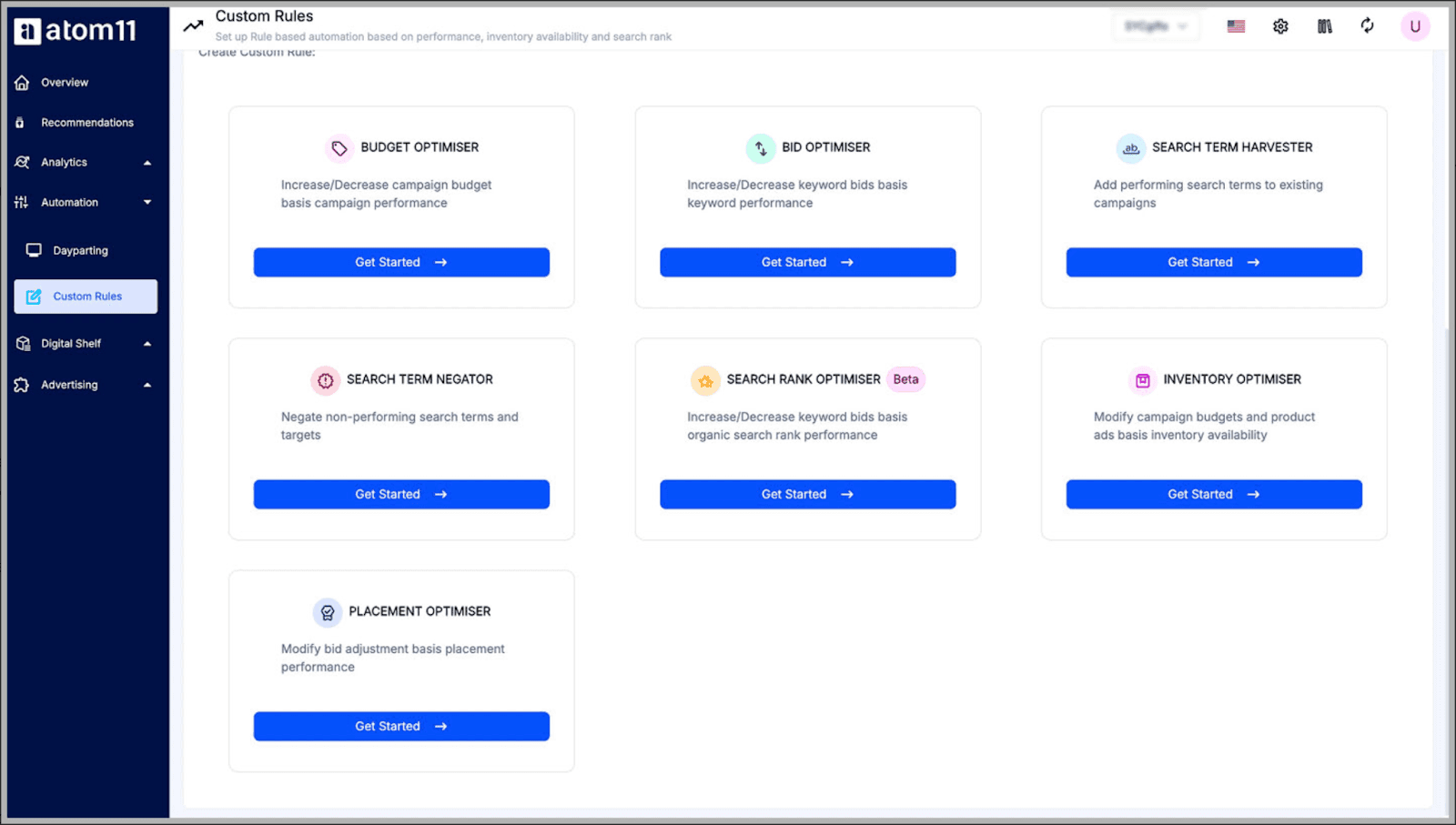
atom11 combines rule-based precision with retail awareness, giving you control while automating the tedious work and day-to-day PPC optimization.
Core Automation Features:
Custom Rules Engine: Build rules using ACoS, ROAS, CTR, conversions, spend, and more.
Bid & Budget Optimizers: Auto-adjust bids and budgets based on performance trends.
Search Term Automation: Promote winning keywords and negate poor performers automatically. All of the above run inside atom11's amazon sponsored ads tool, purpose-built for SP, SB, and SD without the multi-marketplace overhead of Pacvue or Skai. Learn the strategic importance of negative keywords in our guide to search term negation
Real Bid Tracking: See true bid values after placement multipliers for full cost visibility. Real bid tracking runs on live data atom11's amazon marketing stream tool captures hourly bid execution from Amazon Marketing Stream, so cost visibility is real-time, not next-day.
Retail-Aware Automation (Unique to atom11):
Inventory & Buy Box Protection: Pause ads when stock is low or Buy Box is lost.
Rank-Aware Bidding: Adjust bids based on Best Seller Rank and organic position to protect ROI and momentum.
Reporting and Analytics
Pacvue Reporting Capabilities
Pacvue excels at reporting, especially for agencies managing multiple client accounts. The platform offers customizable dashboards, scheduled reports, and cross-marketplace comparisons.
Reporting Features:
Campaign performance across retail channels
Keyword-level analytics with search term reports
Budget pacing and spend tracking
Custom report builder with data exports
Limitations:
Reports focus on advertising metrics in isolation
Limited correlation between ad performance and retail factors
Difficult to identify the root causes of performance changes
No integration with inventory or pricing data
Skai (Kenshoo) Analytics Platform
Skai provides sophisticated data visualization and cross-channel attribution, along with advanced features for analyzing performance across publishers. The platform's strength lies in understanding how advertising across different channels works together.
Analytics Features:
Advanced data visualization with custom charts
Cross-channel attribution modelling
Performance forecasting and trend analysis
Integration with business intelligence tools
Limitations:
A complex interface requires training to navigate
Harder to isolate Amazon-specific performance issues
Reports mix Amazon data with other channels, reducing clarity
No retail context (inventory, pricing, Buy Box) in analytics
How atom11 Enhances Insight
atom11 provides unified dashboards that combine advertising performance with retail signals for complete visibility.
Dashboard Features:
Overview Dashboard: Sales, spend, ACoS, TACoS, conversion rates, and ROAS at campaign, ad group, and ASIN levels
Sales Trends Dashboard: Identifies root causes of performance changes by correlating ad metrics with inventory, pricing, and Buy Box status
Recommendations Engine: Provides personalized, actionable suggestions to move your campaigns closer to your target ACoS based on your account data
Real Bid Visibility: Shows actual bids after placement multipliers, preventing surprise costs
AI Copilots and Intelligence Features
Pacvue's AI Capabilities
Pacvue offers limited AI features focused primarily on bid optimization suggestions and keyword recommendations. The platform leans more heavily on rule-based automation than AI-driven decision making.
AI Features:
Bid recommendation engine
Keyword expansion suggestions
Performance anomaly detection
Limitations:
AI features feel like add-ons rather than core functionality
Additional costs reporting and retail-aware analytics
Dayparting overrides all bid and budget changes done manually
Skai (Kenshoo) Intelligence
Skai's generative AI agent, Celeste AI, is purpose-built for commerce media marketers, surfacing performance insights, accelerating campaign analysis, and identifying optimization opportunities.
Features:
Predictive performance forecasting
Automated budget allocation across channels
Natural language report generation
AI-powered insights and recommendations
Strengths:
Sophisticated AI trained on massive cross-channel datasets
Strong for predicting trends and optimizing omnichannel budgets
Limitations:
Optimized for omni-channel commerce media rather than deep Amazon retail-operations integration
Limited conversational capabilities for campaign management
Expensive add-on requiring higher-tier pricing
atom11's Neo: Amazon-Specialized AI Copilot
atom11 launched Neo, an AI copilot trained specifically on Amazon advertising patterns and retail context. Neo understands the nuances of Amazon PPC in ways generic AI cannot.
Neo's Capabilities:
Natural Language Campaign Management: Comprehend prompts in plain English, like "Increase bids by 15% on all campaigns with ACoS below 20%"
Conversational Analytics: "Why did my ACoS spike last week?" Neo analyses and explains in plain language
Strategic Recommendations: Suggest specific actions based on your account performance, not generic best practices
Amazon-Specific Knowledge: Understands concepts like Buy Box dynamics, organic rank cannibalization, and BSR fluctuations
Atom11’s Neo has even won the AI Innovation Award at the Amazon Partner Awards 2025.
Onboarding and Support
Pacvue Onboarding
Pacvue offers self-service onboarding for most pricing tiers, with dedicated support reserved for enterprise contracts. New users navigate extensive documentation and video tutorials to learn the platform.
Onboarding Process:
Self-guided platform tour
Knowledge base and video library
Community forums for peer support
Dedicated account manager (enterprise tier only)
Timeline: 2 to 3 months to become proficient
The complex interface and lack of guided onboarding mean most sellers struggle for months before feeling comfortable with the platform.
Skai (Kenshoo) Onboarding
Skai provides onboarding support for enterprise clients only. The platform's complexity requires extensive training, typically delivered through scheduled sessions over several weeks.
Onboarding Process:
Initial setup and integration support
Scheduled training sessions (enterprise only)
Documentation and certification programs
Quarterly business reviews (high-tier contracts)
Timeline: 3+ months to achieve proficiency
Skai's omnichannel complexity means even experienced advertisers need significant training. For Amazon-only sellers, much of this training covers irrelevant features.
atom11's Onboarding
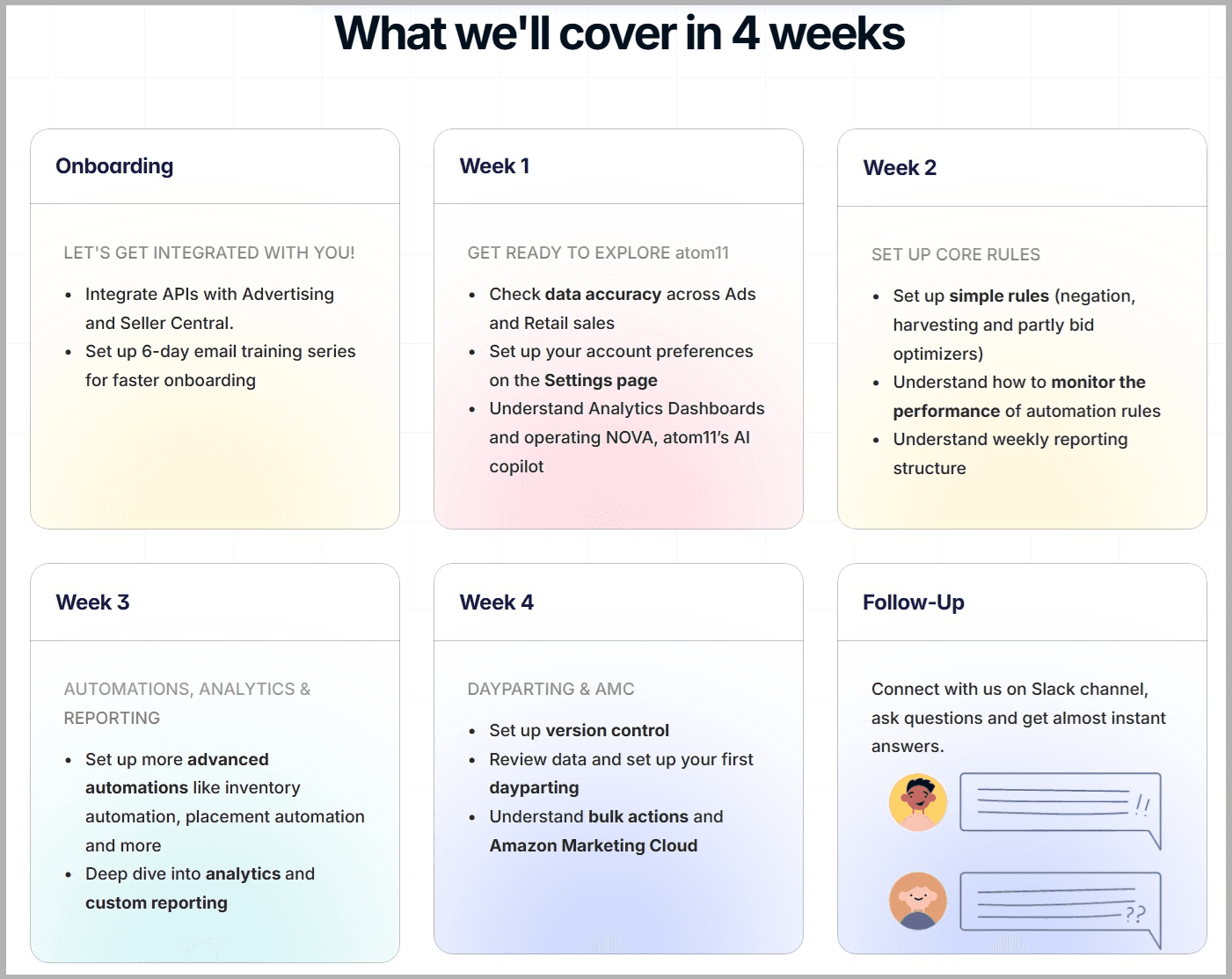
atom11 provides dedicated onboarding support for all pricing tiers, ensuring sellers succeed quickly regardless of their plan level.
Ongoing Support:
Regular check-ins during the first 90 days
Performance reviews and optimization suggestions
Priority support response times
Access to Amazon PPC management and strategy resources
This hands-on approach means sellers don't waste months learning a complex platform. You're optimizing Amazon advertising campaigns and reducing costs within weeks, not quarters.
Explore atom11's comprehensive onboarding program: Onboarding for Amazon Sellers.
Pricing Comparison: What Does Each Platform Cost?
Cost Factor | Pacvue | Skai (Kenshoo) | atom11 |
Free trial? | No | Yes | Yes, 30 days |
Starting Price | Custom Pricing | $114K/year | $499/month |
Setup Fee | Unknown | Unknown | $0 |
Contract | Annual required | Annual required | Options Available |
Platform Fee | 3-4% of ad spend | 3-7% of ad spend | None |
Minimum Spend | $50,000/month | $100,000/month | None |
Pacvue Pricing Structure
Pacvue doesn't publish pricing publicly, requiring sales conversations for quotes. Based on industry data and user reports, expect the following:
Estimated Pricing:
Platform fees are typically 3% to 5% of ad spend
Annual contracts required (no month-to-month option)
Additional charges for premium features and integrations
For smaller sellers and mid-size Amazon businesses spending $5,000 to $50,000 monthly, Pacvue's pricing is prohibitively expensive, especially given the learning curve and time investment required.
Skai (Kenshoo) Pricing Structure
Skai targets enterprise advertisers with pricing to match. The platform's omnichannel approach means you're paying for features you may not need if you're focused primarily on Amazon.
Estimated Pricing:
Platform fees: 3% to 7% of managed ad spend
Annual contracts required with quarterly minimums
Skai Intelligence (AI features): Additional 15% to 25% premium
For Amazon-focused sellers, Skai's pricing structure charges you for omnichannel capabilities you won't use. The platform makes sense when you need integrated management across multiple advertising channels, not for Amazon-only strategies.
atom11 Pricing: Transparent and Accessible
atom11 offers straightforward, transparent pricing designed for Amazon sellers and agencies at all levels.
Estimated Pricing:
No setup fees
No platform percentage fees
No additional charges for premium features
Why atom11 Is the Smarter Alternative for Amazon Sellers
atom11 goes beyond ad metrics by combining advertising data with retail signals like inventory levels, pricing, Buy Box status, and organic rank, giving you a true picture of what drives performance.
Retail-Aware Automation: Dynamically adjusts bids or pauses ads when stock runs low or the Buy Box is lost.
Custom Rules + Real Bid Visibility: Build granular rules using ACoS, ROAS, CTR, and conversions, and see the actual bid after placement multipliers for total transparency.
Placement Optimizer: Automatically adjusts bids across Top of Search, Product Pages, and Rest of Search based on performance. To understand placement strategy in depth, read our Amazon Ads Placement 101 guide covering how placement multipliers impact your true bid costs and conversion rates.
Advanced Dashboards: Explore Sales Trends, Root Cause Analyser, and the AMC Suite to uncover insights that go beyond PPC metrics.
Version Control: Save and restore bid strategies for seasonal events like Prime Day or Black Friday with one click.
Smarter Scheduling: Use Dayparting at both bid and budget levels to focus spend during peak hours.
For the full breakdown of the scheduling rules and setup, see atom11's amazon dayparting software page.
Ready to see how this works on your own account? Book a demo with atom11 and explore these capabilities in action.
Conclusion
Pacvue and Skai (Kenshoo) serve enterprise advertisers with custom pricing ( eg: 114K/year), best suited for omnichannel campaigns or multi-marketplace management.
For Amazon-focused sellers and agencies, atom11 delivers superior value through retail-aware ad automation that integrates advertising with inventory, Buy Box, pricing, and organic rank data. Starting at $499/month with transparent pricing and month-to-month flexibility, atom11 makes sophisticated automation accessible to sellers at all levels.
The platform's Amazon specialization, intuitive interface, and dedicated onboarding mean you're optimizing campaigns in weeks with features enterprise tools lack: Real Bid visibility, retail-aware triggers, and Neo AI trained specifically on Amazon patterns, making atom11 the right Amazon PPC software for Amazon-focused brands.
Ready to see the difference retail-aware automation makes? Book a demo to experience atom11's Amazon-specialized platform in action.
FAQs
Which platform, Pacvue or Kenshoo, offers better features for retail media advertising?
It depends on how wide your retail footprint is. Pacvue is built as a retail-media-first command center with deep marketplace coverage (Amazon, Walmart, Instacart, Target, and more), share-of-voice tracking, and budget planners. Skai approaches retail media as part of a broader omnichannel platform spanning 300+ publishers across retail, search, social, display, and CTV, with strong cross-retailer benchmarking and competitive intelligence. The right choice comes down to whether you want a marketplace-centric tool or a unified layer across many channels. If your revenue is concentrated on Amazon, a focused, retail-aware platform like atom11 often delivers the control and cost efficiency you need without paying for breadth you won't use.
Is Pacvue or Skai better suited for multi-channel ad campaign management?
Skai is generally the stronger fit for true multi-channel management. It was designed as an omnichannel platform spanning search, social, and retail media, with unified data and optimization across Google, Meta, Microsoft, Amazon, TikTok, and others. Pacvue manages campaigns across many retail marketplaces and commerce channels, but its core strength remains retail and marketplace media rather than full-funnel orchestration. Both are built for brands and agencies running at scale. If your priority is going deep on Amazon rather than coordinating across many walled gardens, an Amazon-specialized tool like atom11 keeps your workflow simpler and your data more granular.
What is the difference between Pacvue and Skai for Amazon PPC management?
The main difference is scope. Pacvue is a retail-media-first platform with deep Amazon and marketplace tooling, while Skai is an omnichannel suite that manages Amazon alongside search, social, and other retail networks. Teams that live mostly inside Amazon and marketplaces often find Pacvue more tailored, while teams wanting one platform across many channels lean toward Skai. Both serve enterprise advertisers. For Amazon-first sellers and agencies who want retail-aware automation (inventory, Buy Box, and organic rank built into bidding), atom11 is purpose-built for exactly that use case.
How do user reviews compare Pacvue vs Skai for Amazon advertising?
Reviews tend to highlight different strengths. Pacvue users often praise its retail media focus and marketplace-specific workflows, while Skai users frequently point to its reporting depth and enterprise-grade cross-channel capabilities. On G2, Pacvue and Skai sit closely (roughly 4.3 and 4.1 respectively), so neither has a decisive edge. Both have a learning curve typical of enterprise tools. Amazon-focused teams who want to be productive in weeks rather than months sometimes find a lighter, Amazon-specialized platform like atom11 easier to adopt.
How does pricing compare between Pacvue and Skai for Amazon advertisers?
Both typically work on custom quotes that combine a platform fee with a percentage of ad spend, and both carry minimum spend thresholds and annual contracts. Pacvue generally starts lower than Skai, while Skai's omnichannel scope places it at the higher end for enterprise use. Neither publishes public pricing, so quotes vary by spend and scope. If that model feels heavy for your current budget, a transparent, fixed-fee tool like atom11 (starting at $499/month with no percentage-of-spend fees or annual lock-in) is easier to predict and justify.
Is Pacvue more suited to small and mid-sized Amazon sellers compared to Skai?
Both are built for sophisticated brands and agencies rather than smaller sellers. Pacvue can feel more approachable for marketplace-centric teams because its workflows are retail-focused, while Skai is positioned more squarely at large omnichannel enterprises. For lean, Amazon-first teams, the minimum spends and onboarding timelines on both platforms can be a barrier, which is why many start with a more accessible Amazon-specialized tool like atom11 and scale from there.
What feature sets does Pacvue offer that Skai lacks for Amazon DSP & AMC integration?
Pacvue emphasizes Amazon-specific DSP and AMC workflows out of the box, including combined Sponsored Ads and DSP dashboards, AMC audience creation, and prebuilt AMC reporting tied into automation rules. Skai also supports advanced Amazon ad types, but as part of a broader omnichannel platform rather than treating Amazon as the primary focus. The better fit depends on whether Amazon DSP and AMC are central to your strategy or one part of a wider channel mix. For teams that want AMC insights paired with retail-aware automation, atom11's AMC Suite is designed specifically for Amazon-focused programs.
When should a brand switch from Skai to Pacvue for Amazon PPC strategy?
A brand tends to favor Pacvue when Amazon and other marketplaces are the main growth engine and the priority is deep retail media controls and marketplace-specific automation. Skai becomes the stronger choice when Amazon needs to be coordinated alongside search, social, and CTV in a single omnichannel view. Both are enterprise decisions involving meaningful budget and onboarding. If Amazon is effectively your whole strategy, a dedicated Amazon platform like atom11 gives you that depth without the overhead of a multi-channel suite.
Which offers stronger bid management automation: Pacvue or Skai?
They take different approaches. Pacvue is known for granular, rules-based Amazon bidding with detailed custom logic, while Skai leans into AI-driven optimization with tools like automated ROAS targeting and budget forecasting across channels and retailers. If you want explicit rule-level control, Pacvue's model suits that; if you want algorithmic optimization across a wide channel mix, Skai is built for it. atom11 blends both philosophies for Amazon specifically: a custom rules engine combined with retail-aware triggers like Buy Box and inventory status, plus Real Bid visibility so you always see the true bid after placement multipliers.
Which platform has better reporting for Amazon ads: Pacvue or Skai?
Both report well, with different emphases. Pacvue offers Amazon-specific dashboards and marketplace operational data in one place, while Skai is strong on flexible, cross-channel reporting and historical comparison across publishers and retailers. If your questions are mostly about Amazon retail media, Pacvue feels tailored; if you need to compare Amazon against Google, Meta, and others in unified views, Skai is powerful. For Amazon-focused teams, atom11 unifies ad performance with retail signals (inventory, pricing, Buy Box, organic rank) and can push automated, refreshable reports to Google Sheets, which keeps the analysis close to the levers you actually pull.
Which platform supports broader marketplace advertising: Pacvue or Skai?
It depends on how you define breadth. Pacvue supports a wide range of retail marketplaces (100+ retailers plus Amazon's expanding Retail Ad Services), making it very broad within commerce. Skai spans 300+ publishers across retail media, search, social, display, and CTV, so it's broader if you include channels beyond marketplaces. Pacvue is the wider option for pure marketplace coverage, Skai for total channel coverage. If Amazon is your priority, depth on a single marketplace usually matters more than breadth, which is where an Amazon-specialized tool like atom11 fits.
Which tool is better for Amazon PPC automation: Pacvue or Skai?
For Amazon automation specifically, Pacvue's rules and workflows are built natively for marketplace use cases, while Skai's automation is designed to orchestrate many channels at once, with Amazon as one of them. The right pick depends on whether Amazon is your core focus or one channel among many. If you're focused almost entirely on Amazon and want fast, retail-aware automation without enterprise complexity, an Amazon-first tool like atom11 is a pragmatic alternative that connects bidding directly to inventory, Buy Box, and organic rank.
FAQs
Which platform, Pacvue or Kenshoo, offers better features for retail media advertising?
For retail media advertising features specifically, Pacvue usually has the edge: it’s built as a retail-media–first command center with deep marketplace coverage (Amazon, Walmart, Instacart, Target, etc.), share-of-voice tracking, budget planners, and retail-signal–aware automation across 100+ networks. Kenshoo (now Skai) also has strong retail media capabilities, but they’re positioned inside a broader omnichannel suite, so it’s better if you care as much about cross-channel analytics as about pure retail media. If you’re mainly focused on Amazon retail media rather than a huge multi-retailer setup, a lighter Amazon-first PPC platform like Atom11 can be easier to adopt and more cost-efficient than heavyweight tools such as Pacvue or Skai.
Is Kenshoo or Pacvue better suited for multi-channel ad campaign management?
For multi-channel ad campaign management, Kenshoo/Skai is generally better suited, because it was designed as an omnichannel platform spanning search, social, app, and retail media, with unified data and optimization across walled-garden media like Google, Meta, Microsoft, Amazon, TikTok, and others. Pacvue can manage campaigns across many retail marketplaces and some commerce-focused channels, but its core strength is still retail and marketplace media rather than full-funnel, cross-channel orchestration.
What is the difference between Pacvue and Kenshoo for Amazon PPC management?
The main difference between Pacvue and Kenshoo (now Skai) for Amazon PPC management is that Pacvue is built as a retail-media-first platform with deep Amazon- and marketplace-specific tools, while Skai is an omnichannel suite spanning retail media, search, and social across many “walled gardens.” For a team that lives mostly inside Amazon ads and marketplaces, Pacvue tends to feel more specialized, whereas Skai is often chosen when you want one layer to manage Amazon alongside Google, Meta, TikTok, etc.
How do user reviews compare Pacvue vs Kenshoo for Amazon advertising?
When you compare user reviews of Pacvue vs Kenshoo/Skai for Amazon advertising, Pacvue typically scores slightly higher on ease of use and quality of support, while Skai reviews often praise its strong reporting and enterprise-level capabilities. In practice, users say Pacvue feels more intuitive for retail media teams, while Skai can be more powerful but also a bit heavier to learn.
How does pricing compare between Pacvue and Kenshoo for Amazon advertisers?
In terms of pricing, both Pacvue and Skai usually work on custom quotes, often mixing platform fees with a percentage of ad spend; benchmark data suggests Pacvue commonly starts around the mid-hundreds per month plus up to ~3% of spend, while Skai tends to be priced higher for enterprise use. If that model feels overkill for your current spend, a more focused Amazon PPC tool like atom11 can be easier to justify and predict from a budget standpoint.
