Blog
/
Amazon Ads MCP vs Amazon Ads API vs Amazon Ads Agent: Which Do You Need?
Amazon Ads MCP vs Amazon Ads API vs Amazon Ads Agent: Which Do You Need?
Deepika Thakur

The three are not rivals. The Amazon Ads API is the foundation that developers build on. The Amazon Ads MCP server lets an outside AI assistant such as Claude or ChatGPT use that API in plain language. Amazon Ads Agent is Amazon’s own AI assistant inside the Amazon Ads console. Most advertisers need only one of them, and many need none directly, because a tool they already use handles the connection for them.
This guide gives you a quick comparison, a four question way to choose, a side by side test of the same task through all three routes, and the one blind spot all three share. If you want the deeper dive on any single option, we cover Amazon Ads Agent, the Amazon Ads API and the Amazon MCP server in separate guides.
Quick Comparison: Amazon Ads MCP vs API vs Agent
Amazon Ads API | Amazon Ads MCP server | Amazon Ads Agent | |
|---|---|---|---|
What it is | REST API for building ad software | Translation layer that turns AI prompts into API calls | Conversational AI built into Amazon Ads |
Who uses it directly | Developers at partners, agencies and brands | Partners with active API credentials, building or connecting AI agents | Advertisers enrolled in Amazon’s beta |
How you interact | Code | Natural language in your own AI tool | Natural language inside Amazon Ads |
Access | Application and approval | Open beta for partners with API credentials | Rolling closed beta, by eligibility |
Who owns the AI | Nobody, there is no AI | You or your vendor (Claude, ChatGPT, Gemini and others) | Amazon |
Control | Full, you write every rule | High, depends on the server and your AI tool | Proposals you review and approve |
Effort to start | High, needs engineers | Medium, usually through a vendor | Low, if you have access |
Best for | Production automation and custom reporting | Flexible AI workflows across your own data | Quick help inside Amazon’s own tools |
Key Takeaways
MCP does not replace the API. Amazon says its MCP server turns prompts into structured Ads API calls, and it is open beta for partners with active API credentials. You cannot skip API approval by going through MCP.
Amazon Ads Agent is a separate product. It lives inside Amazon Ads, and its page does not mention MCP or API access.
You rarely need to pick for yourself. Amazon states that advertisers who use a third party tool that uses the API do not need to request API access.
All three see advertising data. None sees inventory, Buy Box or margin out of the box, which is where most expensive mistakes start.
Pick the lightest option that gives you the control your team needs, then add layers only when a real limit appears.
What Is the Amazon Ads API?
The Amazon Ads API is a REST API for building applications that plan, activate and measure advertising on Amazon. Amazon’s API overview lists Sponsored Ads, Streaming TV, Amazon Marketing Cloud, Amazon Marketing Stream, and Display, Video and Audio among what it covers, including campaign management, reporting, custom dashboards and automated bid, keyword and budget optimization.
Three facts matter for the decision.
It requires approval. Partners that build and license software, agencies and advertisers with engineering teams each follow their own registration route.
There are no extra fees from Amazon. Amazon states there are no additional fees to use the API, though normal account fees and campaign costs still apply.
It is where everything else comes from. Third party tools, the MCP server and custom scripts all rely on it. For a full walkthrough of authentication, rate limits and DSP endpoints, see our Amazon Ads API guide.
The API is the most powerful option and the most work. You decide every rule, you handle every failure, and you maintain it each time Amazon changes an endpoint.
What Is the Amazon Ads MCP Server?
The Model Context Protocol is an open standard that lets AI applications call external tools in a consistent way. Amazon announced its Ads MCP server on February 2, 2026. It acts as a translation layer, so an AI assistant can create, update or report on campaigns from natural language without anyone writing API code. Amazon says its prebuilt tools combine several API operations into multi step workflows, such as expanding campaigns to a new country.
What this means in practice:
It needs API credentials. The announcement describes it as available in open beta to Amazon Ads partners with active API credentials, which is why most brands meet MCP through a vendor.
You bring the AI. Amazon does not run the assistant. You connect Claude, ChatGPT, Gemini or another MCP compatible tool, or your vendor does it for you.
Coverage is growing. In February, one independent writer called the server limited in supported workflows. By June 30, 2026, an Amazon Ads engineering leader told Journal du Net that 95% of Amazon Ads APIs are accessible via MCP and that it now covers inventory available through the DSP. That is Amazon’s own figure, so check the tool list for the actions you need.
New expert tools are arriving. On September 30, 2026, Amazon described an AMC SQL Generator as the first expert tool on the server, in closed beta in the United States.
For setup and prompts, see our Amazon MCP guide and Amazon MCP with Claude. For DSP specifically, read our Amazon DSP MCP guide.
What Is Amazon Ads Agent?
Amazon’s own description of Amazon Ads Agent is a built in conversational AI experience. Advertisers ask questions or describe goals in plain language and get insights, recommendations or actions. It covers five jobs: plan, create, manage and optimize, measure and get help. It can turn a media plan into Display, Video and Audio campaigns, apply keyword, bid and budget recommendations for Sponsored ads with one click, and help advanced users write AMC SQL in plain language.
Three points shape the choice.
You review and approve. Amazon says advertisers see a summary of proposed changes and approve them before they are applied.
Access is by invitation. The page describes a rolling closed beta where availability depends on eligibility, marketplace, language, campaign type and capacity, across a long list of countries that includes the United States, the United Kingdom, Germany, India, Japan and the United Arab Emirates.
It only knows Amazon Ads. The page does not mention MCP, API access or pricing, so check with your Amazon Ads account executive for terms.
Amazon reports beta results of 40% faster first sales for auto optimized Sponsored Products campaigns and more than 25% additional unique customers on Display, Video and Audio campaigns that apply targeting recommendations through natural language. Those are Amazon’s estimates and are not predictive. Our full explainer on Amazon Ads Agent covers its features and limits in more depth.
How the Three Fit Together
They sit side by side, not on top of each other, and all three act on the same Amazon Ads platform. The API is the road. MCP is a standard way for an outside AI tool to drive on it. Amazon Ads Agent is Amazon’s own vehicle, already parked inside the console.

Figure 1: Three routes to the same Amazon Ads platform.
Which Do You Need? Four Questions
Answer in order and stop at the first “yes.”
Do you already use a tool that connects to Amazon Ads? Then you likely need none of the three directly. The tool uses the API for you, and Amazon says you do not need to request access yourself. Ask the vendor whether it also offers MCP.
Do you have engineers and a real need for custom automation? Then use the API for anything that must run reliably in production, and consider MCP for exploration.
Do you want to bring your own AI assistant and ask questions across your data? Then you want MCP, usually through a partner, because the server itself requires API credentials.
Do you just want faster help inside Amazon’s own tools? Then ask your Amazon Ads representative about Ads Agent access.

Figure 2: Stop at the first yes.
The same answer by team type
Your team | Start with | Why | Add later |
|---|---|---|---|
Seller running Sponsored Ads with a small team | A platform you already use, or Ads Agent if you have access | No engineering needed | MCP through your platform |
Brand with an in house ads manager | Ads Agent plus a platform | Fast help and structured rules | MCP for cross data questions |
Agency managing many accounts | A partner platform with API and MCP | Needs bulk work, many accounts and logs | Ads Agent for DSP builds where available |
Brand with engineers | The API for production, MCP for exploration | Full control and custom logic | Platform for reporting |
Software vendor | The API through partner registration | You license your own app | MCP to add agent features |
The Same Task Through All Three Routes
The best way to feel the difference is to give each route the same job: pause campaigns with a return on ad spend below 2.
Amazon Ads API | Amazon Ads MCP server | Amazon Ads Agent | |
|---|---|---|---|
How you ask | Write a script | Type the request in your AI tool | Type the request in Amazon Ads |
Steps you handle | Authorize, list profiles, request a report, wait for it, read it, filter, send pause calls | Review the proposed list, approve | Review the proposed list, approve |
Time to set up | Days to weeks | Hours with a vendor, longer on your own | Minutes if you have access |
Where mistakes hide | Bugs in your code, report timing, rate limits | Vague prompts and unchecked tool calls | Recommendations based only on in account metrics |
What it cannot see | Anything you do not build a join for | Retail data unless you connect it | Inventory, Buy Box, margin and competitor prices |
All three can find the campaigns under a ROAS of 2. None of them can tell you that a campaign with a ROAS of 1.6 is advertising a product with nine days of stock left, while a campaign with a ROAS of 2.4 is sending shoppers to a listing that lost the Buy Box. That is the shared blind spot.
The Blind Spot All Three Share
Amazon Ads data tells you what happened inside the ad account. The biggest drivers of waste usually sit outside it: stock levels, the Buy Box, price changes and margin. Amazon Ads Agent optimizes on in account metrics, and the other two routes only see what you connect to them.
A simple test. Before you trust any route with a budget change, ask whether it can answer this question: “Which ASINs in active campaigns have fewer days of cover than their replenishment lead time?” If it cannot, add a data source before you add automation.
Days of cover = Units available ÷ Average daily units sold

Figure 3: What each route can see out of the box.
For the full approach, see our guide on Amazon MCP for ecommerce teams, and our comparison of AI and rule based automation, which explains why hard limits should sit above any AI.
What Each Route Costs
The honest answer is that pricing is only partly published.
What is published | What to confirm | |
|---|---|---|
API | No additional fees from Amazon to use it | Your engineering and maintenance time, plus any tool fees |
MCP server | Amazon covers beta costs for the AMC SQL Generator, with pay per use through AWS Marketplace planned for early 2027 | AI subscription costs, vendor fees and any token based charges |
Ads Agent | Amazon’s page does not mention pricing | Access terms through your account executive |
In every case, normal ad spend still applies, and the real cost is the person time you do or do not save.
Security, Control and Amazon’s Agent Rules
Any route that lets software act on an ad account needs the same four controls.
Start read only. Add write access only for specific actions.
Require approval for spend changes. Amazon Ads Agent builds this in. With MCP or API, you must build or buy it.
Keep a change log and a way to roll back. You need to see what changed, when and why.
Know how to revoke access fast. Amazon announced an Agent Policy on February 17, 2026, effective March 4, 2026, that requires automated agents to identify themselves and stop access immediately when Amazon asks. Trade coverage notes it is unclear whether the policy reaches Amazon Ads APIs or MCP, so check the full text with Amazon and your vendor.
For a staged way to give an agent write access, see the write access ladder in our Amazon DSP MCP guide.
Common Mistakes When Choosing
Mistake | Fix |
|---|---|
Applying for API access when a tool you already pay for covers it | Ask the vendor first, since you do not need to request access when you use a tool built on the API |
Expecting MCP to bypass API approval | Plan for partner credentials or use a partner tool |
Treating Ads Agent as an MCP substitute | Ads Agent is for Amazon’s own interface, MCP is for connecting your own AI |
Giving an agent budget control before checking stock | Run the days of cover test first |
Judging any route on one demo prompt | Test with five real questions from your last month |
Choosing the tool before the team skill | Match the route to who will own it in three months |
How Atom11 Fits In
Atom11 is an Amazon Ads Partner platform built on the Amazon Ads API, so brands and agencies get the API’s power without building or maintaining the integration. It also fills the shared blind spot above.
API layer handled for you. You connect accounts once through Login with Amazon, and authentication, profiles, marketplaces, bulk changes and reporting are managed for you. See our guide to Amazon Ads automation software.
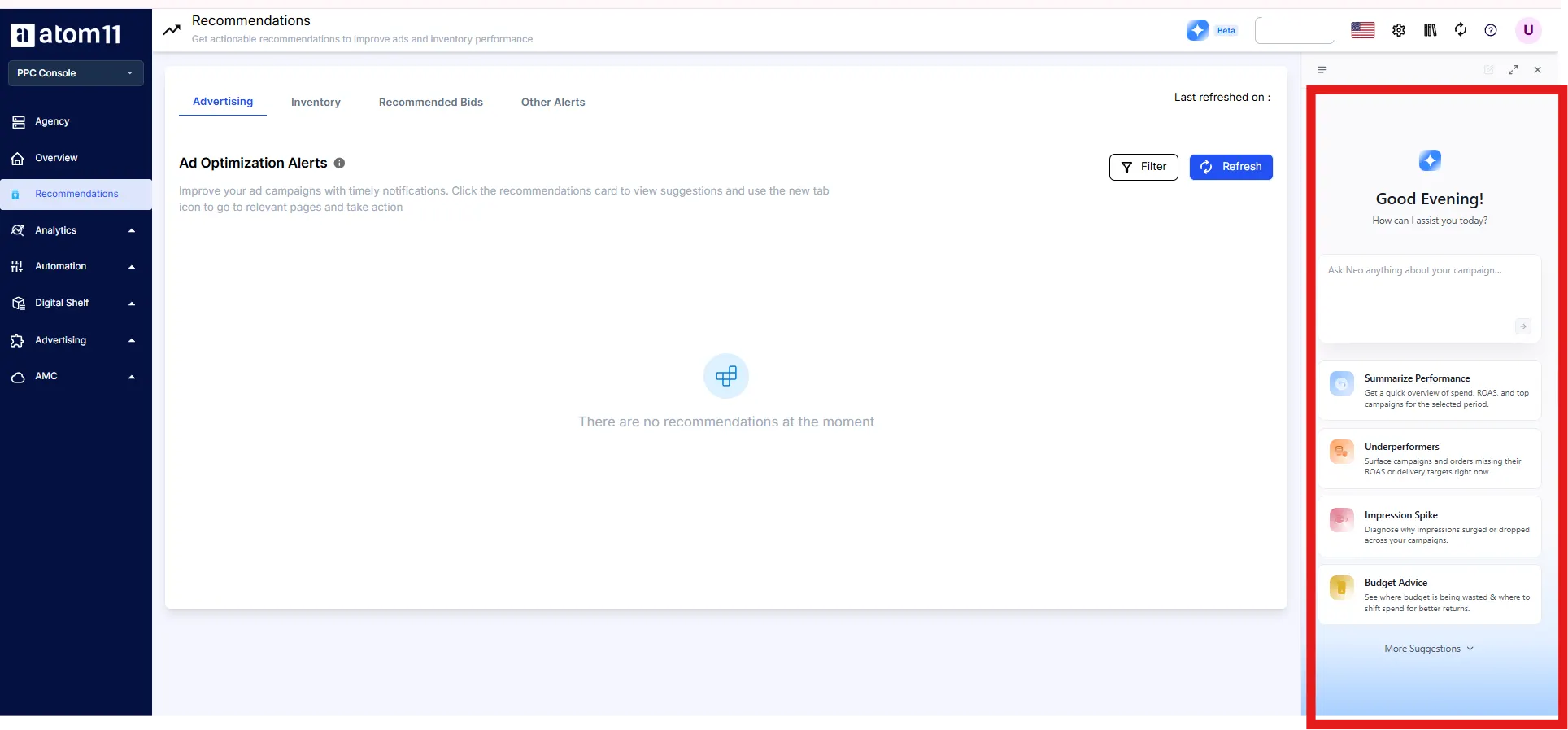
MCP with retail context. The Atom11 MCP gives AI assistants such as Claude, ChatGPT and Cursor governed access to your ad accounts, retail signals and the logic behind Neo, Atom11’s AI analyst. Setup takes about five minutes with no terminal.
Rules and logs above the AI. Automations run on rules you set, using inventory, price, Buy Box and organic rank alongside ad metrics. Version control and the Performance Monitor give you the change log and rollback path every route needs.
DSP included. The Amazon DSP module covers bulk orders, cross order pacing, frequency caps per audience and unified reporting. Our guide to managing Amazon DSP shows how it fits a wider workflow.

Works alongside Amazon’s own tools. Nothing stops you from using Ads Agent for quick help in the console while Atom11 handles automation, retail context and multi account management. Our guide to multi account Amazon PPC management covers the agency setup.
If you need | Route | Where Atom11 helps |
|---|---|---|
Custom automation in production | API | Platform replaces most of the build |
Plain language questions across ads and retail data | MCP | Atom11 MCP adds inventory, price and Buy Box |
Quick help inside Amazon Ads | Ads Agent | Complements it with rules and rollback |
Many accounts or many marketplaces | API and MCP | Multi account workspace and bulk actions |
Atom11 PPC pricing is tiered by monthly ad spend, starting at $499 a month under $50K, with the lowest tier excluding Marketing Stream data and AMC. See the pricing page for current inclusions, and our roundup of Amazon PPC software to compare options.
See how Atom11 connects your ad data, retail signals and AI assistant. Book a demo.
Timeline: How the Three Arrived
Date | Event |
|---|---|
January 2025 | Amazon makes DSP campaign and creative APIs generally available |
November 2025 | Amazon Ads Agent launches in beta at unBoxed |
February 2, 2026 | Amazon announces the Ads MCP server in open beta for partners with API credentials |
March 4, 2026 | Amazon’s Agent Policy takes effect for automated agents |
June 30, 2026 | An Amazon Ads leader says 95% of Amazon Ads APIs are accessible via MCP |
September 30, 2026 | AMC SQL Generator announced as the first expert tool on the MCP server, in closed beta |
Early 2027 | General availability planned for the AMC expert tools, pay per use through AWS Marketplace |

Figure 4: How the three arrived.
Conclusion
Choose by who will own the work, not by which name sounds newest. The API gives engineers full control. MCP lets your own AI assistant use that power in plain language, usually through a partner. Ads Agent gives you Amazon’s help inside Amazon’s tools. All three see ads, and none sees stock, margin or the Buy Box by default.
Start with the lightest option that fits your team, test it on five real questions, and add retail context before you add autonomy. That order saves more money than any choice of protocol.

FAQs
Is Amazon Ads MCP replacing the Amazon Ads API?
No. The MCP server translates natural language prompts into Ads API calls, so it depends on the API. It changes how AI tools reach the API, not whether the API exists.
Is Amazon Ads Agent the same as the Amazon Ads MCP server?
No. Ads Agent is Amazon’s own AI experience inside Amazon Ads. The MCP server is a connection layer that lets outside AI tools such as Claude or ChatGPT work with Amazon Ads. Amazon’s Ads Agent page does not mention MCP.
Can I use Claude with Amazon Ads Agent?
No. Ads Agent runs inside Amazon Ads. To use Claude with your ad account, you connect through an MCP server, either from a partner or directly if you have API credentials.
Do I need API access to use the MCP server?
For Amazon’s own server, yes. Amazon describes it as open beta for partners with active API credentials. Most brands reach MCP through a vendor that already has that access.
Do I need to apply for the Amazon Ads API myself?
Only if you want to build or run your own integration. Amazon says advertisers working with a third party tool that uses the API do not need to request API access.
